Thorium-229: The Atomic Quantum Battery express
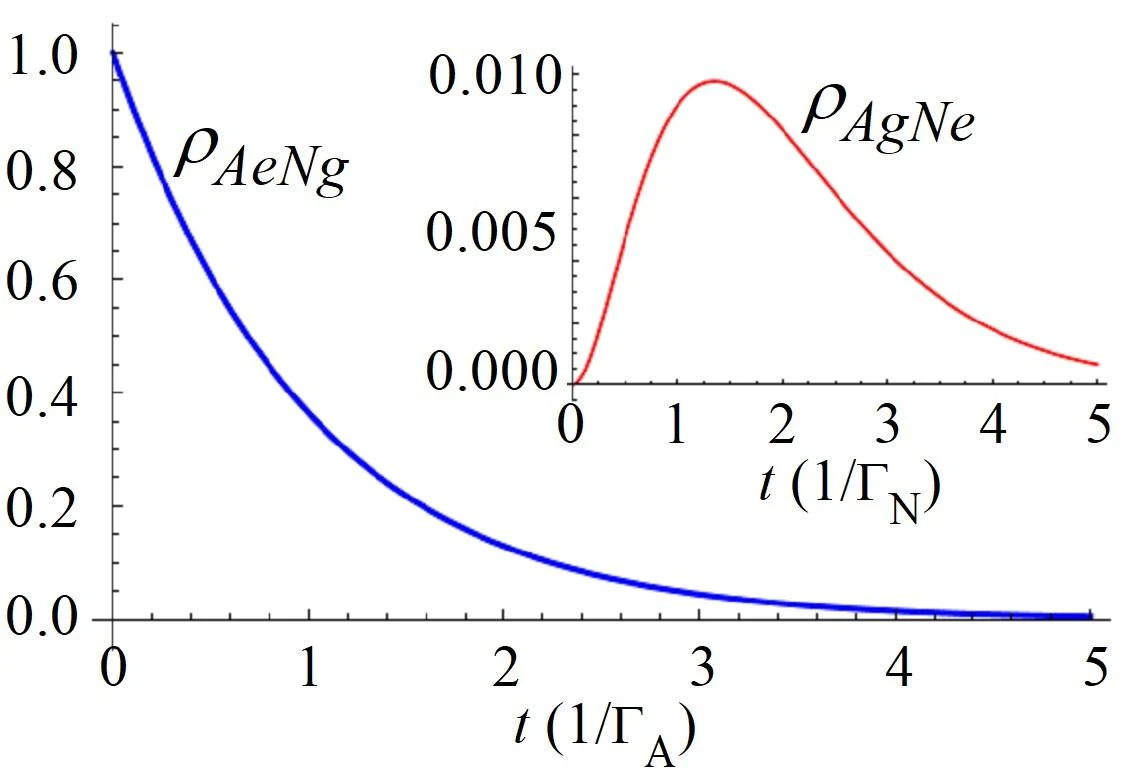
Two pendulums on a shared string trade motion: push one, and the second starts swinging, and a moment later the first gets a push back. In a thorium-229 atom, energy flows nearly loss-free between the electron shell and the nucleus.
This rhythm can be seen in an atom trap: analyzing the light (spectroscopy) and measuring brightness (photometry) reveal the shell's oscillations. A laser charges it, and the energy dives into the nucleus — creating a wireless nuclear battery recharged by light. It all rests on the laws of the Standard Model, which describes matter. Niels Bohr deciphered the layered structure of the atom, and Ernest Rutherford discovered its massive nucleus.
Nuclei usually demand harsh gamma radiation. But thorium-229 is unique: its nucleus is excited by soft ultraviolet light with an energy of just 8.4 electronvolts: that’s electron-level energy, not nuclear. The energy is a million times smaller than typical nuclear energy, so this battery can be built right now.
Original abstract
as written by the authors arXiv:2607.00607
The electron shell of the Thorium ion with the $$M$$1(8.4~eV) transition between levels and the doublet of the $$^{229}$$Th nucleus ground state with the similar transition represent two qubits spatially inserted one within the other. In the case of relative proximity of the energies of these transitions, weakly damped energy oscillations can be excited between qubits, namely, multiple coherent energy transfer from the electron shell to the nucleus and vice versa. This process in the $$^{229}$$Th ions does not require resonant (within the width of the levels) coincidence of the transition energies due to the relatively high interaction energy of the electron and nuclear currents. The electron shell ``breathes'', periodically decreasing and increasing in size. The effect can be observed in an ion trap by the intensity of light scattered by thorium-229 ions. This extends the energy range for the $$^{229m}$$Th$$(3/2^+,8.4$$~eV) isomer excitation via an electron bridge. Furthermore, the system under consideration is transformed into a nuclear quantum battery when exposed to coherent laser radiation. To ``charge'' the battery, i.e. to excite $$^{229m}$$Th, one can use developed methods for charging quantum batteries, in particular, coherent excitation of the electron shell followed by coherent transfer of excitation energy to the nucleus (the coherent electron bridge). This opens the way for the design of the $$^{229}$$Th nuclear quantum battery at the current level of technological development.
The thorium-229 nucleus can be 'charged' not with gamma rays but with ordinary ultraviolet light: its excitation energy is only 8.4 electronvolts, like an electron jump in an atom, not a nuclear reaction.