An exciton is a quasiparticle (collective excitation) representing a bound state of an electron and a hole in a semiconductor or insulator. The Coulomb attraction between them leads to the formation of hydrogen-like energy levels. The binding energy of an exciton ranges from a few meV to tens of meV, comparable to thermal energy at room temperature, but in wide-bandgap materials it can reach ~0.1 eV. Excitons come in two types: Wannier-Mott (weakly bound, radius of tens of nanometers) and Frenkel (tightly bound, on the order of the unit cell size).
History
The concept of an exciton was introduced by Yakov Frenkel in 1931 to explain photoconductivity in dielectrics. He proposed that an absorbed photon does not immediately create free charge carriers but transfers an electron to an excited state that remains bound to a hole. In 1937, Gregory Wannier and Nevill Mott developed a model for semiconductors with high dielectric constant, where the exciton radius spans many atomic layers (Wannier-Mott excitons). In the 1950s, experimental confirmation came from absorption spectroscopy of semiconductor crystals. Later, with the advent of nanotechnology, excitons became a key object in the physics of quantum dots and two-dimensional materials.
How it works
When a photon with energy exceeding the band gap is absorbed, an electron transitions from the valence band to the conduction band, leaving a hole. According to Coulomb's law, an attraction arises between them with potential V(r) = -e²/(4πεε₀r). The quantum mechanical solution of this problem in the effective mass approximation yields a hydrogen-like spectrum of binding energies: E_n = -R*/n², where R* = μe⁴/(2(4πεε₀)²ħ²) is the effective Rydberg constant. The exciton can move freely through the crystal as a whole, carrying energy. Recombination of the electron and hole results in the emission of a photon, often with energy less than the band gap by the binding energy. In low-dimensional systems (quantum wells, dots), the role of Coulomb interaction increases, stabilizing excitons.
In practice
Excitons determine the emission color of LEDs and the efficiency of light absorption in solar cells.
Fun fact
Excitons can exist in liquid helium and even form a Bose-Einstein condensate at ultralow temperatures, exhibiting quantum properties at the macroscopic level.
Three voices merging into a single chord. In the physics of quantum materials, this image takes on a literal meaning: three layers of graphene, separated by thin spacers, force electrons and holes from different layers to move as a single fluid.
In an ordinary semiconductor, it is hard to get two things at once: strong magnetism and a tightly bound electron-hole pair that is born when light is absorbed. Magnetic impurities, which make a material magnetic, also prevent the electron and hole from staying together: they are like noisy neighbors that do not let the pair exist in peace.
In an ordinary semiconductor, it is hard to get two things at once: strong magnetism and a tightly bound electron-hole pair that is born when light is absorbed. Magnetic impurities, which make a material magnetic, also prevent the electron and hole from staying together: they are like noisy neighbors that do not let the pair exist in peace.
Two electrons that leave a metal needle tip almost simultaneously start to repel each other, like two people trying to squeeze through a narrow door at the same time. The closer they are, the more they get in each other's way.
An empty dance floor where people occasionally appear. Each moves on their own, chaotically, with no connection to the others. But when the right music starts and the hall cools down a bit, the dancers suddenly begin to form long chains and move in unison. That's roughly how electrons behave in a dilute three-dimensional gas.
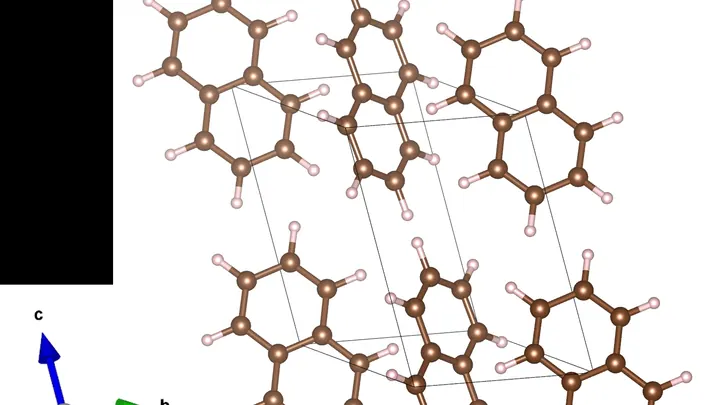
A copper oxide crystal looks like a dark red pebble. But when a short laser pulse hits it, pairs are born inside: an electron and a 'hole'—a place where an electron is missing. Such a pair is called an exciton and behaves almost like a hydrogen atom: the particles circle each other, bound by electric attraction.
An empty dance floor where people occasionally appear. Each moves on their own, chaotically, with no connection to the others. But when the right music starts and the hall cools down a bit, the dancers suddenly begin to form long chains and move in unison. That's roughly how electrons behave in a dilute three-dimensional gas.
A copper oxide crystal looks like a dark red pebble. But when a short laser pulse hits it, pairs are born inside: an electron and a 'hole'—a place where an electron is missing. Such a pair is called an exciton and behaves almost like a hydrogen atom: the particles circle each other, bound by electric attraction.
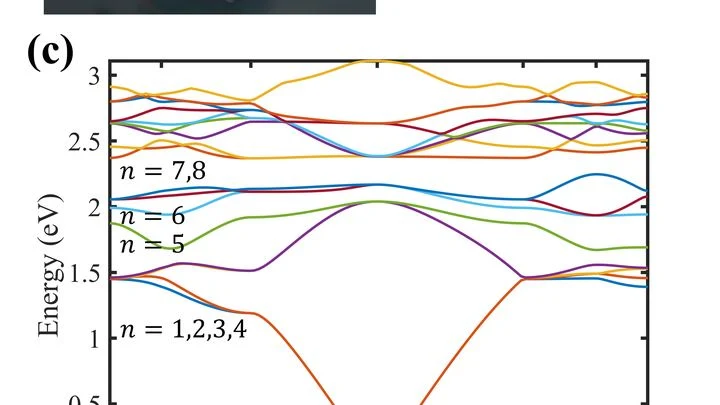
The quantum world is often compared to a musical instrument. Electronic bands in a crystal are like strings, each with its own pitch. Usually, if the strings are tuned simply, without tricky interlacing, then the sound produced by their combined motion remains simple.
The quantum world is often compared to a musical instrument. Electronic bands in a crystal are like strings, each with its own pitch. Usually, if the strings are tuned simply, without tricky interlacing, then the sound produced by their combined motion remains simple.
Take two thin sheets of a semiconductor. One is saturated with free electrons, like a packed café where every table is taken. The other, by contrast, is full of empty spots—'holes' eager to be filled. When these sheets are brought close together, a spark of attraction jumps between them: electrons and holes begin to feel each other across the thin gap.
Take two thin sheets of a semiconductor. One is saturated with free electrons, like a packed café where every table is taken. The other, by contrast, is full of empty spots—'holes' eager to be filled. When these sheets are brought close together, a spark of attraction jumps between them: electrons and holes begin to feel each other across the thin gap.
In a two-dimensional crystal of tungsten diselenide (WSe₂), light creates pairs — an electron and a hole that stick together. Such pairs are called excitons. Among them are "dark" ones: they barely emit, but they set the tone at low temperatures.
In a two-dimensional crystal of tungsten diselenide (WSe₂), light creates pairs — an electron and a hole that stick together. Such pairs are called excitons. Among them are "dark" ones: they barely emit, but they set the tone at low temperatures.
A beam of light darts back and forth between two mirrors. It reflects, runs back, reflects again, and so on, over and over. Inside this gap lies a flat layer of electrons that can rotate under a magnetic field. When the electron rotation frequency matches the light oscillation frequency, a strange dance begins.
In extreme cold — minus 268 degrees — a crystalline perovskite film starts transmitting light differently depending on its polarization. The beam seems to split in two: one part travels slightly faster, the other slightly slower.
In the first fractions of a second after the Big Bang, the Universe underwent inflation — a monstrously rapid expansion that smoothed out all irregularities. But amid this cosmic smoothness, one "wrong" note could have been hidden: quantum fluctuations of the axion field.
Organic light-emitting materials are like a busy intersection without traffic lights. Molecules receive energy but, instead of honestly giving it back as light, they often turn into dead ends: they form dark pairs (exciplexes — short-lived complexes that do not emit) or collide with each other, losing charge.
Imagine a green beam that, passing through an ingenious optical setup, twists into a three-dimensional funnel of light — an optical vortex. At its heart, like in the eye of a hurricane, the intensity drops to zero. It is there that photons disappear.
A light wave is like a rope that has been shaken: it oscillates in a specific plane. This property, polarization, reveals the shape and composition of objects. But capturing it is not easy, especially when you need to cover a wide range of colors. Usually, this requires bulky systems of lenses and filters.
Light hits an organic molecule, and inside, a pair of twin excitations is born. They're called triplet pairs. In single pentacene molecules, such pairs have long been known to share their energy with neighbors: this is the basis of singlet fission, which boosts the efficiency of solar cells.
Musicians in an orchestra each play their own part, not hearing the others. In a perfect crystal of tungsten disulfide on graphene, excitons, bound electron-hole pairs, behave the same way: they barely mix due to a hidden symmetry called the valley. The energy levels of such a system resemble notes sorted into separate folders — the chaos is incomplete.
Light gets trapped in a crystal lattice, but not an ordinary one: it's turned inside out, like a honeycomb where instead of wax there's emptiness, and the edges are made of material. That's how an inverted opal is built: a three-dimensional photonic crystal that blocks light of certain colors.
Light hits a crystal and knocks an electron out of its rightful place. A void remains — a hole that behaves like a positive charge. The electron and hole attract each other and circle around one another, like a pair in a slow dance. Such a pair is called an exciton (from the word "excitation").
But this dance is not in a vacuum.
The Sun is a boiling cauldron of hydrogen and helium, where scorching gas is caught in magnetic snares. When invisible ropes reconnect, energy comparable to billions of thermonuclear explosions is released. Where does it go?
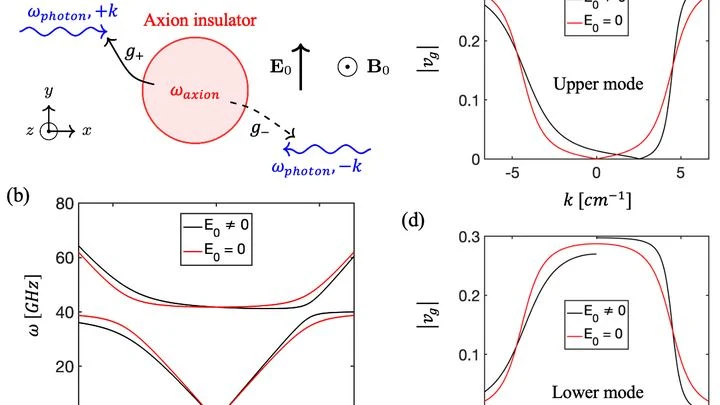
A regular flashlight shines equally forward and backward. But in magnetic crystals, a axion appears — a ghostly excitation, like a wave going around a stadium: atoms pass a magnetic impulse to each other. When light meets an axion, a hybrid forms, whose fate depends on electric and magnetic fields.
In a boron nitride crystal, the perfect atomic lattice is sometimes disrupted: an atom is missing here, or replaced by a foreign one there. Under a powerful microscope, these tiny imperfections appear as traps for electrons: they capture particles and start to emit light, and they also respond to magnetic fields.
Energy transfer in photosynthesis is like a children's slide: it bends under the weight of one, reshaping the path for the next. That's what happens in a leaf: an excited molecule instantly reshapes the 'landscape' of its neighbors.
Physicists reproduce this effect using ions suspended in a vacuum trap.
The pendulum of an old clock swings because a spring mechanism gives it a regular nudge. Now imagine a pendulum that decides on its own when to swing, and does so with a steady rhythm, just because the room is warm and there's a slight draft. That's exactly how time crystals behave, born in clumps of light and matter inside a semiconductor chip.
In a thin sandwich of semiconductors, light creates pairs, an electron and a positive hole, that stick together like a ball on a rubber band. Normally, such pairs, called excitons, quickly emit light and vanish. But there are others, dark ones, that live hundreds of times longer because their internal structure forbids them from easily giving off energy.
Sunlight hits a silicon wafer, and a current flows in the circuit. That's the familiar work of a solar cell: light knocks out electrons, and a p–n junction (the boundary between two layers with different conductivities) forces them to move in one direction. But in some crystals, current arises differently — without any junctions, purely from the material's internal structure.
A pinch of salt falls into water, and sodium and chlorine ions scatter, surrounded by water molecules. Now, instead of an ion, a positron (an antiparticle, the electron's twin but with a plus instead of a minus) joins the molecular crowd.
A big sticky ball thrown onto a dusty shelf bounces off and kicks up a cloud of dust, but if you roll it slowly, it picks up every bit. Rydberg excitons behave just like that — they're giant 'atoms' inside a crystal, named after Johannes Rydberg.
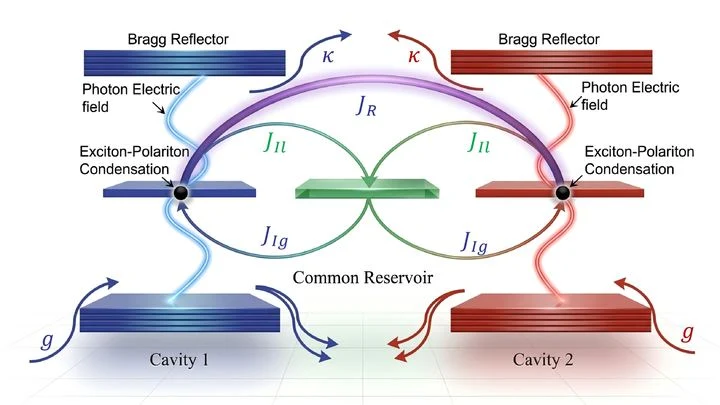
A conventional laser is like an orchestra where musicians must warm up before playing in unison. You first need to pump enough atoms with energy so they 'flip' and are ready to emit light: this is called population inversion. Only then does the beam flash. A polariton laser plays by different rules: its 'musicians'—a mix of light and matter — join in almost without preparation.
In a dark room, an infrared laser flashes, and a speck of black K3C60 powder conducts electricity without resistance for a split second. The light strikes at 10 terahertz — a thousand times faster than a microwave oven. The effect is a hundred times stronger than at other frequencies. Why this particular frequency?
Blue is the most finicky part of any screen. Producing it takes a lot of energy, and the light often comes out dull. Chemists have long searched for molecules that glow deep blue brightly and for a long time. Now they've come up with a new design based on europium, a rare-earth metal that can deliver pure blue light.
Quantum computers and sensors operate at microwave frequencies, but transmitting their signals over long distances is conveniently done via optical fibers, which use light.
Light and atoms, like dancers, can move in sync or out of step. When their interaction is anisotropic (that is, direction-dependent) the dance gets trickier. In a new study, physicists considered a model where many atoms (qubits) collectively interact with an anisotropic light field, and each component is connected to a thermal reservoir.
A quantum dot the size of a virus, squeezed between mirrors, gives birth to two photons in a short flash of light. These photons fly out as a pair, and their polarizations, the directions of wave oscillation, are linked such that knowing one instantly tells you the other.
An ultra-thin crystal made of tungsten and sulfur atoms resembles a perfect parking lot: every spot is taken, everything is neat. But sometimes an atom is missing — leaving a defect pit. If an exciton (a pair consisting of an electron and a 'hole' that carries light energy) falls into such a pit, it can get stuck and emit light differently than in a pristine area.