Coulomb repulsion is the fundamental electrostaticforce that causes particles with the same electric charge to push each other away. This force is one of the four fundamental forces of nature and is described by Coulomb's law, which states that the force between two charged particles is directly proportional to the product of their charges and inversely proportional to the square of the distance between them. For like charges, this force is repulsive, and it is this repulsion that prevents the electrons in an atom from collapsing into the nucleus and gives matter its solid, impenetrable feel.
History
The quantitative law describing this force was formulated by Charles-Augustin de Coulomb in 1785, using a torsion balance to measure the force between charged objects. This work laid the foundation for the classical understanding of electrostatics.
How it works
The force arises from the exchange of virtual photons between charged particles. Every charged particle, such as an electron or proton, creates an electric field. When two like-charged particles are brought near each other, their fields interact in a way that produces a force pushing them apart. The strength of this repulsion is immense at very small scales; for example, the Coulomb repulsion between two protons in a nucleus is enormous, and it is only overcome by the even stronger, but short-range, strong nuclear force that binds them together.
The Coulomb repulsion between electrons is so strong that if you could somehow remove all the empty space from the atoms in your body, the remaining particles would be smaller than a grain of dust, yet the repulsive force between them would be enough to cause an explosion equivalent to a large nuclear bomb.
Water in a glass looks continuous, but it's actually a dance of trillions of molecules constantly breaking and forming bonds. Seeing this dance in full detail was previously impossible: accurate calculations that account for the quantum properties of electrons could only handle tiny droplets of a few hundred atoms. The new model UBio-MolFM changes the game.
The antiproton is the mirror twin of the proton: same mass, but negative charge. When it hits matter, it usually annihilates instantly — disappearing in a burst of energy upon colliding with an atomic nucleus.
Two electrons that leave a metal needle tip almost simultaneously start to repel each other, like two people trying to squeeze through a narrow door at the same time. The closer they are, the more they get in each other's way.
In the first moments, the Universe expanded at an enormous rate. This process is called inflation, and its driving force is the inflaton field. Its energy pushed space apart, like yeast raising dough. But physicists suspect that the dough might have left 'bubbles'—superheavy particles born from the expansion itself.
Quantum entanglement — a phenomenon where the states of two or more particles become interconnected regardless of the distance between them — usually links intrinsic properties such as spin or polarization. However, a new experiment has for the first time realized entanglement of the positions of two atoms in space.
Run a current through a spring of organic molecules, and the electrons that come out are almost all spinning the same way. This trick is called chiral spin selectivity, and it has long puzzled physicists. In light atoms, spin (the particle's intrinsic rotation) is too weakly coupled to charge motion to achieve nearly perfect sorting.
Two grains of salt fall into a glass of water. They dissolve, and sodium and chloride ions spread throughout the volume. The schoolbook truth is simple: like charges repel, opposite charges attract. But recent experiments with tiny spheres in liquids have revealed a picture that breaks this rule.
A handful of rice thrown into a glass of water scatters — the grains spread apart. Now imagine each grain propels itself forward with stubborn persistence and bounces off softly upon collision. Such particles are called active: they spend their own energy to move, like bacteria or microscopic robots.
To uncover the proton's true size, physicists swapped the electron in a hydrogen atom for its heavy copy — the muon. Acting like a magnifying glass with thousandfold power, the muon gets right up against the nucleus and 'probes' the proton with unprecedented precision.
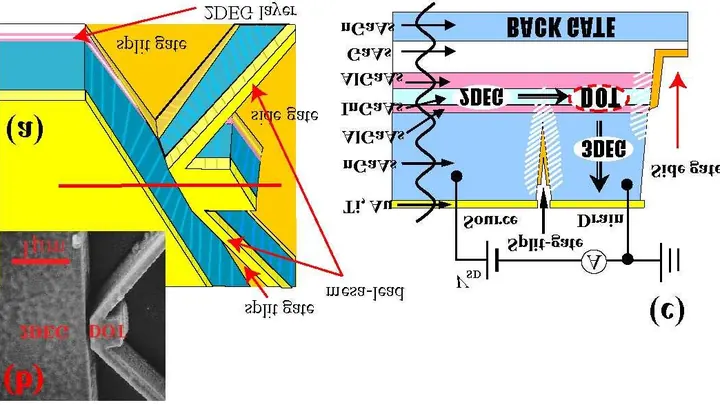
A quantum dot is like a tiny island where one or a few electrons can settle. In this new work, such an island was connected to two 'seas' of electrons: one flat like a pancake, the other bulky like an ocean. Electrons can hop from the island to the seas and back, and this hop depends on the shape of the electron's wave on the island.
According to ordinary mechanics, an electron in an atom should spiral into the nucleus and crash into it, like a surfer losing speed and falling off the board. But atoms live for billions of years. Because space isn’t empty. Even in absolute vacuum, an invisible electromagnetic sea ripples — the zero-point field. Its waves continuously nudge the electron.
A drop of metal on a semiconductor is like an island in the sea. For an electron to reach that island, it must pay a "toll": overcome a barrier that arises because the island is tiny, and each extra charge significantly changes its energy. This phenomenon is called Coulomb blockade. It underpins single-electron transistors, where current flows one electron at a time.
The familiar picture: gravity always attracts. But if a mass is in quantum superposition (that is, in two places at once, like an object in a double-exposure photograph) everything flips. Quantum theory allows a particle to be both here and there in a literal sense: its position is described by a wave function smeared across space.
Gravity always pulls — an apple falls down, planets orbit in circles. But by placing a source of gravity in two places at once, you can get the opposite. Physicists have proposed an experiment: a massive body is put into a quantum state, smeared across space like a cloud. Then a tiny particle is shot into that cloud.