In the electronic structure of a material, a node is a point in momentum space where the energy of an electron is independent of the direction of its motion. This means that at this special point, the electron's energy versus momentum relationship, known as the dispersion relation, becomes isotropic — the same in all directions. Nodes often appear in materials with high symmetry, such as certain crystals or graphene, and they play a crucial role in determining the material's electronic and optical properties.
How it works
The electronicband structure of a solid describes how electron energy varies with momentum. At a node, the band structure has a point where the energy contours are perfectly spherical, so the electron's effective mass is the same in every direction. This isotropy simplifies the equations of motion for electrons, leading to isotropic transport properties like electrical conductivity. In practice, nodes are identified through techniques like angle-resolved photoemission spectroscopy (ARPES), which maps the energy-momentum relationship directly.
In practice
Nodes are important in designing materials for electronic devices, as isotropic dispersion can lead to high carrier mobility and predictable behavior in transistors and other components.
Fun fact
In graphene, the Dirac points are nodes where the energy is exactly zero, and electrons behave like massless relativistic particles.
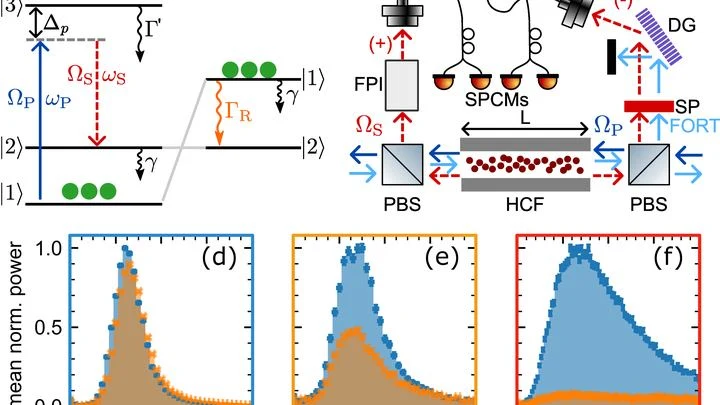
A swarm of fireflies in a night forest flashes randomly: each beetle blinks on its own, and the light scatters equally in all directions. Now imagine the fireflies agreeing to blink so that their combined light goes only north — even though they stay put and none of them turns. That's roughly what physicists did with atoms inside a thin glass tube.