Electronic devices are systems that rely on the controlled flow of electrons to perform functions such as amplification, computation, or sensing. From transistors in computers to diodes in solar cells, these devices are the building blocks of modern technology. The field encompasses a vast range of components, including those based on semiconductors, superconductors, and even liquid crystals, each exploiting electron behavior in unique ways.
History
The field began with the invention of the vacuum tube in the early 20th century, followed by the transistor in 1947 at Bell Labs, which revolutionized electronics by enabling miniaturization and low-power operation.
How it works
The core mechanism is the manipulation of electron flow through materials, often using electric fields, magnetic fields, or quantum effects. In semiconductors, for example, doping introduces charge carriers that can be controlled by voltage, enabling switching and amplification. In superconducting devices, electrons pair up and flow without resistance, allowing for extremely fast and lossless operations, while in liquid crystal devices, electric fields orient molecules to modulate light, indirectly controlling electron-driven displays.
In practice
Electronic devices are ubiquitous, from smartphones and computers to medical implants and sensors, and they are central to emerging technologies like quantum computing, where electron spins or superconducting circuits serve as qubits.
Fun fact
The first electronic computer, ENIAC, used about 17,000 vacuum tubes and consumed 150 kilowatts of power, while a modern smartphone has billions of transistors and runs on a few watts.
The electron beam of a microscope usually flies through emptiness, like a courier on an empty highway. Any air molecule is a bump that makes it bounce and lose direction. So before, to examine a sample, you had to freeze it, dry it, or coat it with metal—and still you could only look in a vacuum.
Catching light one particle at a time is like hearing a whisper in a roaring factory. An electron-multiplying camera (EMCCD) can do exactly that: it turns a single photon hitting a pixel into an avalanche of electrons that can be measured. These cameras are mounted on telescopes to spot a barely visible planet next to a dazzling star.
An empty dance floor where people occasionally appear. Each moves on their own, chaotically, with no connection to the others. But when the right music starts and the hall cools down a bit, the dancers suddenly begin to form long chains and move in unison. That's roughly how electrons behave in a dilute three-dimensional gas.
Blood vessel cells were seeded onto a transparent film just 700 nanometers thick — a hundred times thinner than a human hair. Flat electrodes are hidden beneath the film. They send a weak alternating current and listen as the resistance changes.
A solid electrolyte is not just a crystal lattice: it’s a bustling metropolis for ions. Each act of conduction resembles a trip through the city: there are wide highways with low energy barriers, gridlocks in bottlenecks, and tricky detours where an ion can get stuck.
A superconductor is like an ideal highway with no traffic lights: electrons race along without hindrance. But apply a voltage, and the picture changes. In a new experiment, physicists found that an electric field penetrates the superconductor and creates a mixed regime inside.
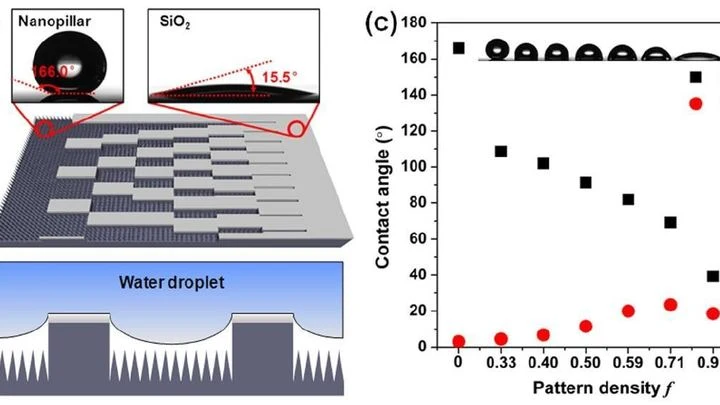
A drop of water on a table usually sits still. But make the table slightly softer on one edge and stiffer on the other, and the drop will crawl toward the stiffer side. This phenomenon is called durotaxis: the liquid itself chooses where to flow, without pumps or electricity.
This trick works because the surface under the drop is not uniform.
A water molecule, finding itself near a carbon ring, starts to vibrate, and immediately falls under the sway of an invisible conductor. The ring's electron cloud, like a maestro, dampens some vibrations while amplifying others.
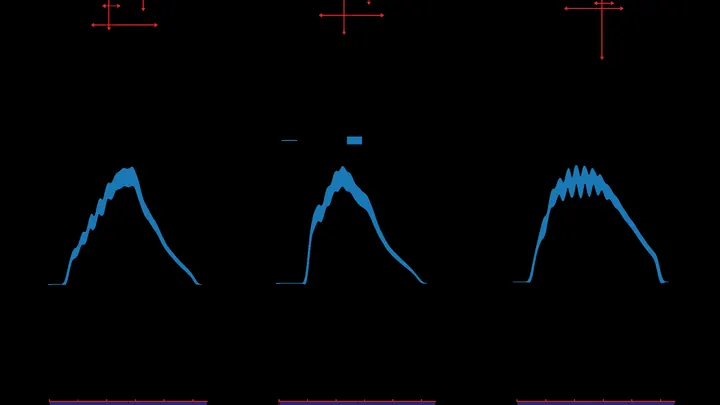
A typical accelerator is like an assembly line where electrons are the workpieces. To get the desired X-ray pulse, the workpiece is fine-tuned after it's already on the line: squeezed, filtered, corrected. In the new work, engineers decided to take a different approach — shaping the workpiece before it even hits the conveyor.
At LCLS-II, electrons are knocked out of a metal by a short laser pulse.
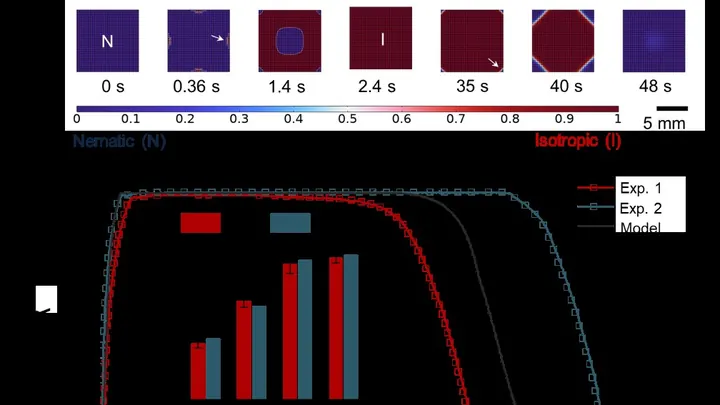
Radio waves surround us, but our eyes can't see them. This new sensor, the size of a fingernail, turns them into a colored patch on a tiny screen.
Inside the chip is a layer of liquid crystals — the same kind used in phone displays. Among them are embedded thin ferromagnetic nanowires. When a radio wave arrives, the nanowires heat up quickly.
Ordinary computer memory constantly uses energy to store ones and zeros. Superconductors, on the other hand, carry current with zero loss — if you could build memory from them, it would barely draw any power. The catch is that superconductors can't remember: their state changes too easily.
Uranium ditelluride crystals turned out to be the exception.
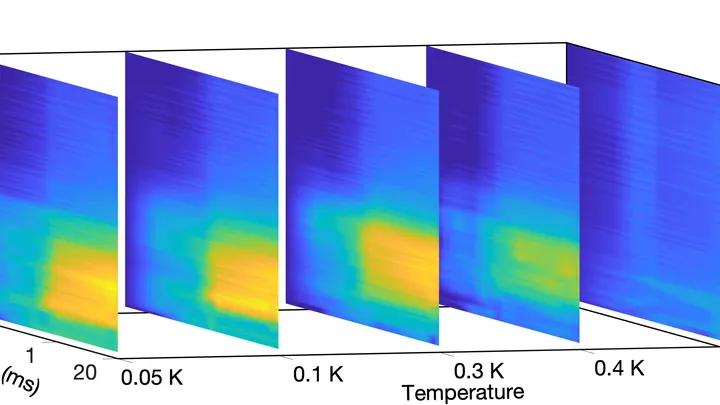
A quantum computer is a machine where qubits replace ordinary bits. A qubit can be not just a 0 or a 1, but both at the same time. One way to make a qubit is to take an electron and make it hover above the surface of liquid helium. The helium is cooled to below two degrees above absolute zero.
A printer that prints not with ink but with metal and ceramic is now a reality. Scientists took an ordinary drop of water containing dissolved metal salts and made it deposit copper, zinc oxide, or nickel hydroxide onto a surface — all with precision down to millionths of a meter.
The secret lies in electricity.
Imagine a superhighway where cars zoom along with barely a slowdown: that's what a layer of ultraclean semiconductor looks like, where electrons travel vast distances without a single collision. Scientists have built a transistor in which electrons run twice as fast as in any similar device before.
Ordinary computer memory constantly consumes energy to avoid forgetting what's stored. A superconductor could store data without loss, but it's hard to make it switch.
In the new work, a superconductor is sandwiched between two magnetic insulators.
Primary human cells, taken straight from the body, are the most honest material for studying diseases and testing drugs. But getting foreign genetic material into them is tricky: cells don't like intruders. Standard methods either damage the cell or work unevenly, especially when the sample is heterogeneous — which it almost always is.
The new platform tackles this with a vortex flow.
At Jefferson Lab, electrons are accelerated to 12 GeV and smash into protons to pry out their secrets. But existing detectors are like cameras with a narrow field of view: you either see a lot but dimly, or brightly but only a tiny patch. Electron scattering is the main tool, but statistics are insufficient for subtle effects.