Light That Picks a Side express
A swarm of fireflies in a night forest flashes randomly: each beetle blinks on its own, and the light scatters equally in all directions. Now imagine the fireflies agreeing to blink so that their combined light goes only north — even though they stay put and none of them turns. That's roughly what physicists did with atoms inside a thin glass tube.
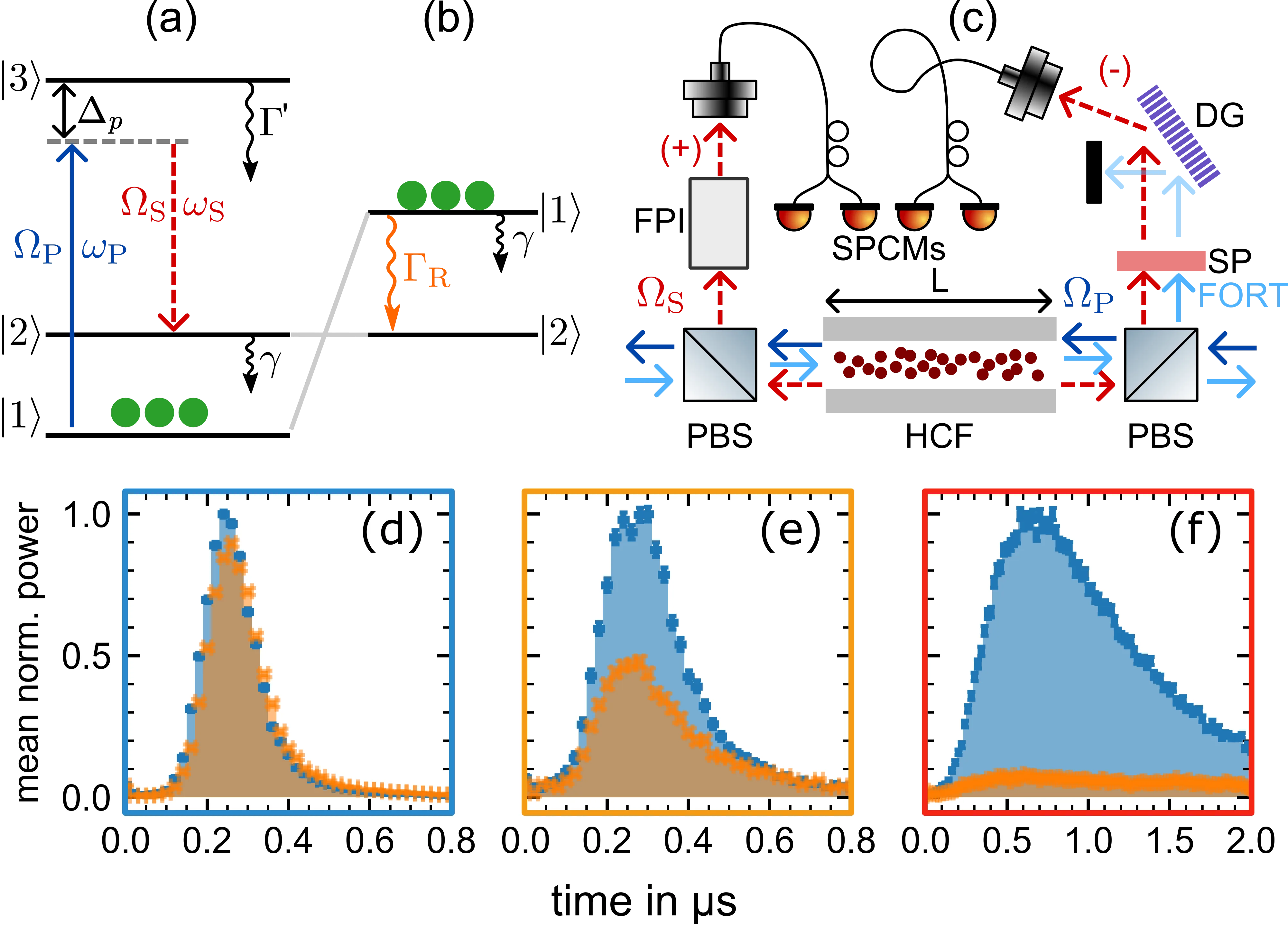
The atoms in the tube were excited by a laser, and they began to emit light. Normally, such light spreads symmetrically: half forward, half backward. But here, the atoms moved along the tube, and their internal "clocks" were tuned so that the light waves from different atoms added up in one direction and canceled out in the other. No single atom was special, and the tube itself was uniform — the whole trick lay in the collective rhythm.
The physicists measured how the character of the light changed as they increased the pump. At first, the flashes resembled noise, like the murmur of a crowd where everyone speaks at once. Then, above a threshold, the light became coherent, like a choir singing in unison. A computer model that included quantum fluctuations accurately described the experiment.
This work shows that to make light go in the desired direction, you don't need to build complex asymmetric structures. You just need to "conduct" the atoms properly — then even from perfectly symmetric building blocks, you can assemble a material that controls light. The same logic could help create new optical devices where light finds its own path.
Original abstract
as written by the authors arXiv:2603.03028
We report the experimental observation of motion-induced directionality in collective atomic emission within a hollow-core waveguide, establishing a general principle: directional interactions can emerge from collective phase engineering alone. Remarkably, neither single-emitter asymmetry nor any asymmetry in the geometric arrangement of the system is required - both the atom-field coupling and the spontaneous emission are fully isotropic in our system. Instead, Raman-induced effective two-level emitters with spatially oscillating transition dipole phases and atomic motion give rise to controllable directionality, reaching values up to 0.89(1). We study the correlations of the superfluorescent bursts close to and well above the threshold to collective emission; we find thermal statistics below and a buildup of coherence above it. Numerical simulations based on the Truncated Wigner Approximation for spins yield good agreement. Additionally we present a simple model based on position uncertainty capable of reproducing the observed directionality. Our results open a new route to directional interactions in non-chiral systems, with direct implications for the design of directional metamaterials and photonic structures built from isotropic constituents.
The directionality of the light in the experiment reached 89%—meaning that out of every ten photons, nine flew in one direction, and only one went the opposite way.