A diode is a two-terminal electronic component that conductselectric current primarily in one direction, offering high resistance in the reverse direction. This asymmetry is the foundation of rectification — converting alternating current (AC) to direct current (DC) — and is essential in virtually all modern electronics. Beyond simple rectifiers, diodes are used in signal demodulation, voltage regulation, and as light emitters (LEDs) or detectors. The principle also extends to quantum and superconducting systems, where 'diode-like' behavior can be engineered without traditional semiconductor junctions.
History
The first practical diode was the vacuum tube 'Fleming valve' invented by John Ambrose Fleming in 1904, followed by the crystal diode in the 1930s and the modern semiconductor diode in the 1940s.
How it works
In a conventional semiconductor diode, a p-n junction creates a depletion region that blocks current flow in one direction. When forward-biased, the applied voltage reduces the barrier, allowing electrons and holes to recombine and conduct. When reverse-biased, the barrier increases, preventing current flow until breakdown voltage is reached. In superconducting or quantum systems, diode behavior can arise from asymmetric tunneling rates or from breaking time-reversal symmetry, allowing current to flow more easily in one direction than the other.
In practice
Diodes are ubiquitous in power supplies, radio receivers, logic gates, and as protective elements against reverse polarity; superconducting diodes are being explored for quantum computing and low-power electronics.
Fun fact
The term 'diode' comes from the Greek 'di' (two) and 'ode' (path), referring to its two electrodes, but the first diodes were actually vacuum tubes with two electrodes.
An empty dance floor where people occasionally appear. Each moves on their own, chaotically, with no connection to the others. But when the right music starts and the hall cools down a bit, the dancers suddenly begin to form long chains and move in unison. That's roughly how electrons behave in a dilute three-dimensional gas.
Conventional antennas for precise direction finding must work coherently: they capture not just volume, but also the wave's phase at a given moment. The slightest tuning mismatch, and the direction is lost. The new method relies solely on signal strength. It's like finding your way in fog, seeing only the brightness of lights, not their color.
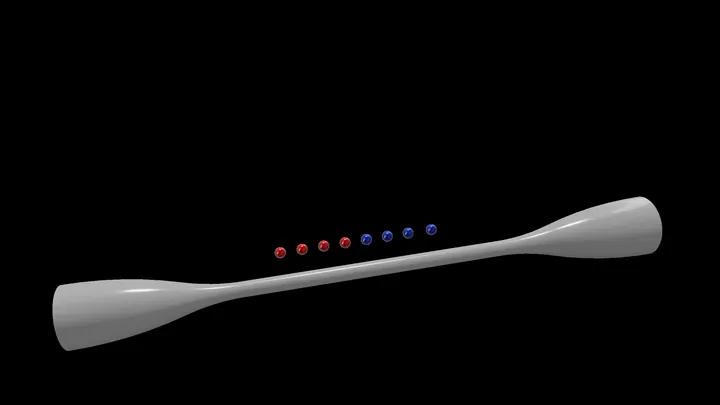
An orchestra without a conductor, where musicians hear each other through a shared wall. That's roughly how the new type of laser works: a few atoms (emitters) sit along a waveguide — a thin track for light on a chip. Light from each atom runs along this track and affects its neighbors.
In a superconducting ring shaped like a washer, current sometimes flows more easily in one direction than the other. This property is called the diode effect. Usually, its direction is rigidly set by the material's structure. But in new work, physicists showed that it can be switched, and the switch is the number of magnetic vortices trapped in the ring.
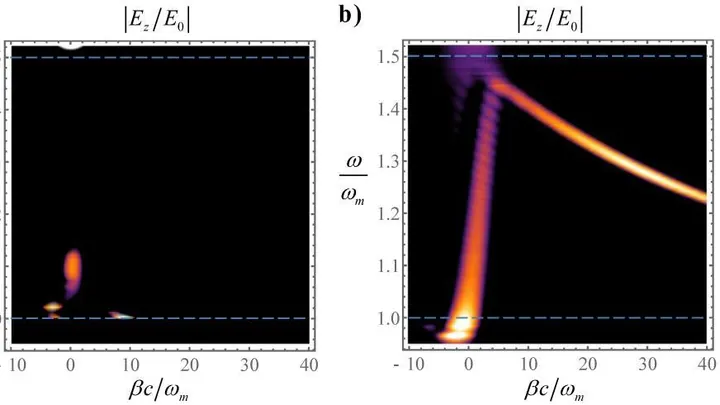
An ordinary microwave cavity resembles a music box: it responds only to strictly defined frequencies: its own notes. But what if you could make it sound different? Scientists changed the rules of the game by making the walls "one-way." Inside such a cavity, a wave can only run forward, never reflecting back.
A switch that knows which way to let current flow. That's how a Josephson diode works — a superconducting bridge where current goes willingly in one direction but meets resistance in the other. In the new study, such a bridge was made from graphene — a sheet of carbon just one atom thick.
An ordinary diode in electronics works like a one-way street: current flows in only one direction. In superconductors, where electricity flows without resistance, such behavior has long been elusive — current is usually symmetric.
The authors of the new work found a way to create a perfect superconducting diode using light.
Light usually behaves like a pedestrian on a two-way street: the path from a streetlamp to a camera matches the reverse path. But near a rotating black hole with broken spatial symmetry, this street becomes one-way. Swap the light source and observer, and the hole's shadow changes shape: from an oval resembling a rugby ball, it turns into a teardrop.
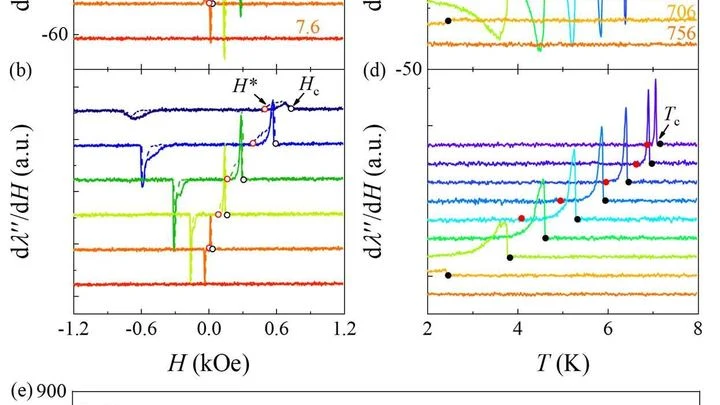
Ordinary magnetic measurements only see the surface of a superconductor, where barriers and viscous flows of magnetic field get in the way. Inside, in the so-called intermediate state, superconducting and normal domains coexist, separated by thin walls. These walls can oscillate, but hearing them directly has been difficult.
An ordinary light sensor answers the question "how much light" but not "where did it come from." To do that, you need lenses, mirrors, or entire arrays. In a new study, researchers propose a sensor that determines the direction of a light beam on its own, without any optics.
Blue pixels in screens are like light bulbs that burn out fast. Conventional organic LEDs for blue are unstable: their light dims over time, and the color shifts. Chemists found a replacement — the rare metal europium.
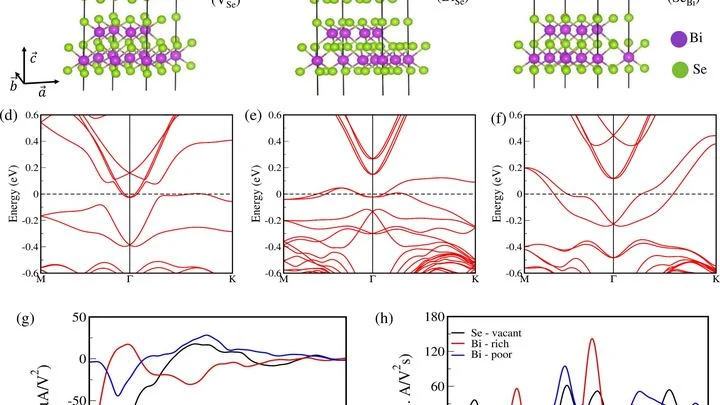
The crystal bismuth selenide (Bi₂Se₃) is symmetric by itself, like a neatly stacked sandwich: flip it over, and nothing changes. But twist one layer slightly relative to the other, and the symmetry breaks. The material begins to 'feel' which side the light comes from and responds with an electric current.
In most magnetic materials, a domain wall, the boundary between regions with different magnetization, moves in one direction under current, set by the current's direction. But in ferrimagnets near a special point where the angular momenta of two sublattices cancel each other, the behavior changes.
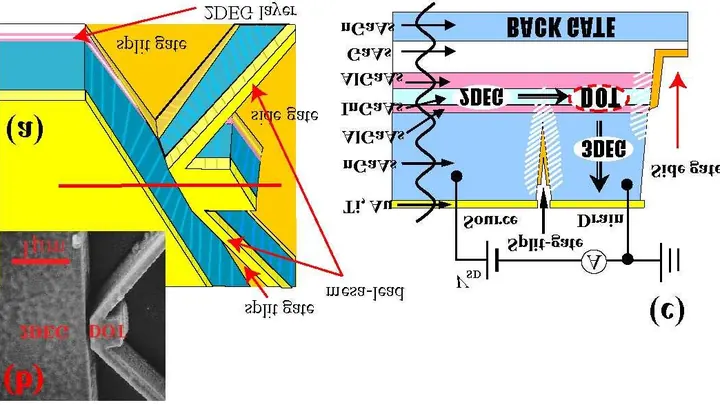
A quantum dot is like a tiny island where one or a few electrons can settle. In this new work, such an island was connected to two 'seas' of electrons: one flat like a pancake, the other bulky like an ocean. Electrons can hop from the island to the seas and back, and this hop depends on the shape of the electron's wave on the island.
A semiconductor diode normally conducts current in only one direction, like a spring-loaded door: it opens easily one way but pushes back the other. But if you dope the crystal heavily, the door starts behaving strangely: under reverse bias, the current doesn't just flow: it shoots up.
The receiver doesn't catch radio waves but submillimeter light — the radiation emitted by cold clouds of gas and dust in distant galaxies. Inside, there's an array of tiny resonators, each tuned to its own frequency, like the strings of a grand piano tuned to notes.
Light passing through a thin crystal can change color and the direction of its oscillations. In a molybdenum disulfide flake just hundreds of atoms thick, an infrared beam turns green, and its polarization, the way the light wave oscillates, obeys the crystal's geometry.
An ordinary conductor carries current equally in both directions, like a door that swings both inward and outward. A diode, by contrast, is a door with a self-closing hinge: it opens easily one way but pushes back the other.
A thin superconducting wire, cooled to near absolute zero, can sense a single particle of light. Such detectors are indispensable for quantum computing and secure communication, but their temperament is spoiled by disorder — random irregularities and impurities that cannot be completely removed.
Instead of fighting disorder, physicists decided to tame it.
Superconductors are materials that conduct electricity without loss, but their properties are usually fixed. In the new work, scientists made a device resembling a crossroads of two superconducting tracks. By applying a weak magnetic field perpendicular to this crossroads, they were able to change the current the device can carry by a factor of four.
A microwave oven heats food, but this circuit harvests energy from radio waves. Engineers have built a rectifier that converts 5.8 GHz microwaves into direct current. The big news: inside, there isn't a single capacitor: those little charge reservoirs that usually sit in every rectifier.