Zero resistance is the defining property of a superconductor: below a critical temperature, electrical current flows without any energy loss. Unlike ordinary conductors, where electrons scatter off impurities and lattice vibrations, in a superconductor electrons form Cooper pairs that condense into a single quantum state. This macroscopic quantum state allows current to persist indefinitely, as demonstrated in experiments where superconducting rings carry current for years without decay. Zero resistance is not just a curiosity — it enables powerful electromagnets, lossless power transmission, and quantum computing.
History
Heike Kamerlingh Onnes discovered zero resistance in mercury in 1911, after achieving liquid helium temperatures. The theoretical explanation came in 1957 with the BCS theory by Bardeen, Cooper, and Schrieffer.
How it works
In a superconductor, lattice vibrations (phonons) mediate an attractive interaction between electrons, overcoming their Coulomb repulsion. These paired electrons (Cooper pairs) behave as bosons and condense into the same ground state, described by a single wavefunction. This state is separated from excitations by an energy gap, so scattering is impossible at low temperatures. The pairs move coherently, carrying current without resistance. An external magnetic field above a critical value destroys this state, returning the material to normal resistivity.
In practice
Superconductors are used in MRI magnets, particle accelerators (like the LHC), and magnetic levitation trains. They are also the basis for superconducting qubits in quantum computers.
Fun fact
In a superconducting loop, a current can persist for billions of years without any power source — longer than the age of the universe.
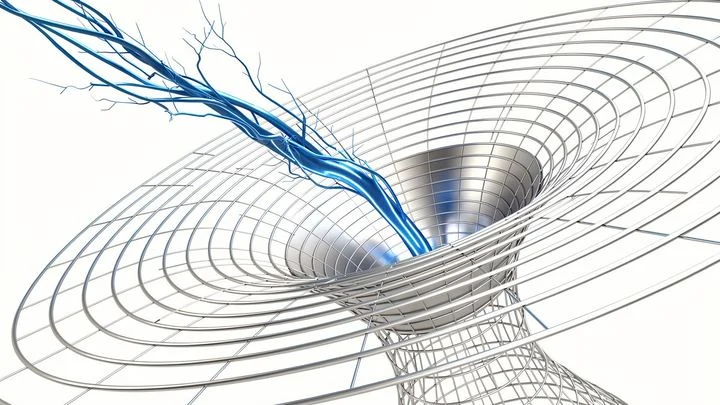
In 1934 Jean Leray proved that the Navier–Stokes equations always have solutions "in a generalized sense". Whether a solution stays smooth or can break down into a singularity he could not tell, and nobody could for ninety years. In 2000 the Clay Institute made the question one of its seven Millennium Prize problems.
A tiny black hole flies through a hydrogen cloud and stretches atoms like taffy. That is what a superconductor looks like when it traps a persistent current: a material in which electricity flows without losses turns into a miniature permanent magnet.
In a narrow corridor, people walk in rows rather than as a crowd. The number of rows depends on the width of the passage. In graphene, this corridor is a quantum point contact — a constriction where electrons move ballistically without scattering.
An ordinary wire heats up when current flows through it — some energy is wasted. A superconductor lacks this flaw: electricity flows through it without loss, like water through a perfectly smooth pipe. The trouble is that most superconductors require either very low temperatures or colossal pressures, like those found in the depths of planets.
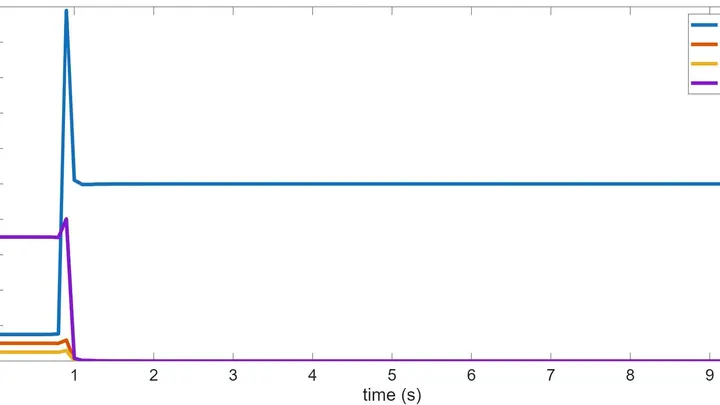
Inside an MRI magnet, current flows through a closed superconducting loop, like water circling in a bucket after you give it a spin, it just keeps going on its own. To change that current, you heat the loop with a small heater: it stops being superconducting, becomes an ordinary resistor, and then an external source can 'top up' or 'draw off' current.
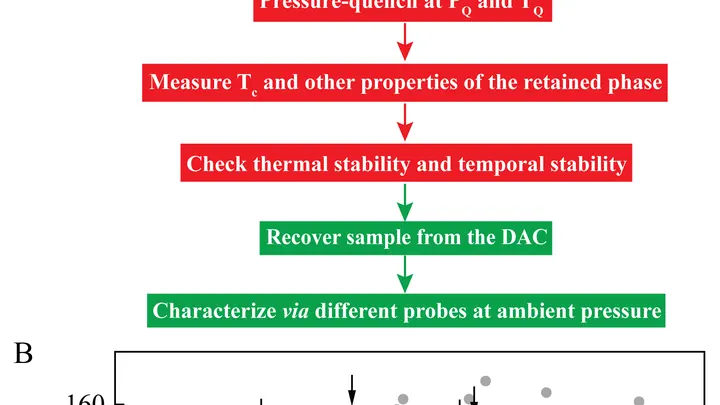
A film sliver thinner than a human hair was placed between diamond anvils and squeezed. The pressure climbed — a hundred thousand atmospheres, half a million, a million… Yet the material kept conducting electricity without resistance.
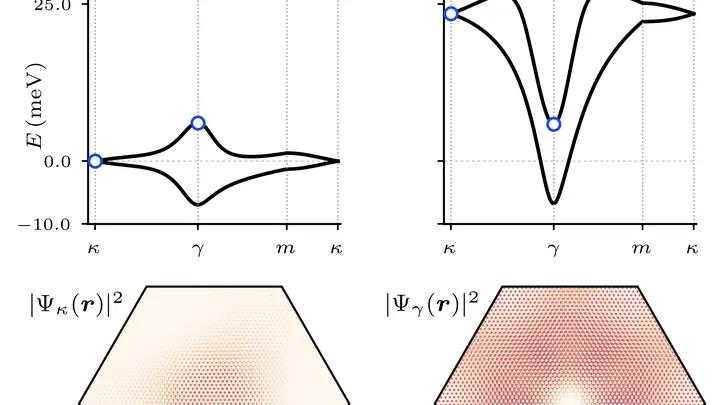
In a crystal, electrons are not distributed randomly. Their waves obey the lattice symmetry, like ripples on water taking the shape of a hoop thrown into it. The new work shows that at high-symmetry points, this ripple must have nodes — places where electron density is strictly zero.
A piece of metal is cooled to minus two hundred degrees, and electric current begins to flow through it without the slightest friction, like water in a pipe flowing without touching the walls. This behavior is called superconductivity.
In a pool, water usually spreads in circles from a thrown stone. But if you direct the flow strictly along the rim, it will run only along the edge. Something similar has been noticed in pieces of the superconducting crystal FeTe0.55Se0.45.
In the crystal CsV3Sb5-xSnx, which becomes a superconductor at low temperatures, current does not flow as a uniform stream but along narrow, winding paths. A scanning microscope with a sensitive magnetic field sensor helped reveal these paths: it picks up the faintest currents, much like a sonar probes the seafloor.
Usually, superconductivity is a story about cold. The lower the temperature, the easier it is for electrons to pair up and flow without resistance. But in a new study, physicists grew thin films of nickelates doped with europium and saw the opposite picture.
A thin film of yttrium barium copper oxide warms under a stream of infrared light, and suddenly stops dissipating energy. That's superconductivity: electrons pair up and move as a single quantum swarm. But in underdoped samples, the harmony breaks long before the pairs fall apart. The pairs are there, but the collective rhythm isn't.
A rubber band that gets thicker the harder you pull it. In electricity, this behavior is called negative capacitance: the more charge accumulates on the plates, the lower the voltage. A regular capacitor works the opposite way — voltage rises with charge.
An ordinary diode in electronics works like a one-way street: current flows in only one direction. In superconductors, where electricity flows without resistance, such behavior has long been elusive — current is usually symmetric.
The authors of the new work found a way to create a perfect superconducting diode using light.
A tiny magnet levitates in a magnetic trap, like a weightless needle. Its magnetized axis is like a stubborn compass needle that is prevented from turning. An invisible wall rises before it. But in the quantum world, particles can seep through barriers — this trick is called tunneling.
Since time immemorial, physicists have dreamed of tunnels piercing the cosmos — wormholes, capable of connecting far-flung corners of the Universe in an instant.
Two paper-thin sheets of a semiconductor are stacked and slightly rotated — by about three to four degrees. The atomic lattices don't match, creating a large-scale pattern — a moiré, like the ripples from two washboards shifted by a small angle. In this pattern, electrons move quite differently than in a regular crystal.
In familiar metals like copper, electrons move almost independently, like cars on an open highway. Resistance arises from rare collisions and can be described by simple formulas.
An ordinary flash drive in your pocket gets warm even when it's just sitting there. Now imagine memory that, in the cold, uses almost nothing, like a thermos that never cools down. A superconductor carries current without loss at liquid-helium temperatures, but it couldn't store data. The new cell changes that.
When you flip a switch, the light doesn't come on immediately — electrons in the wires need time to 'get going' and move together. In ordinary metals and semiconductors, current builds up gradually, like water in a hose when you first open the tap.
In the world of superconductors, electrons don't like to be alone. They typically pair up into Cooper pairs and move without resistance, like figure skaters holding hands. But you can make them dance in fours. The authors of this work propose a scheme where Cooper quartets, groups of four electrons exchanging partners in a rapid rhythm, are born.
Two superconducting banks are connected by a bridge of magnetic material. Inside the bridge lies a domain wall: a narrow boundary where the magnetization rotates, like a column of soldiers changing their marching direction.
A copper crystal is squeezed in diamond anvil cells. As pressure mounts, a battle unfolds inside the material between two states: one prepares electrons for superconductivity, the other hinders their pairing. Scientists tracked this struggle using ultrashort laser pulses.
A thin wire of the new material conducts electricity without loss when cooled to three degrees above absolute zero. It's like water flowing through a pipe without any friction against the walls. The material is called PtPb3Bi, and its hallmark is an internal structure resembling a bundle of threads: electrons run freely along a thread but struggle to jump between threads.
Electric current in a superconductor is like a crowd running down a frictionless corridor. But in type-II superconductors there are obstacles, tiny vortices of magnetic field, that the current shoves out of place. Once a vortex moves, resistance appears and the current drops.
A sheet of graphene one atom thick is twisted at a small angle, and it starts behaving like a layered pie with layers slightly rotated relative to each other. At a certain twist angle, this material becomes a superconductor: electrons begin to move in pairs, like dancers in a waltz, without losing energy. But what exactly happens inside has remained a mystery.
In a crystal made of europium, zinc, and phosphorus, electric current behaves like a car on a bumpy road. Electrons don't run freely but drag magnetic clouds, polarons, behind them.
Atoms settled along a chain of traps, like a line of coastal forts. Nearby, a quantum sea: a Bose-Einstein condensate (a substance with zero resistance, where particles move as a single wave).
A quantum computer is like an orchestra where every musician must hit their note without going flat. But superconducting qubits share a common ailment: random charges accumulate on their electrodes, and the 'note' drifts. Engineers call this charge offset drift, and usually battle it for years.
Superconductivity is the ability of a material to conduct electricity without losses. Ordinary wires heat up, and some energy is lost as heat, but a superconductor carries current with zero resistance.
An ordinary conductor carries current equally in both directions, like a door that swings both inward and outward. A diode, by contrast, is a door with a self-closing hinge: it opens easily one way but pushes back the other.
In the macroscopic world we know, any motion inevitably decays: friction, a dissipative process that scatters energy, intervenes. But quantum reality has surprises in store.
Inside some materials, electric current flows with zero resistance. These are superconductors, and they only work when it's very cold. Copper oxides are special: they stay superconducting at somewhat higher temperatures, but why has been a puzzle for forty years.
A tossed coin is the simplest source of randomness. But if the coin is shaved, it starts cheating. In the quantum world, light plays the role of the coin: its properties are fundamentally unpredictable. The catch is that the device that “flips” the quantum coin might be faulty or even swapped by an adversary.
A regular switch clicks, and current either flows or it doesn't. Now imagine a material that switches itself between 'conducts without loss' and 'resists' under the influence of a magnet. That's exactly the sandwich physicists built: a thin lead film on top of a superconductor made of bismuth, strontium, calcium, copper, and oxygen.
Superconductors are materials that conduct electricity without loss, but their properties are usually fixed. In the new work, scientists made a device resembling a crossroads of two superconducting tracks. By applying a weak magnetic field perpendicular to this crossroads, they were able to change the current the device can carry by a factor of four.
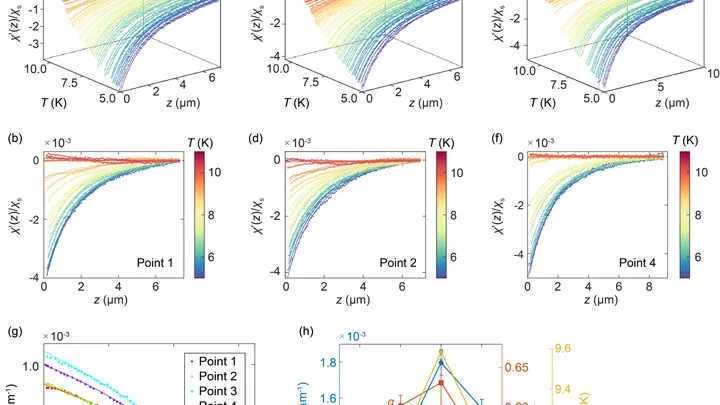
A superconductor is like a city where electrons stop jostling and start moving in pairs, like people strolling arm in arm. In neodymium-strontium nickelate (Nd₀.₈Sr₀.₂NiO₂), this 'parade' kicks in at around 10 kelvin (minus 263 degrees Celsius), but not uniformly.
A qubit, the heart of a quantum computer, is like a soap bubble: the slightest puff and it bursts. On Earth, gravity pulls bubbles down, creating vibrations, and the thermal hustle of atoms adds jitter. Entropy, the measure of this chaos, destroys quantum information.