Electronenergy refers to the kinetic and potential energy of an electron within a physical system, such as an atom, molecule, or solid. In quantum mechanics, electrons occupy discrete energy levels, and their distribution determines a material's electronic, optical, and chemical properties. The concept is fundamental to understanding phenomena like electrical conductivity, band gaps in semiconductors, and chemical bonding.
History
The modern understanding of electronenergy levels stems from Niels Bohr's 1913 atomic model and was refined by Erwin Schrödinger's wave mechanics in 1926, which provided a full quantum description.
How it works
In a solid, electrons fill energy bands separated by gaps. The highest occupied band (valence band) and the lowest empty band (conduction band) define whether a material is a metal, semiconductor, or insulator. Electron energy is governed by the Schrödinger equation, and in many-body systems, it is approximated using density functional theory, which calculates the energy as a functional of electron density.
In graphene, electrons behave as massless relativistic particles, and their energy is linearly proportional to momentum, unlike in ordinary metals where it is quadratic.
Units by system: SI: j · CGS: erg · Planck: e p · natural: ev
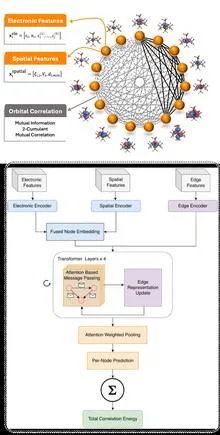
A cartographer who draws not mountains and rivers but invisible bonds between electrons: that's one way to describe the new neural network. Instead of atomic coordinates, it takes molecular orbitals and draws a graph where nodes are orbitals and edges are measures of their quantum entanglement.
Two pendulums on a shared string trade motion: push one, and the second starts swinging, and a moment later the first gets a push back. In a thorium-229 atom, energy flows nearly loss-free between the electron shell and the nucleus.
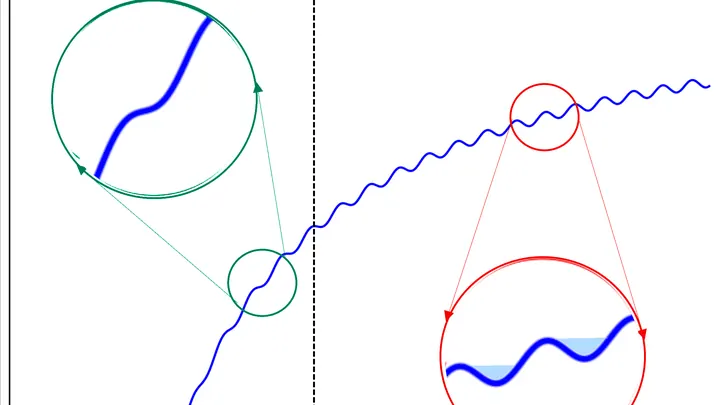
According to ordinary mechanics, an electron in an atom should spiral into the nucleus and crash into it, like a surfer losing speed and falling off the board. But atoms live for billions of years. Because space isn’t empty. Even in absolute vacuum, an invisible electromagnetic sea ripples — the zero-point field. Its waves continuously nudge the electron.
The Sun constantly emits a stream of charged particles — the solar wind. Among them are many electrons, some of which fly back toward the Sun. But observations show that fewer electrons return than expected.
A tiny tungsten tip with a radius of less than a hundred nanometers is the perfect stage for watching a quantum performance. Apply an electric field of a few volts per nanometer, and electrons start flying out of the metal: that’s field emission.
High above Antarctica, a balloon carried an instrument that caught electrons from space. These particles come from distant stellar explosions and other powerful events. The instrument measured their energy, like the force of an impact. And in one energy range, there were more impacts than calculations predicted.