Quantum entanglement preservation refers to the techniques and strategies used to maintain or extend the lifetime of quantum entanglement, which is a fragile resource that degrades due to interactions with the environment. Entanglement is essential for quantum communication, quantum cryptography, and quantum computation, but it is easily destroyed by decoherence. Preservation methods aim to protect entangled states from environmental noise, allowing them to be used for longer periods or over longer distances.
History
The concept of entanglement preservation has been studied since the 1990s, following the discovery of quantum error correction by Peter Shor and Andrew Steane in 1995. The development of decoherence-free subspaces and dynamical decoupling also contributed to the field, with key work by Lorenza Viola and others in the late 1990s.
How it works
The primary mechanism for entanglement preservation is decoherence suppression, which can be achieved through various means. These include dynamical decoupling, where sequences of pulses are applied to the system to average out environmental interactions; quantum error correction, which encodes information redundantly to detect and correct errors; and the use of decoherence-free subspaces, where certain states are inherently protected from noise. Additionally, entanglement distillation can be used to extract a smaller number of highly entangled states from a larger number of weakly entangled ones.
Quantum entanglement can be preserved indefinitely in theory using quantum error correction, but in practice, the overhead required grows rapidly with the size of the system, making it a major engineering challenge.
A pendulum weighing a few grains of sand swings on a hair-thin glass fiber. Its motions are so faint that the thermal jostling of air molecules seems like a hurricane. Yet such a pendulum is the key to witnessing quantum wonders in the world of large objects.
A topological superconducting nanowire is like a bridge, with two inseparable sentinels — Majorana modes — stationed at its ends. These exotic quasiparticles, predicted back in the 1930s, promise to become the foundation of an error-proof quantum computer.
Quantum entanglement is a fragile thing. Two friends move to different cities, each carrying a box with one of a pair of gloves: if one box has the left glove, the other has the right. Entangled particles behave similarly, except that until measurement, no one knows which is where.
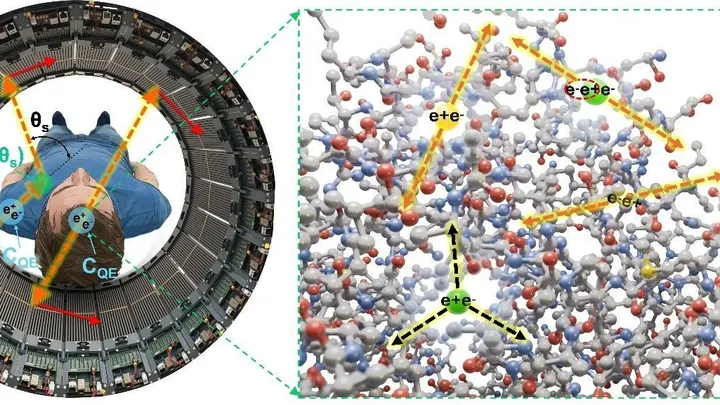
Two photons fly out from a single point in a patient's chest. They are twins: alter one, and you instantly know about the other. This connection is called quantum entanglement. In a PET scan, these pairs are born inside the body when an injected radioactive substance meets electrons in the tissues.
The degree of entanglement is not constant.
Quantum sensors are like an orchestra where musicians play in unison: their entangled states let them pick up signals that ordinary instruments can't. But as soon as you start accumulating the signal, the nonlinear interaction, like a conductor who suddenly starts beating time erratically, ruins the music.
Fourteen rubidium atoms lined up like beads on a string. Each atom is a tiny magnet that can point up or down. Together they follow strict rules, similar to a train schedule: everything is predictable, everything repeats. But introduce a barely noticeable change, and the schedule goes off the rails.