An entanglement measure is a numerical quantity that quantifies how much quantum entanglement exists in a multi-particle system. Entanglement is a non-classical correlation where the state of one particle cannot be described independently of another, even when separated by large distances. Common measures include concurrence, entanglement entropy, and negativity. The value typically ranges from 0 (no entanglement) to 1 (maximally entangled), though some measures can exceed this for mixed states.
History
The concept was formalized in the 1990s with the work of Charles Bennett, William Wootters, and others, who introduced measures like entanglement of formation and concurrence. Earlier, John Bell's 1964 inequalities provided a way to test entanglement experimentally.
How it works
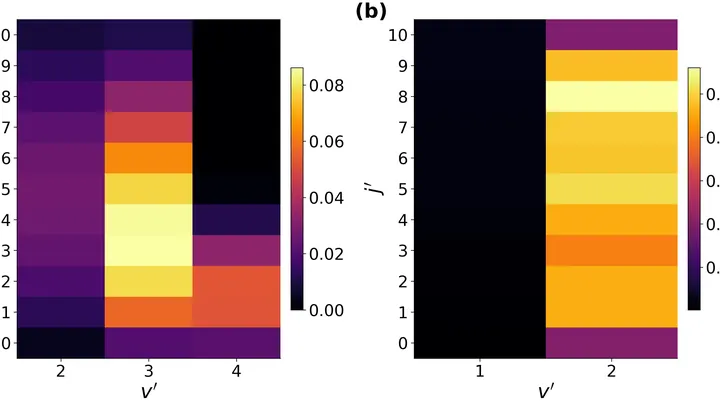
The measure is computed from the density matrix of the system, which encodes all statistical information about the quantum state. For a bipartite system, one often takes the partial trace over one subsystem to obtain the reduced density matrix, then calculates a function of that matrix (e.g., its eigenvalues) to yield the entanglement value. The decrease with oxygen presence suggests that oxygen molecules interact with the entangled particles, causing decoherence that reduces the quantum correlations.
In practice
Used in quantum computing to benchmark the quality of qubit operations, and in quantum cryptography to ensure secure key distribution.
Fun fact
Entanglement measures are not unique; different measures can rank states differently, leading to ongoing research on which measure is most physically meaningful.
The wind carries pollen, and each grain moves as if on its own. But once the air swirls into a vortex, the pollen trajectories can no longer be separated: they are tangled. This is roughly how electrons behave in a strange metal: their motion is so strongly coupled to soft fluctuations of the medium that the usual particle carriers disappear.
A pendulum weighing a few grains of sand swings on a hair-thin glass fiber. Its motions are so faint that the thermal jostling of air molecules seems like a hurricane. Yet such a pendulum is the key to witnessing quantum wonders in the world of large objects.
A quantum chain is like a string of lights, where the bulbs are the spins of particles. Ideally, all bulbs glow in sync, following a common rhythm: that's symmetry. But if you cut off a piece of the string, the rhythm can get out of step: within that segment, symmetry is broken.
Physicists study a chain of strongly interacting particles (the XYZ model).
Light or sound can be confined in a tiny region of a crystal, like a pearl in a shell. Usually, two methods are used. The first is like a heavy ball in a pit: a particle with large mass simply cannot roll out. The second is a perfect cage of mirrors, where waves cancel each other everywhere except in the trap itself.
Toss a handful of phosphorus into silicon, and at a certain impurity concentration the material suddenly starts conducting electricity. This is a metal-insulator phase transition, and it happens abruptly. But what exactly changes in the electron wave functions when an insulator becomes a metal?
Any measuring device is spoiled by quantum noise — the chaotic jitters of elementary particles. To tame it, physicists used a trick on calcium fluoride molecules, much like squeezing a balloon: press in one spot, and it bulges in another.
An acoustic black hole is a fluid flow faster than sound, so sound waves can't escape. The boundary, the surface where the flow speed reaches the speed of sound, spawns pairs of phonons: sound quanta, one flying away, the other plunging inward.
Two entangled photons fly apart in opposite directions but continue to behave as a single whole: measuring one instantly determines the state of the other. That's quantum entanglement. But sometimes it resembles a seasoned spy — leaving no traces detectable by ordinary checks.
Two tiny spinning tops fly apart after a collision. Their rotation is not predetermined: it becomes definite only at the moment of measurement. This is quantum entanglement: the state of one top instantly responds to the state of the other, no matter how far apart they are.
Quantum entanglement is like an invisible web that connects particles even when they are far apart. In large systems (say, a piece of material) this web can either quickly weave through all the atoms or tangle into a knot and stay put. The first case is called quantum chaos, the second localization.
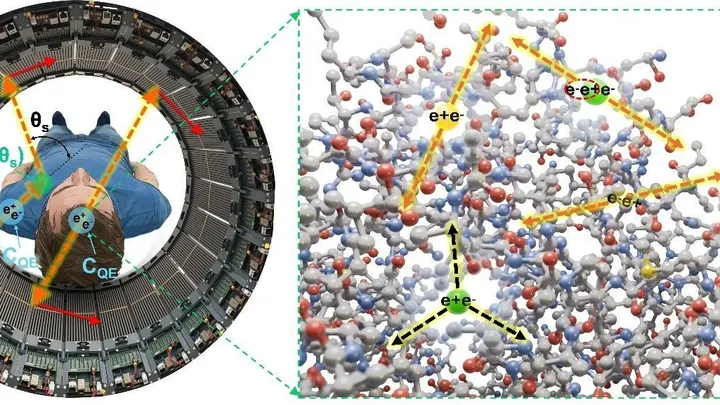
Two photons fly out from a single point in a patient's chest. They are twins: alter one, and you instantly know about the other. This connection is called quantum entanglement. In a PET scan, these pairs are born inside the body when an injected radioactive substance meets electrons in the tissues.
The degree of entanglement is not constant.
Two particles flying apart in opposite directions behave as a single whole: measuring one instantly determines the state of the other. Such quantum entanglement has long been known for light particles, but now it has been observed for the first time in heavy Z bosons — the carriers of the weak force.
In quantum theory, a particle can run along two paths at once. When measured, we catch it on just one. According to Niels Bohr, all other possibilities vanish instantly — like a branch snapped off a trunk. Yet Hugh Everett insisted: the tree of reality grows all its branches at once, and we only see the one we’re on.
Two twins look identical, but one is left-handed and the other right-handed. In the world of elementary particles, there are similar pairs: Ξ- and its antiparticle Ξ+. They are born together in the decay of the J/ψ particle and, like entangled twins, maintain a connection even at a distance.
A good chef tastes the soup and adds a pinch of salt. Ordinary scales won't notice that pinch, but sensitive ones will. In the quantum world, pairs of entangled particles play the role of such scales. It was previously thought that the entanglement had to be as strong as possible, otherwise precision wouldn't improve.
At the Large Hadron Collider, by accelerating particles to nearly light speeds, top quarks are created — the heaviest building blocks of the Standard Model. They live for vanishingly small fractions of a second but manage to exhibit complex quantum connections.
Two photons fly out of a tiny box, and behave like twins who always wear matching outfits. Turn one, and the other instantly turns the same way, even if they are kilometers apart. This is no magic trick but quantum entanglement: a connection between particles that defies distance.
Researchers have built a compact source of such pairs.
A flashlight in thick fog is useless: the beam scatters, and the reflected light drowns in noise. But if you tie two photons with an invisible thread, one can pass through the fog and come back, while the other stays safe. This connection is called quantum entanglement — when two particles behave as a single whole, even when far apart.
Quantum sensors are like an orchestra where musicians play in unison: their entangled states let them pick up signals that ordinary instruments can't. But as soon as you start accumulating the signal, the nonlinear interaction, like a conductor who suddenly starts beating time erratically, ruins the music.
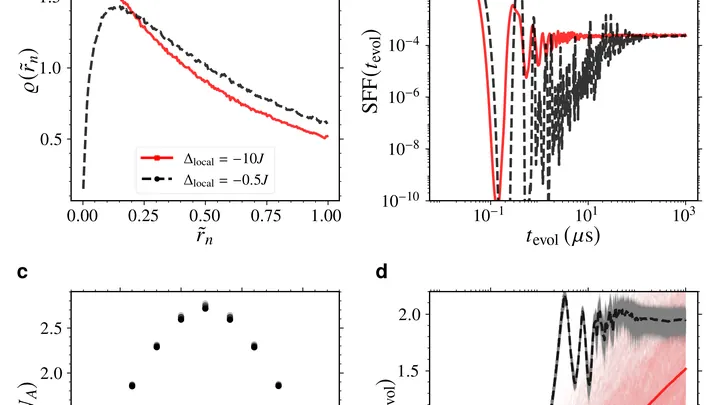
Fourteen rubidium atoms lined up like beads on a string. Each atom is a tiny magnet that can point up or down. Together they follow strict rules, similar to a train schedule: everything is predictable, everything repeats. But introduce a barely noticeable change, and the schedule goes off the rails.
In the quantum world, a collision between particles doesn't destroy their individuality but ties them into an inseparable knot: internal states and motions become intertwined like threads in an intricate tapestry.
The atomic nucleus is not just a bag of protons and neutrons. It is a quantum system where particles are bound by invisible threads of entanglement. When two protons or neutrons interact, their states become intertwined so that describing one without the other is impossible.
Two muons are born in the decay of an eta meson and fly apart, linked by quantum entanglement. One experimenter, Alice, measures the spin of the negative muon, while another, Bob, records the direction of the positron from the decay of the positive muon. It would seem that the order of events should affect the correlations.
Quantum mechanics gave us a captivating image: a system’s state is not a frozen point but a wave of possibilities, dancing in an abstract space. Thanks to the work of Шрёдингера and Дирака, we represent it as vectors in Hilbert space.
A stone falls into water, and ripples spread outward. In the quantum world, a magnetic impurity (that pebble) in a metal perturbs the surrounding electrons, and they form a special cloud around it. This is called the Kondo cloud. Like ripples on water in the dark, it long remained elusive.