Quantum Oxygen Sensor Inside the Body express
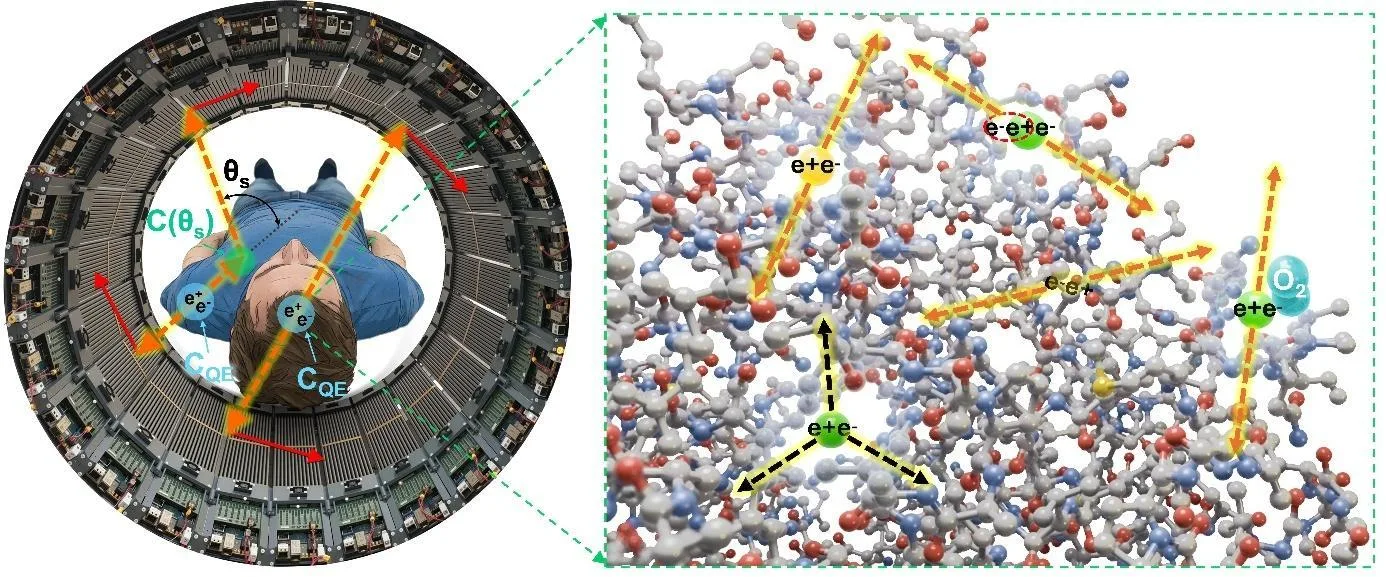
Two photons fly out from a single point in a patient's chest. They are twins: alter one, and you instantly know about the other. This connection is called quantum entanglement. In a PET scan, these pairs are born inside the body when an injected radioactive substance meets electrons in the tissues.
The degree of entanglement is not constant. It weakens if the photons interact with oxygen molecules along the way. The more oxygen dissolved in the tissue, the more the connection is destroyed. The authors propose measuring this weakening, and using it to tell whether cells are suffocating. Calculations were done for water, alcohols, and fatty tissue: in fat with zero oxygen, entanglement reaches 0.89, while in isooctane it drops to 0.78.
The method requires no new equipment. The same PET scanner that looks for tumors is enough. Only now it counts not just flashes but their coherence. It's like listening to an orchestra: before, we only heard the volume; now we can tell whether the violins play in unison or out of sync. Discord is a sign of hypoxia. Thus, an ordinary medical device becomes a meter of tissue respiration.
Positronium (a tiny 'atom' made of an electron and its antiparticle, the positron) lives only a few nanoseconds but manages to emit a pair of entangled photons.