Chaos is not synonymous with disorder. It is orderly unpredictability. Look at the smoke rising from a cigarette: at first it flows in a smooth stream, but higher up it suddenly turns into billowing curls. The transition from laminar to turbulent flow is a typical scenario for the birth of chaos. The equations describing such processes are deterministic (containing no randomness), but so sensitive to initial data that the slightest rounding error grows and nullifies any forecast. This property is called exponential divergence of trajectories.
History
Although the first intuitive insights about the instability of certain motions were expressed by Henri Poincaré as early as the 1890s, modern chaos theory was born in the 1960s–1970s. Edward Lorenz of the Massachusetts Institute of Technology discovered chaos in a simplified model of atmospheric convection in 1963. Mathematician James Yorke and his student Tien-Yien Li introduced the term 'chaos' in 1975. Mitchell Feigenbaum in 1978 discovered universal patterns in the transition to chaos through a period-doubling cascade, linking them to constants named after him.
How it works
The starting point is often the Lorenz system: three ordinary differential equations with two nonlinear terms of the xy and xz type. At certain parameter values (σ=10, ρ=28, β=8/3), the phase trajectories form a chaotic attractor—they endlessly wind around two regions, never intersecting or looping. The evolution of such a system has the property of mixing: any, even tiny, initial cloud of points eventually spreads uniformly over the attractor. Information about the initial state is irretrievably lost, although the equations themselves are reversible. This leads to the practical impossibility of long-term forecasting, despite determinism. Statistical methods, such as constructing return maps (Poincaré sections) and calculating the power spectrum, help distinguish chaos from periodic regimes and noise.
In practice
Weather forecasts are inaccurate beyond two weeks due to the chaotic nature of the atmosphere, and encryption algorithms use chaos to protect data.
Fun fact
In 1961, Edward Lorenz, restarting a long computer weather calculation, entered 0.506 instead of 0.506127—and got a completely different climate. Thus was born the understanding that predictability even in simple systems is limited to a horizon of a few characteristic times.
Write down a recipe, then check it an hour later: if the proportions are off by even a gram, the taste is gone. Chemical reactions in open systems behave much the same way: the slightest difference in initial concentrations grows over time into completely different states.
In a mountain range, there are trails that can be contracted to a point if you walk through a flat valley. But there are also loop routes that cannot be shrunk without crossing a ridge.
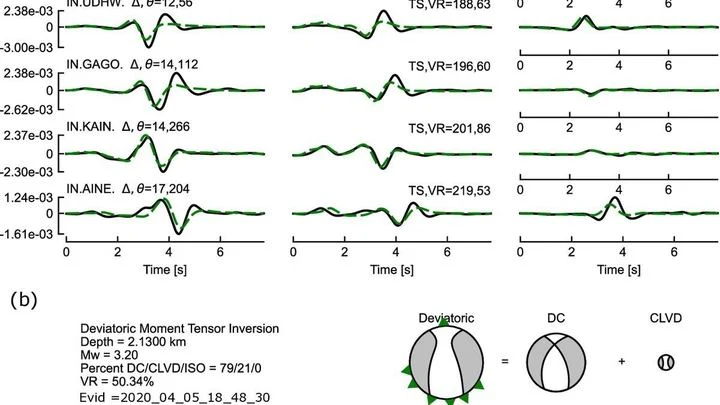
In 2019, residents of Palghar district in western India felt the ground slip from under their feet — not once, but thousands of times. Over two years, seismographs recorded about 50,000 tremors. This wasn't a typical earthquake with a main shock and aftershocks, but a swarm: a series of events that quiets down and then flares up again, like a smoldering fire fed with twigs.
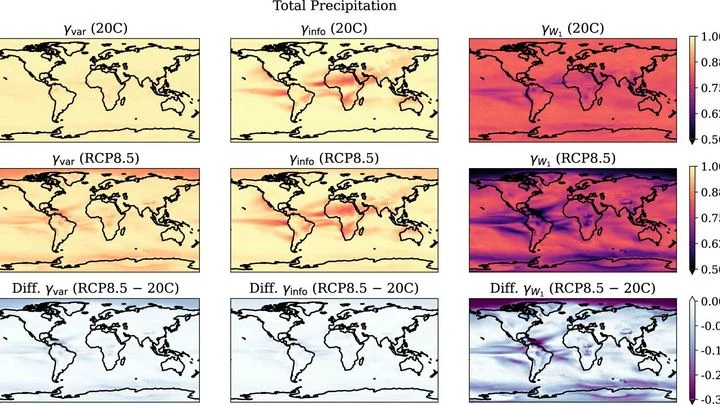
In winter, one part of town gets three times as much snow as the neighborhood next door. One year is a scorcher, the next is a cold snap. That's the whims of weather. But over decades, a different, slow shift emerges: winters, on average, get milder. Telling the two apart is the central challenge for climate scientists.
A courtroom interpreter is distracted by every rustle: the creak of a chair, a cough in the back row, the rustle of papers. By the end of the day, they are translating not what the witness said, but what they heard through the noise. Rare translation errors are not the result of a single loud shout, but of the accumulation of many small disturbances.
In an oven, as temperature rises, molecules move faster and disorder increases. With language models like ChatGPT, it's the opposite. When developers increase the 'temperature' parameter, the model gets access to a wider choice of words, but its long texts suddenly start looping.
A team of researchers tested 11 different AIs by generating 12,000 text continuations.
The brain doesn't just react to the world: it's constantly guessing what will happen next. This principle is called predictive coding: neurons compare expectations with reality and update their internal picture when an error occurs. But how such a complex system could be wired into the living tissue of the cortex remained unclear.
A jazz ensemble: at first, a cacophony of random notes. Then — a catchy riff that plays over and over. Such is the riddle of the origin of life — only in the language of chemistry.
A star circles a rotating black hole like a figure skater at the center of a rink. While it is far away and can be treated as a point, the dance remains predictable: the orbit follows clear laws, like music that is easy to glide to. But as it approaches, gravity begins to act unevenly.
A solid under a microscope is not a monolith at all. In glass, polymer, or solidified resin, atoms are arranged randomly, and as a result, the material's properties vary from point to point. On large scales, we are used to describing them with smooth fields, like temperature or pressure in a room. But when you zoom down to a few atomic layers, that smoothness disappears.
A disease outbreak is like a wildfire: the fire runs through dry grass, and its speed depends on wind and humidity. But an infection has its own 'wind'—how often people infect each other. When this rate changes along with the fraction of already infected, the epidemic wave can behave differently.
A hundred thousand stars in the dense core of a globular cluster move like steel balls in a giant pinball machine. Each 'bump' — a gravitational encounter between a binary system and a single star — triggers a cascade of unpredictable events.
Technological disasters like Chernobyl rarely strike without warning. They gestate for years: organizations ignore warnings, their complexity mirroring the rise of entropy — a measure of relentless chaos that builds up unnoticed until it avalanches.
When a pipe bursts in the basement, a plumber acts step by step: locates the leak, measures the pressure, determines the cause, patches it up, and checks if it's dry. The same recipe — the standard model DMAIC — is being proposed against epidemics.
First, they determine the scope — how many hospital beds are occupied, which industries are sagging.
In a city where danger zones pop up and vanish without warning, a malicious GPS is always trying to steer you into a trap. This unpredictable foe operates at every intersection. Yet a mathematical universal framework calculates all possible ploys and charts a path that guarantees safety even amid severe interference.
A robot swarm is like a cloud of fireflies: each moves on instinct to wherever is freer, and chaos turns into order. For a long time, it was a mystery how coherence emerges without communication or commands. The answer came with the creation of the Response Map — a tool that, like an X-ray, illuminates the hidden logic of the machine brain.
Mathematicians confirmed: the ideal response to a pandemic is the 'hammer and dance' strategy. First, a sharp lockdown smashes the wave of infections like a hammer blow. When hospitals empty, the dance begins — a cautious, step-by-step return to normal life.
Complex machinery, from drones to surgical robots, sometimes behaves like a wild mustang: full of disorder and whims, where the slightest touch triggers a storm. Instead of rote memorization of formulas, the new method observes the system like a horse breaker.
An experienced detective doesn't calculate a criminal's path using the laws of physics: he checks a file of similar cases. The new prediction method works the same way: instead of complex equations, it has a vast archive of trajectories that have already happened — planetary motions, currency exchange rates, signals from space.
Every month, satellites measure temperature and humidity over different parts of the planet. Over 24 years, thousands of such paired measurements have accumulated. Normally, temperature and humidity change in concert: when it warms, the air holds more water; when it cools, it releases it. But before a sharp climate shift, this coordination breaks down.
The quantum world is often compared to a musical instrument. Each system, whether an atom or a chain of particles, sounds at its own frequencies, which physicists call energy levels. In chaotic systems, like an orchestra without a conductor, these frequencies usually fill the entire available range without gaps.
In the microscopic world, noise, random fluctuations, usually destroys fragile quantum states, much like ripples on water break the reflection in a puddle. However, in some systems, collective, coordinated noise from many particles produces the opposite effect: a stable unidirectional flow emerges.
Imagine a ball in an unfamiliar hall: two guests start from opposite corners. Their movements are not a smooth waltz but chaotic improvisation in search of rare treasures. Contrary to intuition, the outcome hinges not on tempo but on the geometry of the floor.
Musicians in an orchestra each play their own part, not hearing the others. In a perfect crystal of tungsten disulfide on graphene, excitons, bound electron-hole pairs, behave the same way: they barely mix due to a hidden symmetry called the valley. The energy levels of such a system resemble notes sorted into separate folders — the chaos is incomplete.
A thousand particles enter a gradient dance. Each feels an attraction to regions of high probability and repulsion from neighbors — so they don't bunch up.
In the mid-20th century, physicists noticed something odd: the energy levels of complex atomic nuclei behaved like lottery balls — completely unpredictable. Since then, the search for such hidden chaos in the microworld has never stopped. Until recently, it was thought that chaos only appeared in systems that are constantly pushed, like a blender.
Two pendulums suspended from a single invisible spring swing in a shared air current. One always lags the other by exactly half a period: when the first swings left, the second is already returning from the right. By watching the first, you can tell where the second will be half a period later.
Air flowing over a wing or turbine blade behaves like a string: it starts smooth and layered: that's the laminar regime. But as speed increases or external ripples appear, the string breaks into chaotic vibration — turbulence. Predicting the exact moment of breakdown is crucial: it affects drag, heating, and noise.
A stone falls into a pond, and ripples spread evenly in all directions. But some media behave as if the wave knows which way to turn, like water that only swirls clockwise. This asymmetry comes from odd viscosity and odd elasticity — properties of media with broken mirror symmetry.
A handful of sand falls onto a table: each grain rolls down until it rests in a hollow. That's how a potential works: the table's surface tells the grains where to go. But in a river with whirlpools, there's no single basin everything flows into. Water swirls, returns, and meanders. For such systems, the usual map of 'pits and hills' doesn't apply.
Entropy is a measure of disorder. Two shuffled decks of cards, dumped into one pile, won’t become more chaotic than the sum of their individual disorders. This is the rule of subadditivity: the whole is no more chaotic than its parts.
Time crystals are quantum phases of matter that spontaneously oscillate, like a tuning fork with an infinitely decaying echo. If an ordinary spatial crystal repeats an atomic pattern in space, breaking translational symmetry, a time crystal exhibits periodicity in time, breaking time translation symmetry.
Spacetime is often pictured as a smooth fabric. But at the very microscopic level, this fabric might not be continuous; instead, it could consist of individual 'atoms'—events linked by causality. This picture of the world is called causal set theory.
Drop a handful of sand into calm water — the ripples spread and fade. Drop it into a running blender — the vortices mix everything in an instant. Physics has a similar rule: chaos cannot grow faster than a certain rate.
A busy intersection without traffic lights. Cars drive, brake, and change lanes, and from the outside, it looks like complete chaos. But if you watch for a while, you can notice a rhythm: the flow thickens and thins. In physics, this rhythm of disorder is called entropy: it shows how far a system is from calm equilibrium, like water in a boiling kettle.
A pendulum swings in thick syrup. In the first fractions of a second, it moves quickly, but the syrup slows it down, and then suddenly the syrup becomes thinner, and the pendulum speeds up again. Something similar might have happened to our universe.
Mountain river water doesn't flow smoothly: it churns, swirls into eddies, and suddenly accelerates. This chaotic motion is called turbulence. But even within it, there are hidden rhythms — rare and intense bursts that briefly alter the entire flow pattern.
Our Solar System isn't an island in the void: it's a sensitive web stretched in a dark cosmic corner. Planets circle their orbits like dewdrops on threads, and we are the spider sensing the faintest tremor. That tremor betrays the approach of the catastrophe astronomers call the Big Rip.
A pendulum chooses how to swing on its own. If you give it a strong push, it quickly returns to a smooth rhythm. If you hold it at its extreme position, it will stay there, but as soon as you let go, it resumes its usual motion.