Quantum teleportation is a protocol for transferring a quantum state, using a pre-distributed entangled pair and a classical channel. Unlike a fax, the state is not copied but transferred with the destruction of the original (due to the no-cloning theorem). Bell measurement yields one of four outcomes; these classical bits tell the receiver which unitary transformation to apply to reconstruct the state. The protocol does not transmit information faster than light, as the classical signal is limited to this speed.
History
The concept was proposed in 1993 by Charles Bennett, Gilles Brassard, and co-authors. First experiments with photons were conducted in 1997 by groups led by Anton Zeilinger and Francesco De Martini. In 2012, teleportation was achieved over 143 km. In 2016, the Chinese satellite Mozi (Micius) teleported states between the satellite and Earth.
How it works
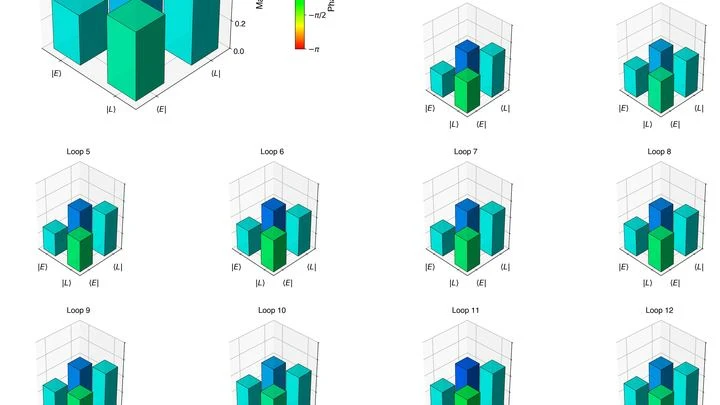
Teleportation uses entanglement and linearity. Bell measurement projects one pair into an entangled state, and the remote particle is corrected by a unitary operation. The necessity of a classical signal ensures causality. The impossibility of directly measuring the original state is related to the uncertainty principle. The protocol is a form of quantum error correction. Experimentally, photons with entangled polarization, time bins, or orbital angular momentum are used. Sources of entangled pairs include spontaneous parametric down-conversion; Bell measurement is performed with interferometers, and conditional operations with fast modulators.
Without the classical signal with measurement results, the receiver sees only random noise. Therefore, teleportation does not violate causality and does not allow superluminal communication.
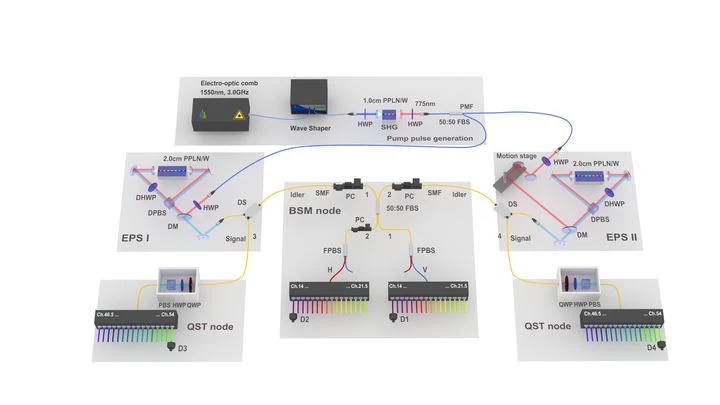
Quantum communication is like sending a secret letter that tears apart at any attempt to peek. So far, such a letter can only be sent along one road, and that's slow. Scientists have figured out how to send 16 couriers along 16 parallel roads, different frequencies of light, and verified that the letters arrive intact.
In 1996, physicists asked: how much noise can a quantum channel withstand before it stops transmitting information? A phone call where every third word is replaced by random noise is still understandable. Up to what level of interference can the listener still grasp the meaning?
An ordinary random network is like a road map: to connect four cities with a complex interchange, you need to lay down many highways. In the quantum world, things are different.
In an ultracold cloud of atoms cooled to near absolute zero, regions with different spin orientations emerge, like patches with different magnetization. The boundaries between them are called domain walls. Usually they are stationary, but in this experiment the walls started moving on their own.
Alice prepares a quantum particle in one of several states and sends it to Bob. The channel the particle travels through isn't perfect: it's noisy, scatters, interacts with the environment. Bob receives the signal and tries to figure out what Alice actually sent. This is the classic "prepare-send-measure" scheme, and there's always a risk of losing something along the way.
Two observers, Alice and Bob, sit at opposite ends of the same lab. Between them is a source that fires off two pulses in turn. Each pulse gives birth to a wave packet flying toward its own detector. So far, this looks like an ordinary experiment with quantum particles.
In the world of quantum particles, there are introverts — anyons. They are unlike familiar electrons or protons. If you swap two such introverts, they remember the maneuver, as if leaving an invisible trace.
At the heart of a dying star, as its core collapses into a neutron sphere, an invisible storm is born. Trillions of neutrinos, particles that barely interact with matter, race through the scorching plasma. There are so many of them that they begin to influence each other, changing their 'flavors' (electron, muon, tau) like chameleons.
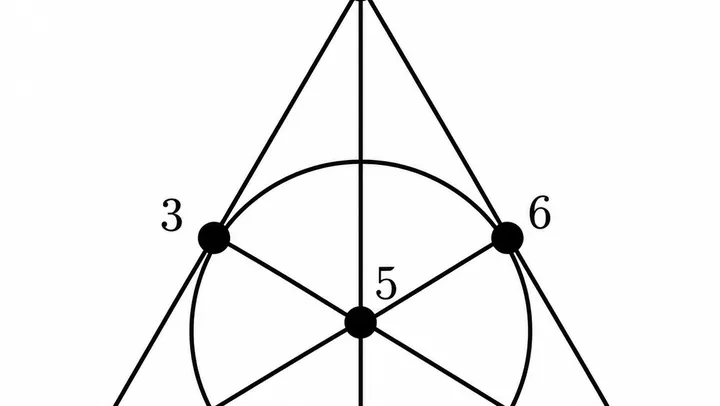
Seven dancers step onto the stage. They join hands so that any trio or quartet moves in perfect harmony with the rest — no group falls out of the overall rhythm. In the quantum world, this is called an absolutely maximally entangled state (AME for short). It's a perfect knot where every part knows everything about the whole.
A quantum computer based on neutral atoms is like a city where couriers, laser tweezers, physically carry packages between addresses. While one courier drags an atom across the entire chip, the others sit idle. This is slow and error-prone.
The new architecture replaces couriers with a shared radio wave.
Imagine a postal service where couriers suddenly stop moving. It would seem that letters would stop arriving and communication between cities would break down. But what if the envelopes themselves suddenly gained the ability to change shape and transmit messages through a shared web without moving an inch?
The quantum networks of the future resemble the Tower of Babel: each node speaks its own dialect. Some store information in the polarization of a photon — the direction of oscillation of the light wave. Others use time bins: that is, when exactly the pulse arrives.
Hot tea cools down, and ice cream melts — heat always flows from warm to cold, and this law seemed unbreakable. But in the quantum world, even familiar rules can be rewritten. Physicists placed a tiny mechanical resonator (a vibrating bridge the size of a microbe) in an optical cavity between two mirrors.
A translator gets distracted by every rustle in the hall, and a one-hour meeting stretches into two. That's roughly how thermal noise disrupts quantum teleportation: the carrier particles lose synchronization, and the message gets corrupted.
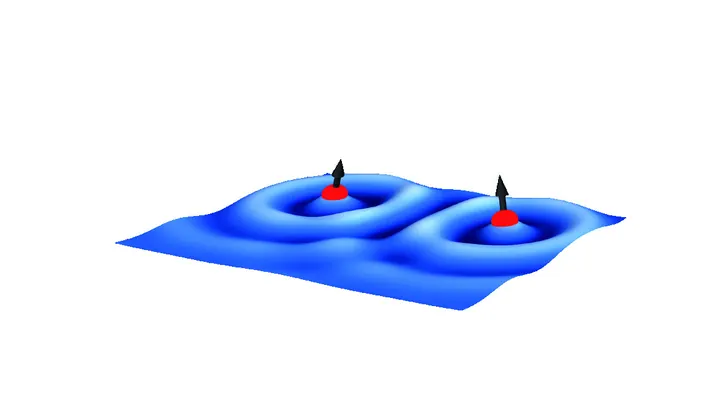
Quantum entanglement — a phenomenon where the states of two or more particles become interconnected regardless of the distance between them — usually links intrinsic properties such as spin or polarization. However, a new experiment has for the first time realized entanglement of the positions of two atoms in space.
In the quantum world, there is its own dance. Two superconducting toroids, each comfortably holding its quantized magnetic flux, whirl in a synchronous waltz. Between them is a vacuum, not a single field line, yet they mirror each other’s moves without fail.
The hunt for non-Abelian anyons is a quest for a quantum ghost that leaves only one clue: entropy. These particles live in two-dimensional systems at ultralow temperatures. Their exchange doesn't just flip the sign of the wavefunction — it entangles states, creating topological order.
Building a quantum network node is like teaching a dancer to balance on a carbon thread over an abyss. One leg must spring lightly from the wire, hurling photon-messengers into the external world. The other must grip the rope tightly, guarding precious quantum information.
Quantum tunneling — the ability of particles to pass through barriers forbidden by classical physics — powers stars with thermonuclear fusion, ignites primordial nucleosynthesis, and gives us flash memory.
An electron and its antiparticle — the positron, predicted by Дираком, — upon meeting, momentarily form позитроний: a tiny pair circling each other, like in an atom but without a nucleus. Almost instantly it decays, emitting two photons that turn out to be mysteriously linked.
Quantum entanglement often behaves like a synchronized dance visible from only one angle. Change the way you observe it, and the particles appear disconnected. This limits secure communications. Now physicists have created a pair of photons whose 'dance' is flawless from all perspectives.
Quantum computers of the future will likely communicate via light. An atom stores information, and a photon carries it across the network. But an atom doesn't hang still: it jitters and oscillates, and this motion can corrupt the signal.
Previously, engineers could only calculate for a stationary atom.
Data on the internet travels at the speed of light through fiber optics. In classical networks, delays aren't critical, but for quantum communication, perfect synchronization is essential: particles of light with encoded information must converge at the detector in the same instant.
A quantum computer is like an orchestra where each musician, a qubit, must play their part accurately and on time. Usually, musicians are seated in fixed positions and connected by conductors' consoles. But what if we let them move freely across the stage and turn the movement itself into part of the music?
A lone potassium atom enters a dense cloud of sodium atoms cooled to near absolute zero. Such a medium is called a Bose–Einstein condensate — all particles merge into a single quantum wave. One might expect the impurity to simply pick up a single neighbor and form a pair. But the experiment showed something else.
A single camera shot stores both a normal picture and a hidden map of how light rippled through the scene. Quantum entanglement makes this possible. Pairs of linked photons are generated: one visits the object, its twin takes a detour. Later, measuring the twin one way pulls out the brightness information.
Two simultaneous interpreters sit in the same booth. The first translates from English into Russian but swallows half the words. The second goes from Russian into French, and also loses half. If you put them together, you'd expect a mess: the losses would add up, and only a quarter of the meaning would reach the listener. But what if they start correcting each other?
Quantum entanglement is a fragile thing. Two friends move to different cities, each carrying a box with one of a pair of gloves: if one box has the left glove, the other has the right. Entangled particles behave similarly, except that until measurement, no one knows which is where.
If you carry a cup of coffee slowly and steadily around a room and then return to the same spot, nothing happens to the drink. But in the quantum world, things are different: a particle that makes such a loop comes back not quite the same. It picks up an elusive 'extra'—the geometric phase, which physicists call the Berry phase.
Quantum computers in the cloud are like a post office: you send a letter, and someone else reads the address and the contents. In ordinary computing, the server sees your data and algorithm. Blind quantum computing is an unopenable envelope: the server does the work but doesn't know what it's doing.
An infinite chain of atoms spaced at equal intervals. Shift the entire chain by one step, and the picture doesn't change. That's translational symmetry: the world looks the same wherever you look. You'd think such a simple rule would give rise to simple states, like a crystal lattice assembled from identical building blocks.
But the authors counted those blocks anew.
Two particles behave like a pair of unusual dice: thrown at opposite ends of the universe, they always land on the same face. Physicist John Stewart Bell calculated: if the dice had hidden rules, the frequency of matches would have a strict limit.
Three people sit in three corners of a room. Each receives a sealed envelope from an invisible courier, but the couriers do not coordinate and have never met. The people open the envelopes and see a note with one word: "yes" or "no." They choose nothing themselves: they just read.
Two mailboxes at opposite ends of a city. Drop a letter in one, and an identical one instantly appears in the other. That's roughly how quantum entanglement works: two particles behave as a single unit, even when separated by a great distance. But until recently, this connection could only be maintained within a single room or across a lab bench.
A quantum memory node is a tiny diamond with a defect that can store and emit single photons. But its light has a wavelength of 637 nanometers, the same red as a ruby, and is almost completely absorbed after just a few meters of standard optical fiber.
A drop of cream falls into a cup of coffee, and within a minute, the entire drink turns beige. This mixing process can be quantified: how much "stirring" is needed to transform one distribution of particles into another? In mathematics, this approach is called optimal transport, and the measure of effort is the Wasserstein distance.
The authors applied this idea to quantum systems.
Among magnets, there are quiet masters of disguise. An ordinary magnet attracts paperclips and has two poles — north and south. But there are materials that are internally arranged like a magnetic chessboard: their atoms are aligned in a strict order, yet externally the material behaves neutrally, as if no magnet exists at all. Such substances are called altermagnets.
A deuterium molecule, two atoms of heavy hydrogen, falls apart under a laser pulse. One electron is ripped away, leaving an ion behind. At that moment, they are still linked: the direction of one immediately tells you which way the other went. This link is called quantum entanglement.
Light can act as a courier carrying secret messages. But to ensure the courier doesn't lose a single letter, you need to meet and check it very quickly. The new chip made from a thin film of lithium niobate is like a turnstile that opens and closes in billionths of a second, letting light pulses through at just the right moment.
Light is the fastest courier, but it can't wait. For quantum computers to exchange messages, we need memory that can catch a photon and hold it until the recipient is ready. In warm metal vapor, atoms buzz around like bees in a hive, and each movement scrambles the recording. As a result, stopped light quickly turns into mush.