El halo oscuro de la Vía Láctea está achatado y retorcido exprés
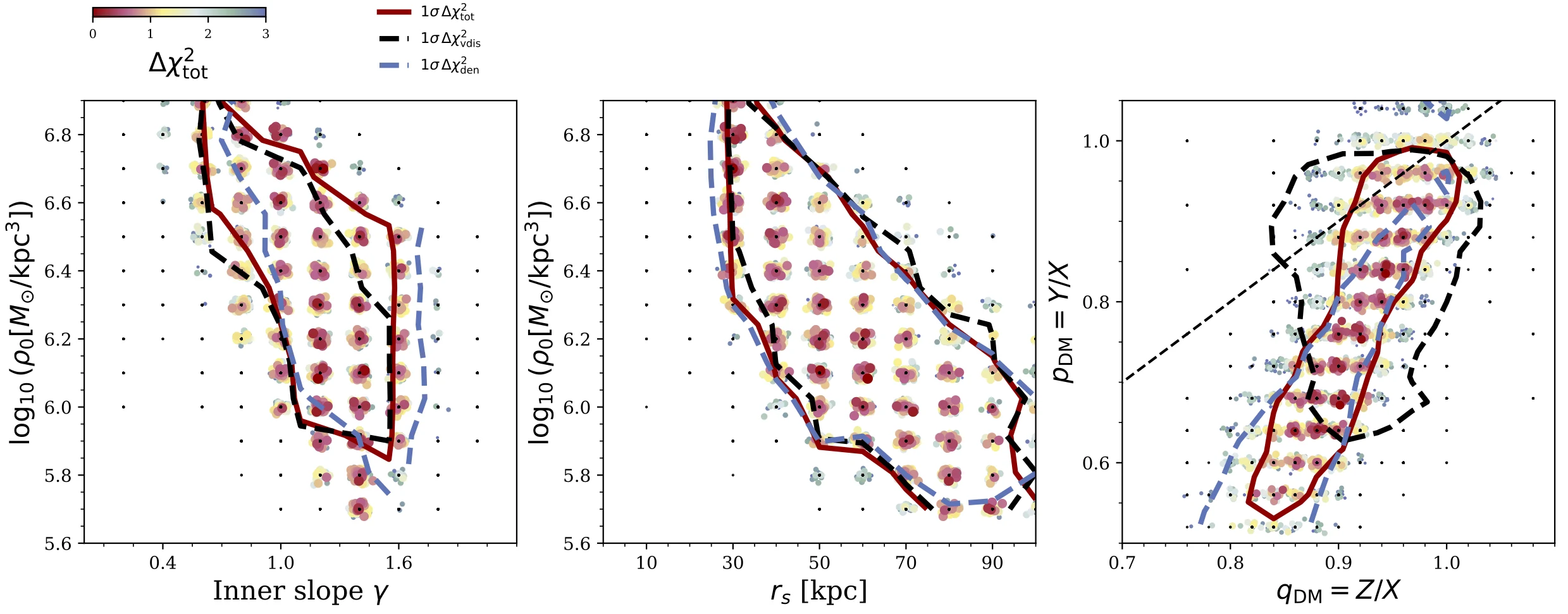
El disco estelar de la Vía Láctea es como una brillante veleta, y la materia oscura es la nube invisible a su alrededor. Por primera vez se ha medido su forma con precisión. Los astrónomos rastrearon el movimiento de millones de estrellas y construyeron un mapa tridimensional del halo oscuro hasta una distancia de 160 000 años luz. Hace tiempo, Fritz Zwicky y Vera Rubin demostraron la existencia de masa oculta, pero su distribución seguía siendo un misterio.
El resultado fue asombroso. El halo no es esférico, sino alargado y achatado, como un balón de rugby desinflado. Y su eje mayor se eleva casi vertical respecto al disco estelar, como si un armazón invisible estuviera inclinado 90 grados. Esta orientación coincide con el plano en el que orbitan las galaxias enanas satélite.
Esta inclinación se explica fácilmente: hace miles de millones de años, el disco de la Vía Láctea se volcó bajo la presión gravitatoria de pequeñas galaxias. Las simulaciones por ordenador lo confirman. El descubrimiento vincula el modelo cosmológico estándar con el comportamiento real de las galaxias y, por fin, explica el enigmático plano de los satélites.
Resumen original
tal como lo escribieron los autores, en inglés arXiv:2510.08684
Unveiling the 3D shape of the Milky Way's dark-matter halo is critical to understanding its formation history. We created an innovative dynamical model with minimal assumptions on the internal dynamical structures and accommodates a highly flexible triaxial DM halo. By applying the method to 6D phase-space data of K-giant stars from LAMOST + Gaia, we robustly determine the 3D dark-matter distribution of the Milky Way out to approximately $$50$$ kpc. We discover a triaxial, nearly oblate dark-matter halo with $$q_{\rm DM} = Z/X= 0.92\pm0.08$$, $$p_{\rm DM} = Y/X= 0.8\pm0.2$$ averagely within 50 kpc, where $$Z$$ axis is defined perpendicular to the stellar disk. The axes ratio $$q_{\rm DM} > p_{\rm DM}$$ is strongly preferred; the long-intermediate axis plane of the dark-matter halo is unexpectedly vertical to the Galactic disk, yet aligned with the `plane of satellites'. This striking configuration suggests that the Galactic disk (and the inner halo) has flipped, likely torqued by minor mergers, from an original alignment with the outer dark-matter halo and satellite plane, as supported by Milky Way analogues from Auriga and TNG50. By allowing $$q_{\rm DM}(r)$$ and $$p_{\rm DM}(r)$$ vary with radii, we find tentative evidence that the dark-matter halo is twisted, that it agrees alignment with the disk in the inner regions and transitions to a vertical orientation at $$r\gtrsim 20$$ kpc, supporting the disk flip scenario prediction. Such disk reorientation is non-trivial yet its physical mechanism is straightforward to comprehend and naturally originates a vertical satellite plane. Our findings offer a unified framework that links dark-matter halo orientation, satellite alignment, and disk evolution, reinforcing the internal consistency of the Milky Way in $$\Lambda$$CDM model.
Hay cinco veces más materia oscura que materia ordinaria. Sin su gravedad invisible, las galaxias se desintegrarían por la fuerza centrífuga.