Caos en una película líquida que fluye exprés
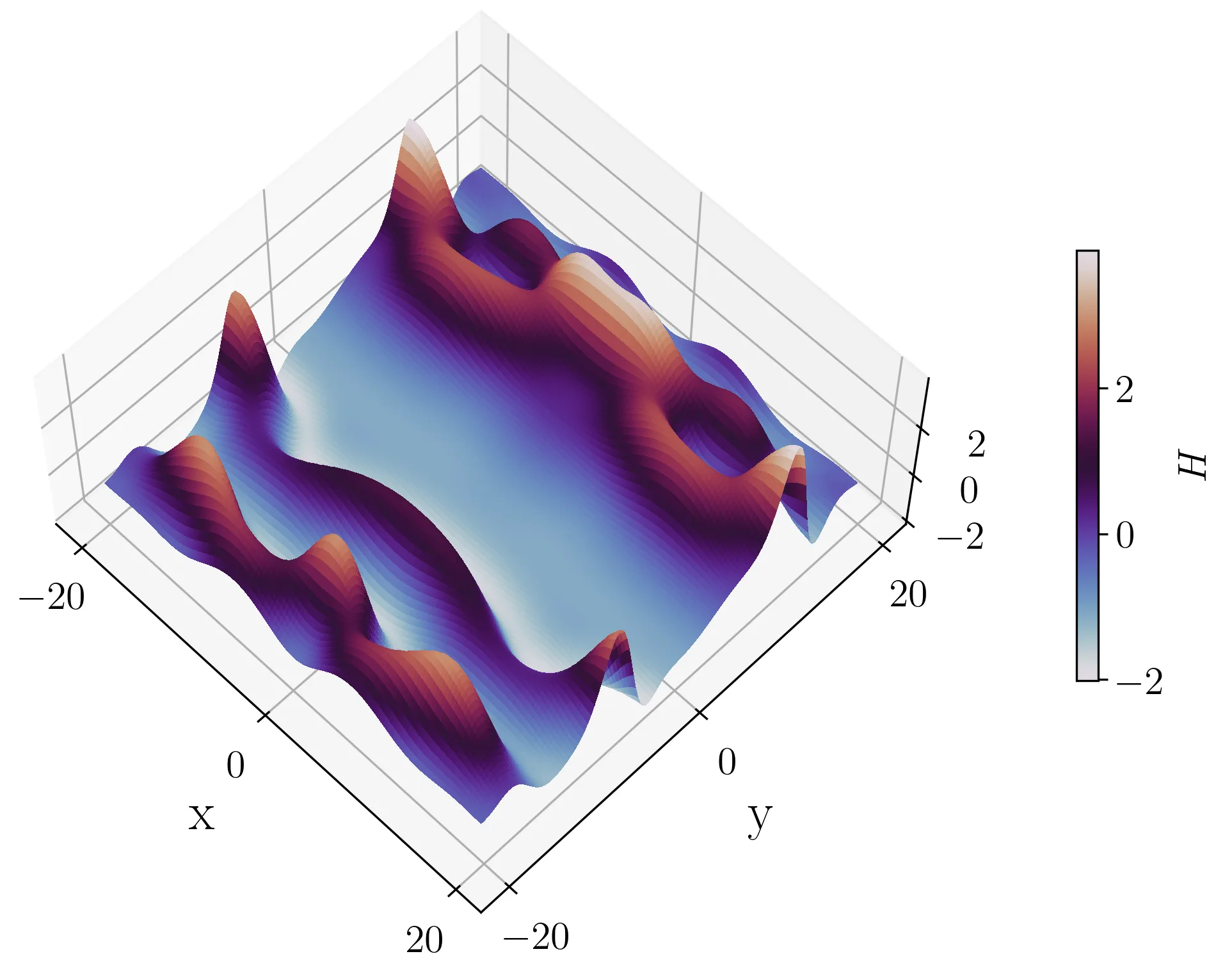
Un fino chorro de agua en el cristal de la ducha se agrupa en senderos serpenteantes que tiemblan y cambian ante nuestros ojos. Esta película de líquido que fluye por una superficie vertical es un ejemplo clásico de caos en la naturaleza: todo parece fluir hacia abajo, pero la superficie vive su propia vida impredecible.
Los físicos tomaron las ecuaciones que describen este flujo y las ejecutaron para múltiples variantes: diferentes anchos de flujo y propiedades del líquido. El resultado fue un mapa: en algunas zonas, ondas uniformes corren por la superficie, como pliegues de una cortina; en otras, las ondas estallan periódicamente en ráfagas; y en otras reina el desorden total. En la zona caótica, el flujo se asemeja a una papilla hirviendo: los patrones aparecen y desaparecen sin ritmo alguno.
Resulta que incluso en la zona más turbulenta se pueden distinguir motivos repetitivos. Los científicos calcularon estos "andamiajes" ocultos: patrones estacionarios, ondas viajeras y ciclos que regresan a sí mismos. El flujo caótico se acerca a ellos una y otra vez, como si recordara un baile familiar, para luego volver a lanzarse a la improvisación.
Esta es la primera vez que se logran aislar estructuras tan precisas en el caos de una película que cae. La utilidad práctica radica en comprender cómo controlar el flujo en la industria: desde la aplicación de recubrimientos hasta el enfriamiento de superficies.
Resumen original
tal como lo escribieron los autores, en inglés arXiv:2603.07297
Dynamical-systems approaches to spatiotemporal chaos have been developed primarily for single-phase flows, where the system state is defined by bulk velocity fields. Extending these ideas to two-phase flows remains challenging because the dynamics are intrinsically coupled to the evolution of a deforming interface. Here, we address this challenge for a two-dimensional vertical falling film by formulating the dynamics in terms of the interface evolution. Starting from the Navier--Stokes equations, we recover a classical long-wave interface evolution equation, originally derived by Topper & Kawahara (1978). Using this formulation, we perform an extensive parametric study to construct a regime map in the space of domain size and dispersion parameter. The resulting map reveals a rich range of interfacial behaviors, including travelling waves, bursting travelling waves, and fully chaotic regimes. In the chaotic falling film regime, we exploit the dissipative nature of the governing equation, which suggests that the long-time dynamics evolve onto an inertial manifold. Using a data-driven approach, we parameterize this inertial manifold and estimate its intrinsic dimension, suggesting approximately linear growth with domain size. We then construct low-dimensional models in manifold coordinates to facilitate the search for exact coherent states of the full system. Using this approach, we identify travelling waves, relative periodic orbits and equilibria embedded within the chaotic attractor. Chaotic trajectories repeatedly approach the neighbourhoods of these invariant solutions, indicating that the recurrent interfacial patterns observed in the dynamics correspond to visits to these coherent states. To the best of our knowledge, this constitutes the first identification of exact coherent structures embedded in chaotic falling-film dynamics.
La película de líquido que fluye no solo se encuentra en la ducha: así funcionan algunos tipos de reactores químicos, donde el líquido fluye en una capa delgada por la pared para mejorar la mezcla y el intercambio de calor.