Un gaz quantique défie les manuels scolaires express
Les manuels divisent les particules en deux camps : les bosons aiment se serrer dans un même état, les fermions, catégoriquement non. Mais la nature admet une troisième option. Les anyons sont des quasiparticules dont le comportement se situe quelque part entre les deux. Ils peuvent « se souvenir » de la façon dont on les a échangés et obéir à une interdiction non standard de voisinage.
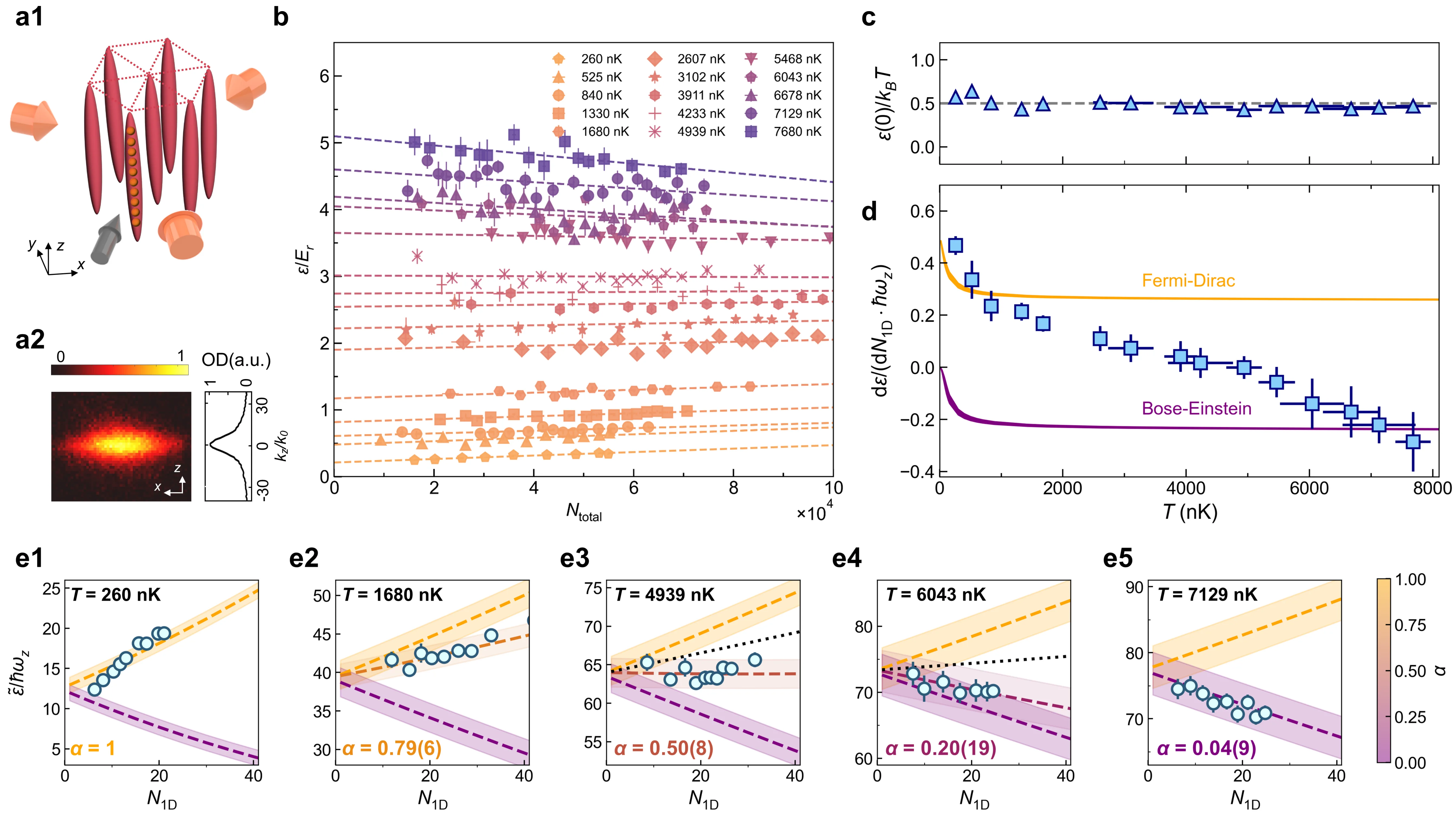
Un groupe de physiciens a pris un gaz quantique unidimensionnel d'atomes fortement interactifs et l'a transformé en ensemble thermodynamique anyonique. En une dimension, l'interaction dynamique entre particules peut être convertie en statistique — c'est une astuce mathématique bien connue. En faisant varier la force de répulsion et la température, les auteurs ont relevé l'équation d'état du gaz. Les graphiques ont montré des écarts nets par rapport aux statistiques de Bose–Einstein et de Fermi–Dirac.
Ces écarts se sont exactement superposés aux courbes de la statistique d'exclusion généralisée — cette version étendue du principe de Pauli. Des mesures supplémentaires de la pression et du contact de Tan ont confirmé le tableau. Les chercheurs ont désormais entre les mains une plateforme où la statistique des particules peut être réglée d'un simple tour de bouton.
Résumé original
tel que rédigé par les auteurs, en anglais arXiv:2606.19009
Anyons are quasiparticles with quantum statistics interpolating between those of bosons and fermions. Two distinct manifestations of anyonic behaviour have been theoretically established: fractional exchange statistics where particle exchange can produce any phase, and generalized exclusion statistics which extends the Pauli exclusion principle. While anyons exhibiting fractional exchange statistics have been observed in diverse platforms, experimental realizations of generalized exclusion statistics and direct measurements of its thermodynamic signatures have remained elusive. Here, we realize an anyonic thermodynamic ensemble obeying generalized exclusion statistics and detect its anyonic thermodynamics in a one-dimensional strongly interacting quantum gas. To achieve this, we exploit the bijective mapping between dynamical and statistical interactions in one dimension. By tuning interaction strength and temperature over a wide range, we measure the equation of state and identify clear departures from Bose-Einstein and Fermi-Dirac statistics. These deviations are quantitatively captured by generalized exclusion statistics, providing direct evidence for the generalized Pauli principle. Independent probes of other thermodynamic quantities including pressure and the Tan contact further validate this framework. Our results establish a versatile platform for engineering anyonic exclusion statistics and open the door to thermodynamic applications of anyons in quantum technologies.
Le monde unidimensionnel est bien plus accueillant pour les anyons : en deux ou trois dimensions, créer une telle statistique réglable par interaction est beaucoup plus difficile.