Земля как линза для поиска тёмной материи экспресс
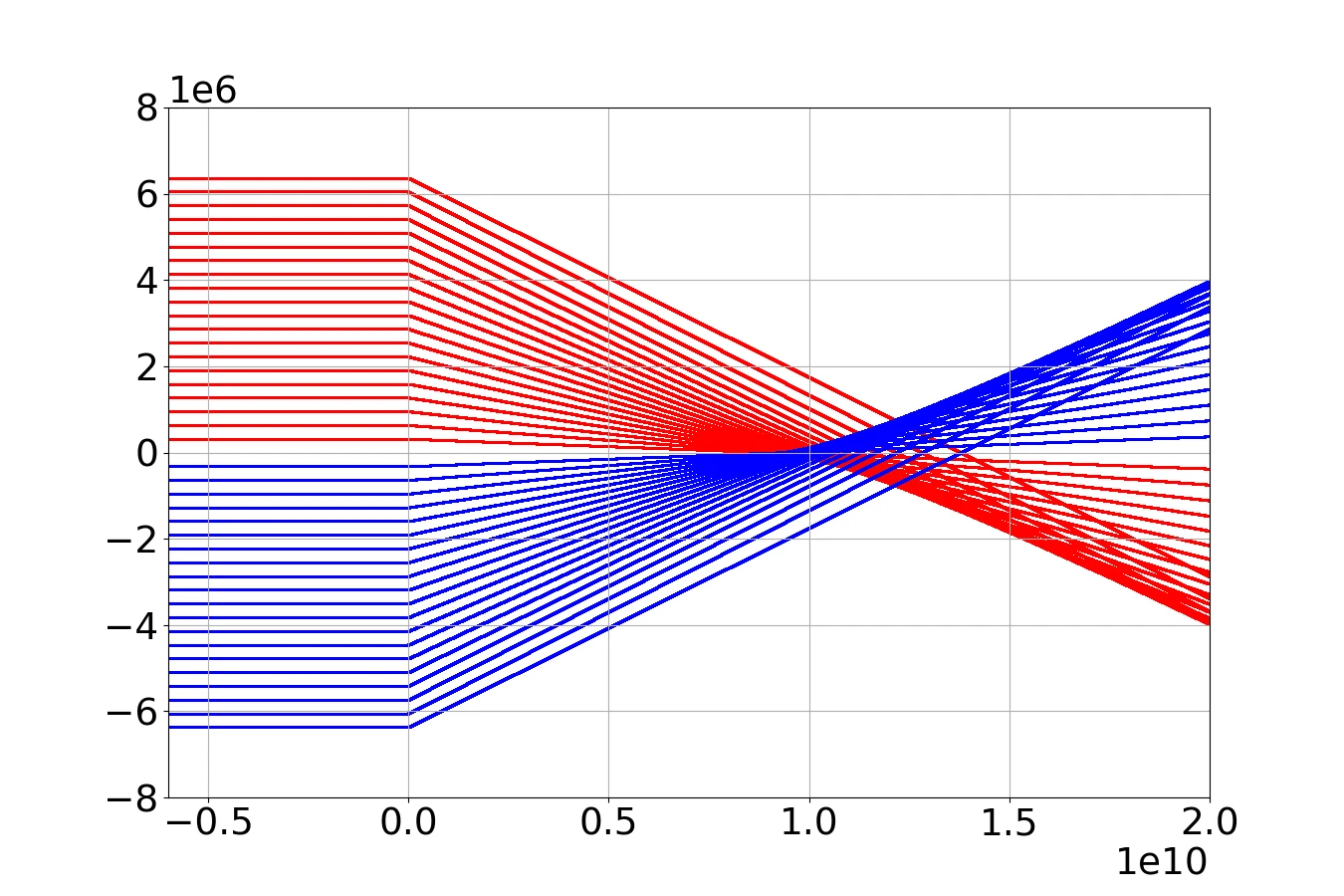
Тёмная материя — невидимая основа Вселенной. Вера Рубин доказала её существование по движению звёзд, но частицы до сих пор не пойманы. Новый метод превращает Землю в гигантскую гравитационную линзу: массивное тело, как показал Эйнштейн, искривляет пространство-время и фокусирует пролетающие частицы тёмной материи в точку за орбитой Плутона. Размер этой точки сравним с футбольным полем.
В фокус направляют мощный лазер. Если тёмная материя состоит из аксионов — сверхлёгких частиц вне Стандартной модели, — то луч заставляет их на миг становиться фотонами и отражать свет обратно. Так лазер, словно спичка, поджигает невидимый порох, и вспышку можно зарегистрировать.
Расчёты показывают: при скоростях около 520 км/с фокус находится в 9–14 миллиардах метров. Чувствительность такова, что сигнал можно уловить даже с противоположного края Галактики. Этот подход открывает путь к космической обсерватории для прямого детектирования тёмной материи.
Оригинальная аннотация
как её написали авторы, на английском arXiv:2510.27416
We propose a novel telescope concept based on Earth's gravitational lensing effect, optimized for the detection of distant dark matter sources, particularly axion-like particles (ALPs). When a unidirectional flux of dark matter passes through Earth at sufficiently high velocity, gravitational lensing can concentrate the flux at a distant focal region in space. Our method combines this lensing effect with stimulated backward reflection (SBR), arising from ALP decays that are induced by directing a coherent electromagnetic beam toward the focal point. The aim of this work is to numerically analyze the structure of the focal region and to develop a framework for estimating the sensitivity to ALP-photon coupling via this mechanism. Numerical calculations show that, assuming an average ALP velocity of 520,km/s -- as suggested by the observed stellar stream S1 -- the focal region extends from $$9 \times 10^9$$,m to $$1.4 \times 10^{10}$$,m, with peak density near $$9.6 \times 10^9$$,m. For a conservative point-like ALP source located approximately 8,kpc from the solar system, based on the S1 stream, the estimated sensitivity in the eV mass range reaches $$g/M = \mathcal{O}(10^{-22}),\mathrm{GeV}^{-1}$$. This concept thus opens a path toward a general-purpose, space-based ALP observatory that could, in principle, detect more distant sources -- well beyond $$\mathcal{O}(10),\mathrm{kpc}$$ -- provided that ALP-photon coupling is sufficiently strong, that is, $$M \ll M_\mathrm{Planck}$$.
Расстояние до гравитационного фокуса Земли примерно равно пути, который свет проходит за полминуты, — это дальше, чем Плутон, но всё ещё в пределах нашей Солнечной системы.