Radio Sky on Volunteers' Shoulders: How Citizen Science Teaches AI to See Complex Galaxies ✛
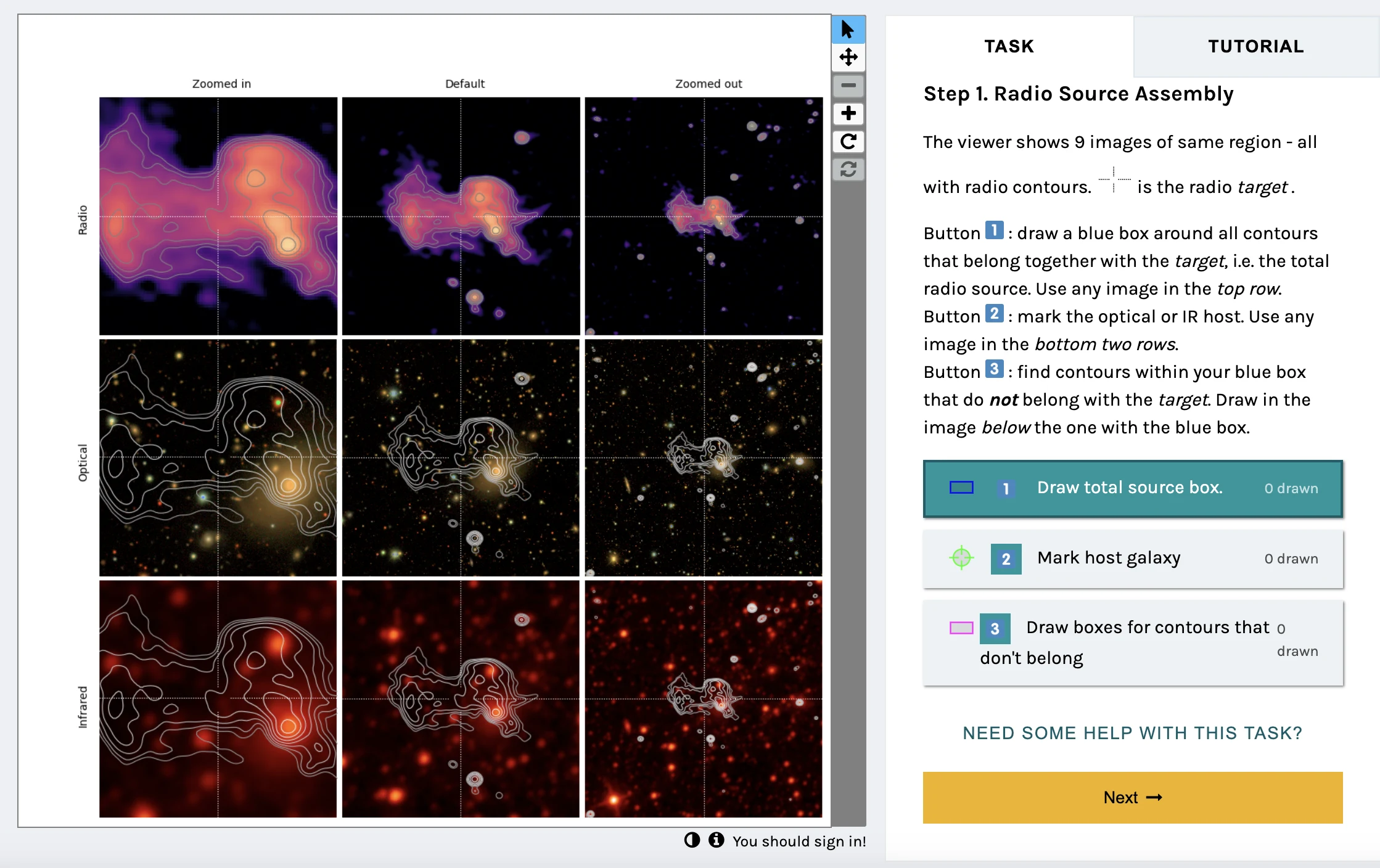
The ASKAP telescope collects data on millions of radio sources in a single night. Automated algorithms confidently identify compact points but struggle with extended structures featuring jets, bridges, and bubbles. Volunteers came to the rescue: in the first phase of the Radio Galaxy Zoo EMU project, more than 2500 people completed 97,000 classifications of 6230 complex objects.
The selection is based on the Kolmogorov measure: the worse an image compresses, the richer its internal structure. Angular size is added to ensure volunteers get the most interesting and largest objects. On the Zooniverse platform, volunteers mark connected components, find host galaxies, and assign simple tags like "hourglass," "bent," "host galaxy traces." These tags emerged from a semantic taxonomy: first, 22 morphological features were extracted from descriptions, then reduced to a set of about ten intuitive labels. This creates a shared vocabulary understandable to both humans and algorithms.
The hybrid approach provides what neighboring projects lacked: reference labels for training deep models. Previously, automated algorithms could not reliably recognize rare morphologies, and expert labels were scarce. Now there is a labeled corpus of 6230 extended sources with tags from thousands of volunteers. It can be reused across various tasks, from improving the EMUCAT catalog to preparing for the Square Kilometre Array.
Over the next five years, the project will expand to the entire EMU survey, covering about four million extended sources. Active learning will close the loop: models will propose the most informative objects for labeling, and new labels will improve the models. This cycle will serve as a testbed for reliable AI before the SKA launch, where data volumes will grow by orders of magnitude. Volunteers who started with simple tags will become co-authors of a tool that will one day work autonomously.
One of the classification tags is "hourglass": that is what radio galaxies with two symmetric lobes look like, resembling the figure used to measure time in antiquity.