A hybrid approach in quantum physics combines classical computational methods with quantum mechanical treatments to study systems that are too complex for a purely quantum simulation. This often involves treating a small quantum subsystem exactly while approximating the surrounding environment classically, or using classical algorithms to optimize quantum circuits.
In practice, a hybrid approach might use a classical computer to solve for the dynamics of a large environment, while a quantum computer handles the strongly correlated core. Alternatively, it can involve variational quantum eigensolvers (VQE), where a quantum processor prepares a trial state and a classical optimizer adjusts parameters to minimize energy. The classical and quantum parts iterate until convergence, leveraging the strengths of both.
In practice
Hybrid approaches are used in quantum chemistry to calculate molecular energies, in optimization problems for energy grids, and in simulating condensed matter systems where full quantum treatment is infeasible.
Fun fact
The term 'hybrid' in this context often refers to the 'holy grail' of quantum computing: using classical resources to mitigate the errors of noisy intermediate-scale quantum (NISQ) devices.
Quantum systems made of many particles are the basis of future computers and secure networks. But the more particles there are, the harder it is to understand how they are arranged: the number of possible states grows like an avalanche. The usual approach, measuring everything, takes an incredibly long time.
An ordinary random network is like a road map: to connect four cities with a complex interchange, you need to lay down many highways. In the quantum world, things are different.
A stone drops into a pond, and ripples spread across the water. In the same way, massive bodies generate gravitational waves, except it's space itself that ripples. So far, these waves have been caught by giant detectors that barely flinch as a wave passes through. But what happens on the microscopic scale, inside a tiny piece of matter?
Light escaping a massive body loses steam. Its frequency dips slightly, and its color shifts toward red. Physicists call this gravitational redshift. In classical theory, it's all clear, but the moment you bring quanta into the picture, trouble starts.
Previously, this shift was modeled as a kind of mode mixer — a device that entangles different states of light.
The Josephson junction is a bridge made of superconductor, separated by an ultra-thin insulating layer. Current flows through it even without voltage. But when the current becomes too large, the bridge starts to oscillate, and even steps, Shapiro steps, appear on the voltage graph. Between these steps hide invisible gaps where the system behaves strangely.
An electrical grid stuffed with power electronics resembles a huge orchestra without a conductor. Each converter, each line adds its own note, and sometimes the instruments start playing out of tune.
Space is not a void but a mosaic of tiny cells. In loop quantum gravity, spacetime curvature is transferred from a smooth sheet to a network of 'atoms' of volume — spin networks. Each node of such a network is a quantum of space, and the links between them are quanta of area.
But how does this mosaic change over time?
For a long time, identifying quantum phases was like interrogating a witness: you had to reach every corner of the system to uncover its secret. In the era of Landau, order was tied to symmetry breaking and a local parameter — everything plain as day.
Quantum devices are no longer lab curiosities. They are assembled, tuned, and repaired like ordinary hardware — except inside them, it's not just current but intricate tangles of particles that can exist in multiple states at once. Engineers draw schematics, programmers write code, physicists calculate effects.
In classical thermodynamics, heat engines are like a virtuoso musician on stage: the closer to perfection in performance (Carnot efficiency), the slower the tempo (power).
The Mpemba effect is a mystery where hot вода sometimes freezes faster than warm water. Usually this is attributed to how вода loses heat and энтропию (a measure of disorder). But in a glass of water, chaos prevents a precise model.
Physicists built a quantum model: a particle in a well with two depressions separated by a barrier.
The classical neuron is a chamber musician, drawing only one note from each string: it takes a weighted sum of inputs, adds a bias, and passes it through a nonlinearity.
Hybrid perovskites are the rising stars of photovoltaics: their efficiency is growing so fast it feels like we're on the brink of a solar revolution. But these materials, like intricate atomic mosaics, are extremely vulnerable — moisture, heat, and light quickly turn them to dust.
A quantum computer is like a finicky musical instrument: the slightest change in temperature, humidity, or string tuning, and the melody sounds different.
A translator who translates not words but the very structure of a conversation runs into trouble when the chat moves beyond a quiet room. In a familiar simulation on a spatial lattice, everything follows a strict script. But the moment the interlocutors find themselves in a noisy square, where sound is distorted by echoes and the crowd keeps changing direction, the script falls apart.
Quantum spin chains resemble a line of people passing along a secret handshake: each turns to a neighbor, and how firmly they clasp palms determines how the wave runs through the entire chain. In the ideal Heisenberg chain, quantum magnetism’s bedrock, all handshakes are equal.
Once Richard Feynman saw in quantum systems a challenge for classical computers. Now we face the inverse problem: understanding what exactly the quantum processor has simulated. Among the states it births are veritable 'black boxes'—topological phases of matter.
A network of tiny magnets seeks the state with the lowest total energy: that's roughly what the quantum Max Cut problem looks like, one of the toughest in physics. Scientists have been hunting for its solution since the days of Werner Heisenberg.
Strike a tuning fork with a mallet — it vibrates, and the sound gradually fades. A black hole behaves much the same way when disturbed: it emits gravitational waves — ripples in spacetime itself — and then settles down.
A neuron resembles an electrical circuit with batteries and variable resistors. The resistors are played by ion channels — protein pores in the membrane that open and close, letting charged particles through. Whether a nerve impulse fires depends on how fast and at what voltage these pores operate.
In the world of atoms and particles, everything tends toward rest: particles lose energy, just as a swing slows down due to energy loss (friction). But many devices — from hydrogen masers to atomic clocks — live by repetitive cycles.
Gravity seems simple: it keeps us on the ground and makes planets orbit. But if it were classical (described by Einstein's equations as the curvature of spacetime, while all matter follows the quantum laws of the Standard Model) then an ordinary quantum bit (qubit) falling freely…
In the scorching heart of a dying star, an invisible stream is born — a neutrino gas. The particles race through matter almost without stopping, but when their density is enormous, they start to feel each other. Old calculations described this as a jostle in a crowd: each shove changes direction, but no connection arises between passersby.
A quantum computer is like an orchestra: each musician plays their own part, but the slightest noise from the audience can throw off the whole ensemble. The particles that store information easily lose their coherence from thermal jolts or stray magnetic fields.
In the ocean of bank transactions, fraud is rarer than neutron stars in space, just 0.1% of all operations. A conventional detector gets used to the clean flow and loses vigilance.
Enter Q-SYNTH, a hybrid system with a quantum generator. It creates plausible fake transactions itself, drawing on scraps of real data.
Gravity is a cosmic net: massive bodies stretch it, and lighter objects roll along its curves. But in the world of atoms, this net begins to tremble chaotically, producing infinite values in the equations. Spacetime curvature ceases to be smooth.
Usually, quantum corrections to gravity explode into infinities.
Dip your finger into water once, and from that single sensation, try to guess its temperature. In the quantum world, such one-shot measurements happen all the time, except you have to guess invisible parameters: say, the squeezing strength of a laser beam.
In the kitchen, the sequence of actions is strictly dictated by the recipe: first chop, then fry, and nothing else. In quantum physics, the role of the recipe is played by causality — one event causes another, and they cannot be swapped. But in recent years, theorists have devised clever scenarios where the order of events seems to 'hang' in uncertainty.
The Universe's expansion is accelerating, and maybe gravity doesn't work the way we think. Physicists come up with alternative theories, but to test them, they need to calculate how ripples after the Big Bang grew into galaxies. Such calculations involve long equations with hundreds of terms, where it's easy to get lost.
A pot of water boils, and molecules break into a chaotic dance. You cannot stop that moment or freeze the dance, but in the quantum world there is a workaround: you can create a 'double' of the system that stores all the information about its thermal state.
Quantum computers promise to solve problems that regular computers can't. But where is the line? The authors of a new study stumbled upon a surprising case: electrons paired up behave like a well-behaved orchestra. Even if you add a bit of "magic"—a special quantum resource: their behavior remains predictable.
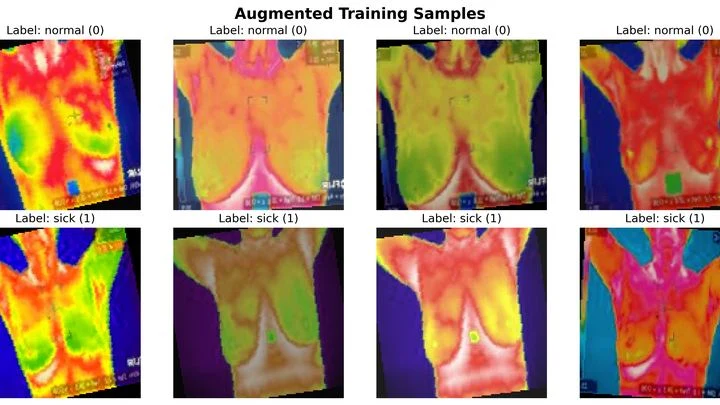
The hot air above asphalt shimmers, betraying the heated surface. Medical thermography works in a similar way: the skin over a tumor is often slightly warmer than healthy skin — by just fractions of a degree. Computer programs try to catch this difference and determine whether it's dangerous.
A crowd of people suddenly starts moving as one. In physics, this happens with atomic spins — tiny magnetic arrows. When many spins come together and interact through a shared medium, they form one big magnet, or a macrospin. This macrospin doesn't just point in one direction; it can get stuck in several positions, like an ice cube that refuses to melt even when it's warm.
A laser beam hits an atom, and an electron is knocked loose. It accelerates, returns, and, crashing into the atom, emits a flash of light — a harmonic. If there are two light beams and they are crossed like an intersection, the electron can choose different routes. In the new experiment, the two beams had comparable strength and were directed at right angles.
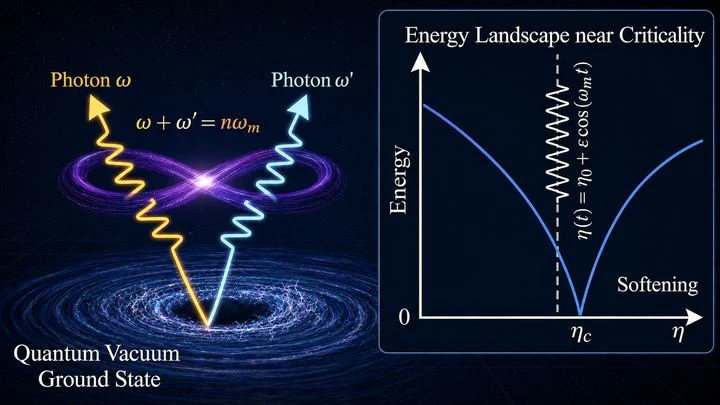
The quantum vacuum is not emptiness, but a tautly stretched string, where particles constantly appear and vanish. Abruptly changing conditions, like shifting the mirrors of a microcavity, causes the 'string' to emit real photons.
Inside an exploding star, neutrinos race so densely that they start to influence each other. Their quantum states become entangled, like threads in a tight ball where you can no longer tell which is which. Ordinary computers struggle with this task, as the number of possible states grows avalanche-like.
Quantum annealing works like a smart way to find a path through a maze: instead of checking every dead end, it uses quantum effects to find the exit faster. But this maze has a quirk: the numbers that describe the walls and corridors must be roughly the same size.
Magnetic monopoles are like halves of a magnet that cannot exist alone in ordinary materials. But in spin ice, they appear in pairs connected by an invisible thread — a Dirac string. Previously, such monopoles were only seen in artificial systems at room temperature, but their quantum motion remained a mystery.
Physical systems can compute. If you build a landscape of hills and valleys so that the lowest point corresponds to the answer, the system will roll there by itself, like a ball. The problem is that the bottom is often flat, and the ball crawls around for a long time before settling.
The authors propose nudging the ball to the right place before it even starts.
In a lab, you measure a very weak signal — say, a tiny change in a magnetic field. The instrument trembles from passing cars, from the experimenter's breathing, from wires heating up. This technical noise can't be fully eliminated, and it sets a limit on precision. An ordinary sensor works like a scale that sways with any draft.