The Radio Sky on Volunteers' Shoulders: How Citizen Science Teaches AI to Spot Complex Galaxies ✛
Context
A new generation of wide-field radio telescopes, such as ASKAP, collects data on millions of sources in a single night. Automated algorithms handle compact objects well but struggle with extended structures with peculiar morphologies: jets, bridges, bubbles. Around this problem, a whole research direction has formed: some groups search for technosignatures, others build maps of hundreds of thousands of galaxies with neural networks, and still others catch faint glows at the edges of clusters. RGZ EMU stands apart: it does not discover new sources but creates reference annotations, without which all those maps and searches would remain raw.
Methods
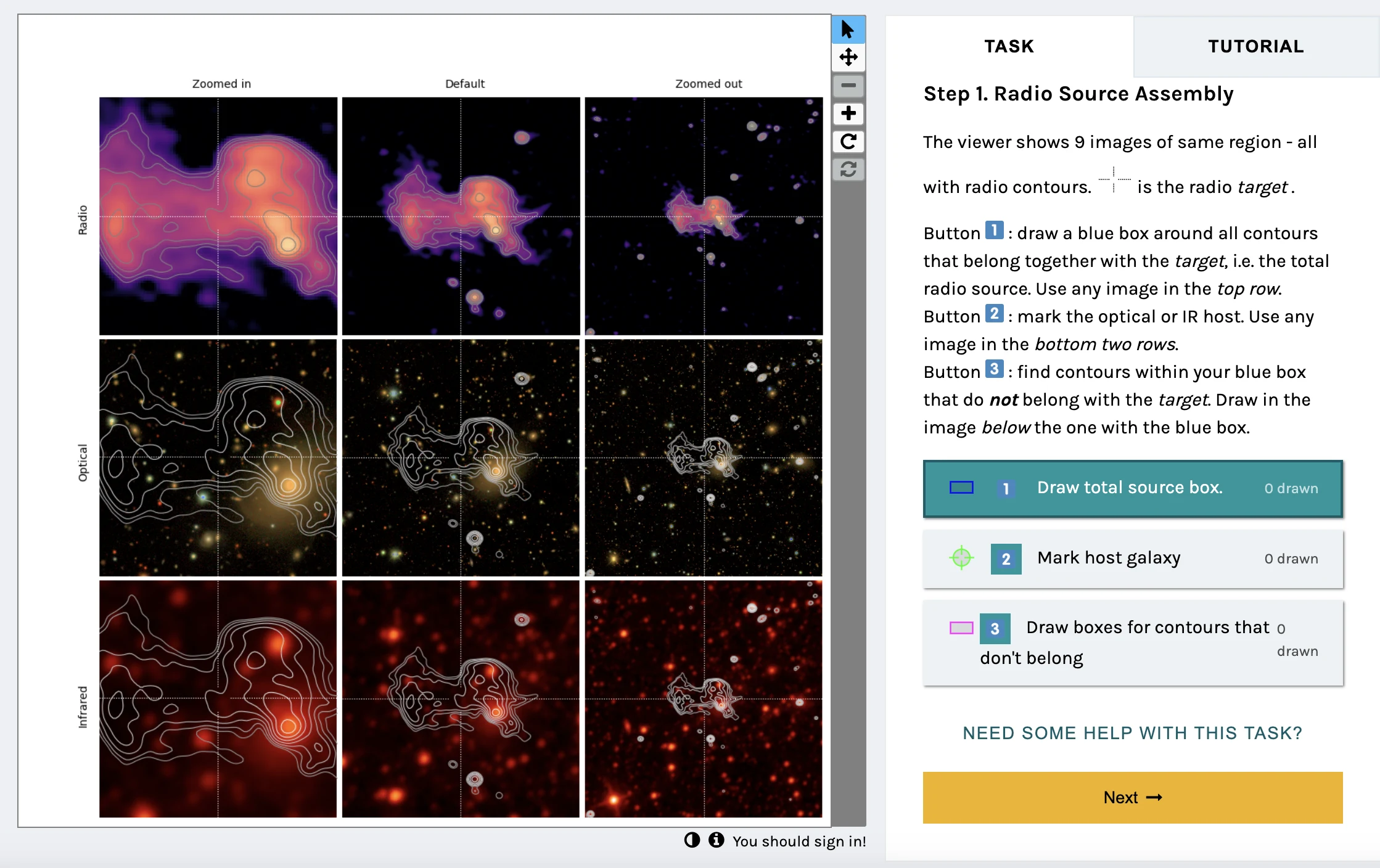
At the core is a hybrid pipeline where human and machine complement each other. First, sources with high morphological complexity are selected from the Selavy catalog, using a rough Kolmogorov measure that estimates how poorly an image compresses, that is, how rich its internal structure is. Then angular size is added to complexity, so volunteers get the most interesting and largest objects. On the Zooniverse platform, volunteers mark connected radio components, find host galaxies, and assign simple tags like "hourglass," "bent," "host galaxy traces." These tags emerged from a semantic taxonomy built with natural language processing: first, 22 morphological features were extracted from descriptions, then reduced to a set of about ten intuitive labels. This creates a common vocabulary understandable to both humans and algorithms.
Results
In the first phase, more than 2500 volunteers completed about 97,000 classifications. Preliminary analysis shows that collective volunteer accuracy approaches expert consensus once a sufficient number of independent answers is gathered. This aligns with earlier Galaxy Zoo results and confirms the suitability of "golden samples" for training models. Particularly valuable are rare and ambiguous sources, where automated pipelines often err. Multilingual deployment (Greek, Chinese, Urdu, Japanese) underscores the project's openness and expands the participant pool.
Implications
This work provides reference annotations for training deep models, something neighboring projects lacked, as they relied either on pure automation or limited expert samples. The difference from closest neighbors lies in scale and systematicity: here we do not search for alien signals or build maps with a single algorithm, but create an annotated corpus that can be reused across various tasks. This is the first test of the hybrid approach on real EMU data, where source complexity is higher than in previous surveys.
Future development
Over the next five years, the project will expand to the entire EMU survey, covering about four million extended sources. Active learning will close the loop: models will propose the most informative objects for annotation, and new annotations will improve the models. Such a cycle will serve as a testbed for reliable AI before the Square Kilometre Array, where data volumes will grow by orders of magnitude.
Impact
The results will directly affect the EMUCAT catalog and preparation for SKA, as well as multi-wavelength studies with POSSUM, WALLABY, PEGASUS, and Euclid surveys.
Next steps
Scaling to the full EMU, integrating active learning, and releasing the first version of the catalog with hybrid classifications.
Key open problems
For radio astronomy, the question remains open: how to automatically recognize rare morphologies without bias in the training sample. Citizen science offers a way to gather diverse examples but does not solve the bias problem: volunteers also prefer bright and unusual objects. The long-term challenge is to understand where human intuition is irreplaceable and where algorithms already surpass it.
The knowledge machine's view
This section is addressed to the author of the paper and their colleagues. Neighbouring works were found by meaning-based search across our archive, not by word overlap. We do not review: we show the field around the work.
What the work does
This work describes the Radio Galaxy Zoo EMU project: crowdsourced annotation of 6230 complex radio sources from the EMU survey by 2500 volunteers, who performed about 97,000 classifications. A hybrid approach was used: automatic selection based on morphological complexity (Kolmogorov measure) and angular size, followed by manual annotation on the Zooniverse platform with tags from a semantic taxonomy built using NLP methods. The result will be the open catalog EMUCAT and training data for models preparing for the SKA era.
Where its strength is
The strength of the work lies in creating a benchmark annotated corpus for complex extended radio sources, obtained through a consistent tag vocabulary understandable to both humans and algorithms. The scale and systematic approach provide a foundation for training deep models where automatic pipelines often fail.
Where it could go next
- It might be interesting to compare the obtained annotations with the results of automatic classification described in the work where a neural network, without hints, discovers new galaxies: this would allow assessing how models trained on RGZ EMU data improve the detection of rare morphologies.based on: Neural Network Discovers New Galaxies Without Any Guidance arXiv:2511.05439
- Related work includes a neural network that mapped 639,000 galaxies: one could try using the annotated RGZ EMU sources as an additional training set to improve the quality of maps of extended structures.based on: Neural Network Drew Maps of 639,000 Galaxies arXiv:2606.16507
- In the archive, there is a full analysis of who hides in the radio light of galaxies: it discusses the connection between morphology and source physics, and your tags could help interpret such connections for the EMU sample.based on: Radio Map of Three Galaxies: Compact Sources Versus Diffuse Background arXiv:2507.23332
Worth trying
- Test how well the tags from the semantic taxonomy correlate with physical source parameters (e.g., redshift, power) using the catalog from the full analysis.
- Train a model on current annotations and compare its predictions with volunteer consensus on new data to assess accuracy gains.
- Use the NLP approach to automatically expand the taxonomy based on volunteer descriptions of rare sources.
Why this may matter
Benchmark annotations of complex radio sources are critical for preparing for the SKA data stream, where manual inspection of every object will become impossible. The open RGZ EMU corpus could become the standard for training and validating classification algorithms, improving the reliability of automatic catalogs and freeing experts to analyze truly unusual objects.
Nearby works in our archive
- Neural Network Drew Maps of 639,000 Galaxiessimilarity 0.52
- Five Thousand Giants on the Radio Skysimilarity 0.51
- Gravitational Sirens: Where to Find the Key to the Dark Universesimilarity 0.50
- Cosmos Trained to Predictsimilarity 0.50
- Light from Distant Galaxies: How to Tell the Quiet from the Wildsimilarity 0.50
- Neural Network Discovers New Galaxies Without Any Guidancesimilarity 0.49
- Radio Map of Three Galaxies: Compact Sources Versus Diffuse Backgroundsimilarity 0.49
The archive is sparse around this work: the closest review is only 0.52, against a usual 0.64. It looks like few have drilled nearby.
One of the classification tags is "hourglass": that is what radio galaxies with two symmetric lobes look like, resembling the figure used to measure time in antiquity.
Key numbers
- number of classifications: 97,000
- number of volunteers: more than 2500
- Phase I sample size: 6230 extended sources
- EMU-PS survey sensitivity: 25–30 μJy/beam
- angular resolution: 11–18 arcseconds