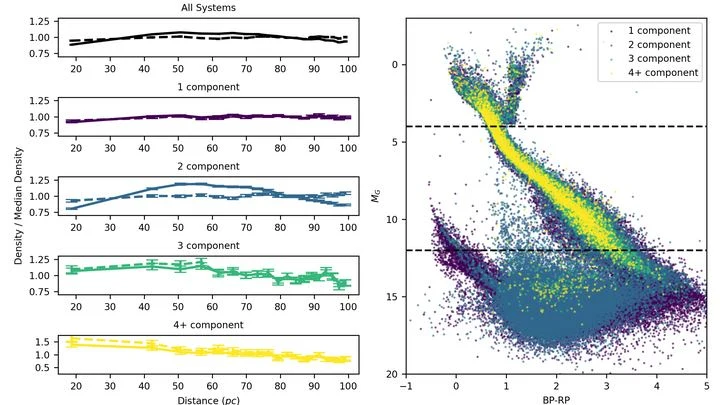
The Gaiatelescope is a space observatory launched by the European Space Agency in 2013, designed to measure the positions, distances, and motions of over a billion stars in the Milky Way with unprecedented precision. Its primary goal is to create the most accurate three-dimensional map of our galaxy, revealing its structure, dynamics, and evolutionary history. By repeatedly scanning the sky, Gaia measures stellar parallax — the apparent shift in a star's position due to Earth's orbit — which allows astronomers to calculate distances directly, and it tracks proper motions to see how stars move across the sky over time.
History
Gaia was launched on December 19, 2013, as a successor to the Hipparcos mission (1989–1993), which measured about 100,000 stars. The mission was proposed in the 1990s and developed over two decades, with its first data release in 2016 and subsequent releases in 2018 and 2022.
How it works
Gaia sits at the L2 Lagrange point, about 1.5 million kilometers from Earth, where it rotates slowly and scans the sky with two identical telescopes pointing in different directions. As it spins, it captures light from stars onto a billion-pixel camera, recording their positions, brightness, and spectra. The key to its precision is repeated observation: each star is measured about 70 times over the mission, and the tiny changes in position are used to compute parallax and proper motion. The data is then processed on the ground, where complex astrometric and photometric algorithms convert raw measurements into a catalog of stellar properties.
In practice
Gaia's data is used to study the structure of the Milky Way, discover brown dwarfs and exoplanets, test theories of stellar evolution, and even measure the gravitational influence of dark matter on stellar motions.
Fun fact
Gaia is so precise that it can measure the width of a human hair at a distance of 1,000 kilometers, and its data has revealed the 'Gaia sausage' — a stream of stars that are the remnants of a dwarf galaxy that merged with the Milky Way billions of years ago.
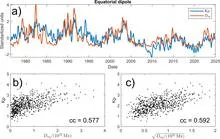
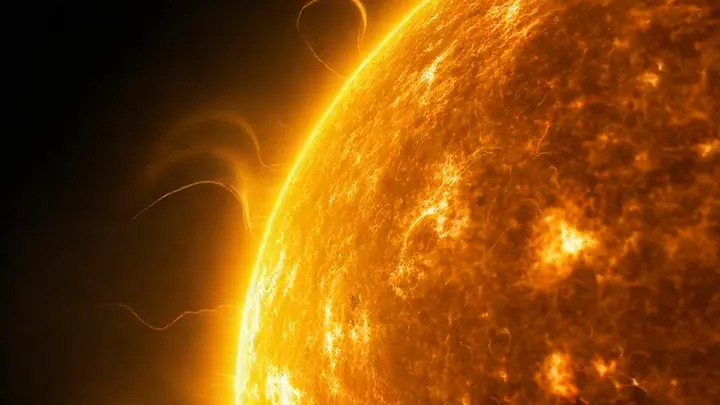
The Sun breathes, and that breath has a magnetic rhythm. Every 27 days, the visible surface of the star makes a full rotation, and with it, its magnetic field, like an invisible ribbon wrapped around the star.
From 1987 to 1991, astronomers last measured how Jupiter's icy moons reflect radio waves. Then came a long pause. In 2011–2024, researchers aimed a radar beam at Europa again: this time using the 70-meter antenna at Goldstone and the Green Bank Telescope.
Ice is nearly transparent to radio waves, like clear window glass is to light.
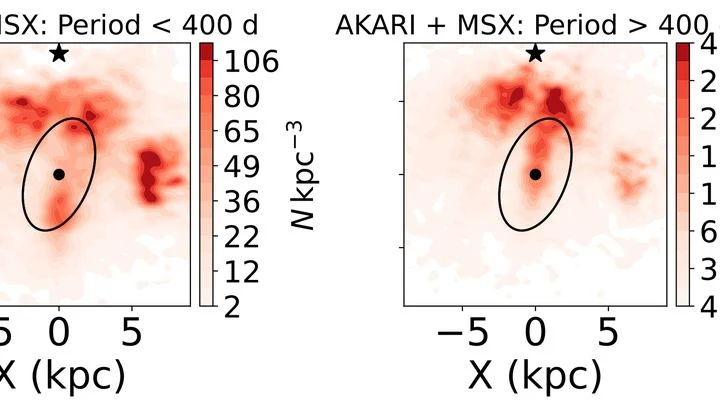
Red giants in the center of the Milky Way resemble distant lighthouses that brighten and dim. Their light pierces through dense dust, but standard distance-measuring methods fail here: the stars are too bright and unstable, and dust distorts the picture.
Astronomers found a workaround.
The calm surface of a lake suddenly ripples — somewhere in the depths, an underwater cliff has collapsed. The water trembles almost imperceptibly, and the circles spread wider and wider until they reach a bobber near the shore.
At the very heart of the Milky Way, stars whirl around an invisible supermassive black hole. One of them, S301, completes an orbit in just 8.7 years. Its path is a highly squashed ellipse: sometimes it grazes the black hole, sometimes it shoots far away. At closest approach, the distance to the black hole is tiny by cosmic standards.
The hunter of ancient light, the James Webb Telescope, aimed its mirrors at a tiny patch of sky and caught a strange beacon. The object, with the working name beacon_1420-$$5253_{4770}$$, flashed and faded. At first, it was logged as a candidate for the most distant galaxy, as if we were seeing it just 300 million years after the big bang.
15 175 107 stars. Each one got an age. But no number is free of uncertainty: a star's age isn't a nail hammered into the timeline: it's a probability cloud, a fog hiding the true value. For galactic evolution, such a timestamp is priceless: without it, the map of the Milky Way remains flat.
The universe sounds with silence. The lion's share of matter — about 85%—remains invisible, manifesting only through gravity. Back when Vera Rubin Vera Rubin showed that galaxies spin as if wrapped in unseen mass.
The light of a distant star is no perfect beacon. Passing through the gravitational field of another star, it bends, splits, and magnifies, creating a fleeting Einstein ring in the sky. This is how gravitational microlensing manifests, predicted by Fritz Zwicky back in the 1930s.
The standard cosmological model ΛCDM, where dark matter and dark energy act as the chief architects of the cosmos, has predicted astronomical data with Swiss-watch precision for decades. Its foundation was laid by three geniuses.
The search for extraterrestrial intelligence is like panning for gold in an endless river. For decades, SETI has been listening to the hum of the Galaxy, but the ether is silent. It’s not about antenna sensitivity — it’s that we don’t know where to dip our pan.
Two beams of light race around a closed loop, heading toward each other. Since the speed of light is constant, when the ring turns, one beam has to catch up with a moving finish line, while the other meets it sooner. Their meeting creates a pattern, and from that pattern we can tell how fast the whole system is spinning.
A lighthouse blinks steadily once per second. If it moves in a circle, its flashes arrive sometimes a bit early, sometimes a bit late, and they give away an invisible companion. That's exactly how astronomers exposed the hidden partner of the star IY Lyrae.
IY Lyrae is a pulsating variable star in the thick disk of the Galaxy.
Imagine a dark room with dust floating in the air. A bright flashlight goes off, and the dust particles light up, revealing their positions. Astronomers have applied a similar trick to our Galaxy. The flashlights were gamma-ray bursts, the most powerful explosions in distant galaxies, and the dust particles were interstellar clouds.
At the very heart of the Milky Way, something is continuously glowing in gamma rays. This light is special: its energy is exactly 511 thousand electronvolts. Such energy is produced when an electron meets its antimatter counterpart, a positron, and they annihilate, leaving behind a flash of light.
A lighthouse blinks every few seconds, but then begins to slowly brighten and dim over the course of a year. That is exactly what about a third of red giants do — huge stars in the late stages of life. Their normal pulsations take days or weeks, but on top of that, long secondary periods are visible: months and years.
A massive star's explosion is bright but brief. The flash itself lasts weeks, but the dust it heats around it glows in infrared for years. It's like a camera flash illuminating a room, then hot dust particles lingering in the air — only on a cosmic scale.
At night, a distant streetlamp seems motionless, but if you walk closer and look carefully, you might notice it swaying slightly in the wind. That's roughly how astronomers hunt for planets around other stars: they measure how a star shifts ever so slightly under the gravitational tug of its invisible companions.
When a massive star dies, a supernova explosion occurs, so powerful that a single flash outshines an entire galaxy. In this fire, billions of axions are born — invisible particles that leave almost no trace. Every second, trillions of these tiny things fly right through each of us, completely unnoticed.
Like a river that suddenly disappears underground, the Perseus Arm in the Milky Way breaks off in a region astronomers call the Giraffe Bay. Where the bright band of stars should continue, a dark 'void' is visible.
The Milky Way and the Andromeda Galaxy are like two vast flocks of birds drawing together in the celestial expanse. New data from the Gaia telescope shows: Andromeda barely deviates sideways. The chance of their merger is a whopping 90%. Even the gentlest crosswind could steer their paths apart, but calculations say: it’s almost nonexistent.
For a long time, the Universe was seen as a strict baker: it was thought that in every corner, stars were mixed from the same recipe — for each giant star, there were roughly the same number of dwarfs, no matter where they were born.
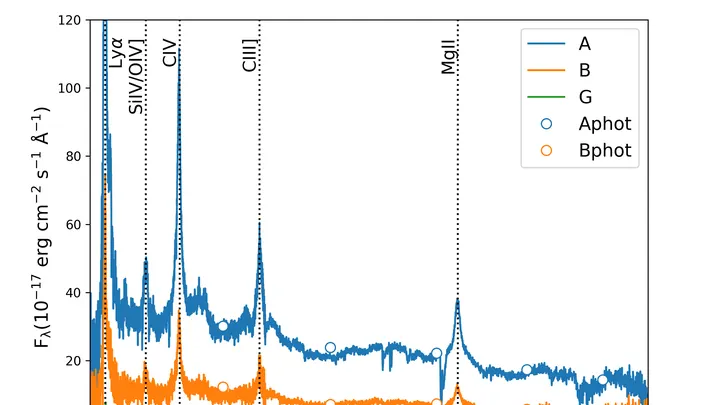
Light from a distant galaxy traveled to us for 13.4 billion years. The James Webb Space Telescope caught it and split it into colors. The spectrum shows a bright hydrogen line, like a fingerprint saying that galaxy GS-z13-1-LA is actively forming stars.
Young hot stars inside the galaxy act like floodlights.
The Gaia space telescope measures star positions with an accuracy of a microarcsecond, like spotting a coin on the Moon from Earth. In 2022, it noticed that the bright star HD 12800 was wobbling slightly, as if tugged by an invisible companion. Astronomers hypothesized that a planet orbits the star.
But a wobble can be deceiving.
In a constellation where new stars are born, one of them behaves like a faulty lightbulb: sometimes shining steadily, sometimes dimming by a factor of several. Astronomers have been monitoring the star Gaia-GIC-1 for several years and now understand that its blinking is the shadow of a huge dust cloud that periodically passes in front of it.
The night sky is no longer as quiet as it used to be. Thousands of satellites are whizzing overhead, and each one can accidentally emit radio waves, interfering with astronomers trying to listen to distant galaxies. To make sense of this noise, scientists pointed the 21CMA radio telescope in China at Starlink satellite passes.
The light of every star is its unique passport, but the entries are written in the language of spectra and colors. For old giants, such documents are almost indistinguishable: their spectra overlap, and deciphering the details by hand was practically impossible.
When two galaxies collide, their central black holes begin a long dance of approach. Until they merge into one, we can see a pair of quasars — bright beacons that ignite as the black holes consume gas and dust. Such pairs in the sky are like two lighthouses standing close together, each shining from its own harbor.
Two spotlights placed side by side: from a distance, their light blends into one patch, and it seems there's a single source. The same happens in space: about 10–20% of faint stars are actually close pairs of identical stars. Individually, they can't be resolved, but together they shine noticeably brighter than a single star with the same parameters.
An aging star sheds its outer layers, leaving behind a dense, hot core the size of Earth — a white dwarf. If remnants of planets, asteroids, or comets orbit nearby, they heat up and begin to glow in the infrared. That extra light is like a warm spot on a cold floor.
An X-ray telescope captures light from hot gas around stars, but that light arrives 'blurred'—like a voice over a bad phone line. To make out the words, you need a dictionary of the exact frequencies at which atoms glow. Such a dictionary is written not only with calculations but also with direct experiments.
Light from the hottest young stars usually cannot leave its galaxy: hydrogen absorbs it, like a thick curtain blocking a sunbeam. But sometimes the curtain parts, and ultraviolet photons burst into intergalactic space.
The scorching gas streaming from the Sun is not a continuous flow but rather a soup of charged particles. In this soup, waves constantly boil up: electric fields flare and fade like ripples on water from a tossed stone. One such wave is the ion-ion acoustic wave.
A laser hits tissue, and the tissue responds with a barely audible click — a sound wave. Sensors pick it up, and from that, an image of what's inside is built. That's how photoacoustic imaging works: light reaches deep, and sound carries the picture out.
In the new scheme, there are no sensors. Instead, several thin light beams are sent through the area where the wave has passed.
Sun-like stars rarely spin alone. Many of them dance with invisible partners — brown dwarfs: objects bigger than planets but too lightweight for steady stellar burning. In their cores, hydrogen fusion flickers, only to fade fast, never matching the stability of the Sun.
The night sky looks like a scattering of identical sparks. But hidden among them are true giants — red supergiants. These stars are hundreds of times wider than the Sun and shine so brightly that they can be seen from enormous distances. You'd think there'd be no better beacons for a map of the galaxy.
Light from quasar PS J2305+3714 has been traveling toward us for more than eleven billion years. On its way, it passes near a massive galaxy whose gravity bends its path, like a heavy ball denting a stretched sheet. Through a telescope, we see not one quasar but two images — two points of light that are actually the same distant object.
A bus schedule drifts: if you don't check it, you'll miss your ride. Planets around other stars have the same problem – their crossings of the star's disk gradually shift. The ExoClock project pooled 30,000 observations from Earth and space to refine the schedule for 620 distant worlds. For 45% of the planets, transits were found to be off by hours.
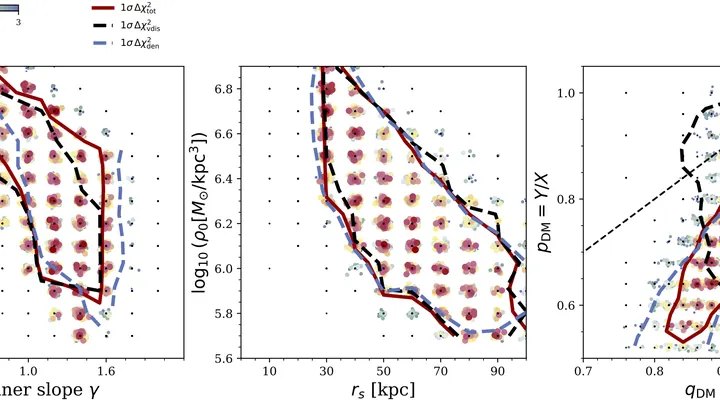
The Milky Way's stellar disk is like a glowing pinwheel, and тёмное вещество is an invisible cloud around it. For the first time, its shape has been precisely measured. Astronomers tracked the motions of millions of stars and built a 3D map of the тёмное гало out to 160,000 light-years.
The ASKAP telescope collects data on millions of radio sources in a single night. Automated algorithms confidently identify compact points but struggle with extended structures featuring jets, bridges, and bubbles.