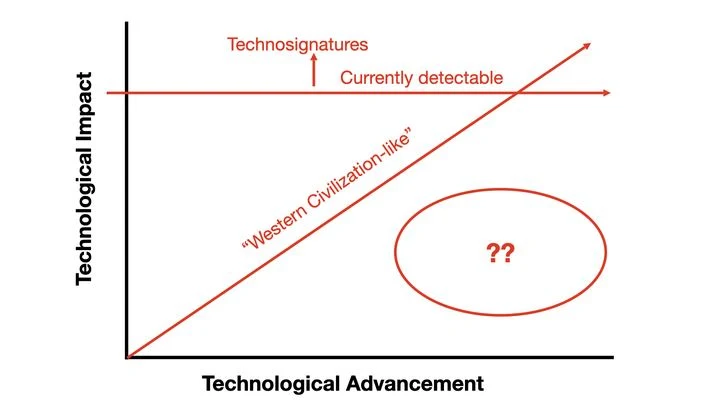
Technosignature search is the scientific endeavor to find evidence of advanced extraterrestrial civilizations by looking for signs of their technology. Unlike biosignatures, which indicate life, technosignatures point to intelligent, technology-using beings. These can range from radio signals and laser pulses to more exotic artifacts like Dyson spheres, which are hypothetical megastructures that harvest a star's energy, or even pollution in an exoplanet's atmosphere.
History
The modern scientific search began with Frank Drake's Project Ozma in 1960, which listened for radio signals from two nearby stars. The term 'technosignature' gained popularity in the 2000s, broadening the scope beyond radio to include any detectable sign of technology.
How it works
The search employs a variety of methods. Radio telescopes scan the sky for narrow-band signals that are unlikely to occur naturally. Optical telescopes look for brief, intense laser pulses. Other approaches involve analyzing the light from stars for unusual dimming patterns that might indicate a large structure passing in front, or examining the chemical composition of exoplanet atmospheres for industrial pollutants like chlorofluorocarbons. The key is to distinguish these signals from natural astrophysical phenomena.
In practice
This field drives the development of advanced data analysis techniques and observational strategies, and it informs the design of future telescopes and space missions that could detect such signatures.
Fun fact
In 2017, astronomers detected an interstellar object, 'Oumuamua, whose unusual acceleration and shape led some to speculate it might be an alien artifact, though no conclusive evidence of a technosignature was found.
A telescope stares at a star for many nights in a row. Somewhere in the stream of light hides a tiny dip in brightness — an Earth-sized planet briefly blocking part of the star. Such a dip lasts a few hours and repeats once a year or less. Catching it is like hearing a single quiet click in a noisy hall.
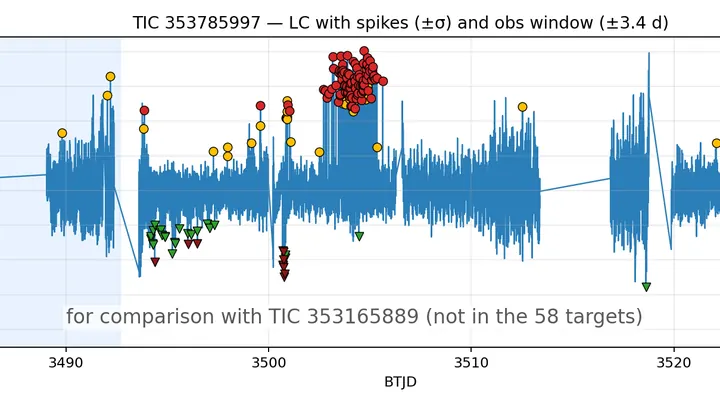
A star wrapped in an invisible blanket warms up more than it should. That's exactly how ten red dwarfs look, which astronomers from the Hephaistos project have been monitoring. These stars lie within 300 parsecs (about 1000 light-years) of us and emit far more infrared energy than their modest sizes can explain.
The light of a distant star carries within it the silent hum of the atmospheres of planets orbiting it. For a long time, capturing it was like trying to make out a whisper over a roaring waterfall. But with the advent of the 39-meter Extremely Large Telescope (ELT) and the ANDES spectrograph with a resolution of 100,000, this task is no longer hopeless.
In 1960, the Tatel radio telescope spent weeks listening to emptiness around Tau Ceti and Epsilon Eridani. Project Ozma was searching for technosignatures — traces of another mind at work.
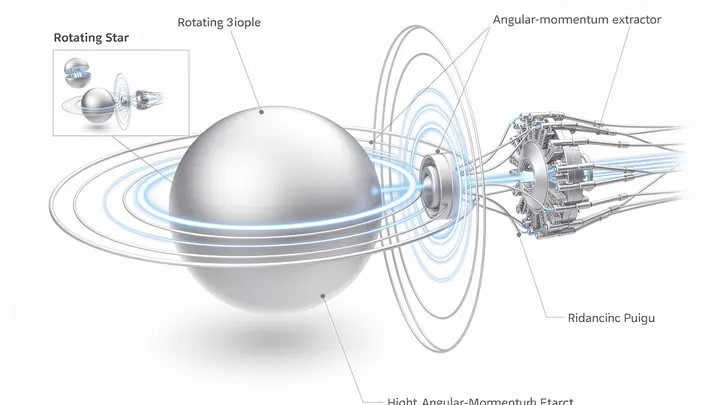
For decades, SETI has hunted for Dyson spheres — hypothetical shells that capture a star's light stars and re-radiate it in the infrared. But the cosmos remains silent. Perhaps an alien intelligence operates more elegantly: instead of collecting light, it tames the rotation of a sun, like a giant flywheel.
Imagine an artist whose canvas is an entire planet, and whose palette is molecules drinking starlight. His brush is billions of years of evolution, and his painting is a spectral portrait visible even from another star system.
Every star is a living archive, and its spectrum a multilayered manuscript. Over billions of years, the history of the galaxy is written into it: the galactic chemical evolution of the Milky Way leaves a smooth trace in elemental abundances.
3I/ATLAS burst into the Solar System like an uninvited guest, a gift of fate for hunters of extraterrestrial intelligence. This comet-like wanderer from the depths of the Galaxy flew close enough to be heard in all its details — unlike distant exoplanets.
The Drake Equation is an attempt to guess the number of intelligent civilizations in our Galaxy. It’s like counting finished cakes in an unknown bakery: you know the ovens (stars), the baking sheets (planets), and the baking time. But were eggs added to the batter? Western science, relying on a single earthly recipe, considers them a rare ingredient.
The Moon is a natural archive that has been collecting cosmic dust for billions of years. Among the microscopic grains that arrived from distant stars, there could be techno-specks — particles created by alien civilizations.
From childhood, we're used to thinking of space as infinite and isotropic. But Einstein and Lemaître were already asking: could the Universe be closed in on itself, like a Möbius strip or a 3-torus?
Think of a baby mobile: figurines dangling on threads, twitching at even a whisper of breeze. In the same way, planets on very wide orbits barely cling to their star's gravity, and they feel the faintest gravitational drafts. Astronomers have proposed turning such planets into detectors of dark matter.
Civilizations in the Universe are separated not just by distance, but by the vast gulf of time. Hunting for their traces is like archaeology: instead of palace ruins, we find clouds of cosmic dust.
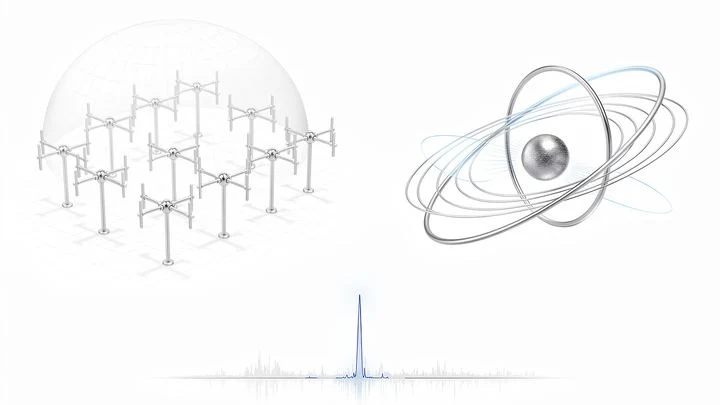
Listening to the cosmos requires patience and a finely tuned ear. Astronomers chose the most sensitive low-frequency instrument for this: the OVRO–LWA antenna array — 352 dipole antennas scattered across two and a half kilometers of California desert.
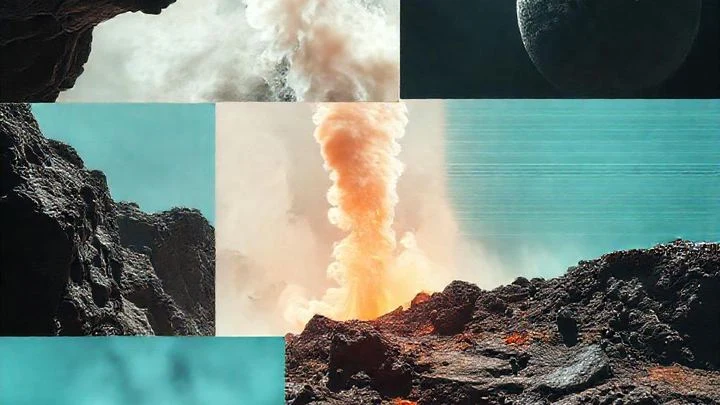
The search for extraterrestrial life is like a detective investigation: from tiny clues, you must distinguish traces of life from random imprints of non-living nature. On Saturn's moon Enceladus, the investigators are lucky — geysers burst from cracks in the icy crust, ejecting water from the subsurface ocean straight into space.
When the light of a distant planet is split into colors, it suddenly jumps at the boundary between red and invisible infrared, as if someone flipped a switch. This is how the vegetation red edge manifests itself: chlorophyll is transparent to near-infrared radiation, and the leaf, to avoid overheating, reflects it away.
The smell of fresh bread unmistakably signals a nearby bakery. But to know if baking is happening right now, it's better to catch not the aroma itself but its intensification — the continuous stream of hot air from the oven. This everyday analogy helps grasp a revolution in the search for extraterrestrial life on exoplanets — planets beyond our solar system.
A swarm of mirrors and antennas envelops a black hole like bees around a hive. But instead of honey, this structure collects energy enough to power a consciousness the size of a galaxy. These very 'Dyson minds' were the topic of a recent meeting at MIT. The idea traces back to [scientist:F. J.
Imagine a tiny coin hidden inside a perfect safe, but the walls are so thin that the coin sometimes slips right through, leaving a barely audible sound. Axions are like those coins — except instead of metal, they're particles, and instead of a safe, they're ordinary matter. They barely notice obstacles, making them incredibly hard to catch directly.
Astronomers occasionally spot interstellar objects — rocky chunks or comets from other star systems. Most look ordinary, but some puzzle us with their shape, speed, or shine. To stop guessing, scientists applied the Loeb scale: from 0 (plain rock) to 5 (technosignature — an artificial signal from space).
The fate of a civilization isn't just a matter of luck or disasters. Scientists simulated a thousand years of history under ten different scenarios, accounting for resource consumption, governance, and random shocks. The key metric turned out to be the 'activity coefficient' – the fraction of time when a civilization is technologically alive. At best, this fraction nears 100%; at worst, it drops to 38%.
Imagine you and your friends are in a dark room. You agree that after a common flash, each of you will turn on a flashlight ten seconds later, but with a correction for the light delay — since the light from the flash reaches each of you with a slight lag.
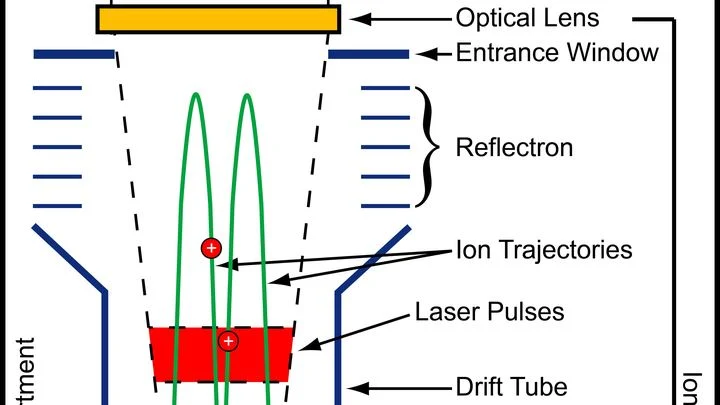
A chemical detective searches for life on other planets. Its tool is a mass spectrometer that identifies molecules by weight (the same device earthly forensic scientists use to analyze clues).
If you build a giant blanket around a star, you get a Dyson sphere. It absorbs all the radiation and glows in invisible heat rays. No such sphere has been seen yet, but astronomers know: to find it, look for this thermal glow.
The night sky is dotted with stars, and many of them have planets. But how do you spot a tiny dark disk against the glare of a distant sun? The Kepler telescope spent nine years watching hundreds of thousands of stars, waiting for a planet to pass in front of its star and briefly dim it. That 'wink' is the only way to find worlds like ours.
To spot life on other planets, you don't necessarily need to search for oxygen in the air. Living beings paint the surfaces of their worlds: Earth's plants in green, bacteria in purple. The future HWO space telescope will capture these "paints of life" on exoplanets.
The galaxy is like a city at night: most windows shine steadily, but sometimes a skyscraper lights up all its lights and then goes dark. Just like that, according to a new hypothesis about planets around alien stars (exoplanet), we might first notice another civilization — by a short but blinding flash that could mark its demise.
A bus schedule drifts: if you don't check it, you'll miss your ride. Planets around other stars have the same problem – their crossings of the star's disk gradually shift. The ExoClock project pooled 30,000 observations from Earth and space to refine the schedule for 620 distant worlds. For 45% of the planets, transits were found to be off by hours.
The James Webb Space Telescope gathered thousands of spectra from distant galaxies — colorful fingerprints of their light. To avoid drowning in this diversity, astronomers tasked a program with sorting through the finds.
The chemical composition of a sample is like a soundscape. A living forest sounds polyphonic: chirping, rustles, the hum of insects. A barren desert is just the whistle of the wind.
Back in the 18th century, William Herschel was searching for life on Mars. Today, astronomers are targeting not planets but artifacts — for example, alien probes lurking in the Solar System. The problem is that spotting a tiny object next to the blinding Sun is nearly impossible.
The ASKAP telescope collects data on millions of radio sources in a single night. Automated algorithms confidently identify compact points but struggle with extended structures featuring jets, bridges, and bubbles.
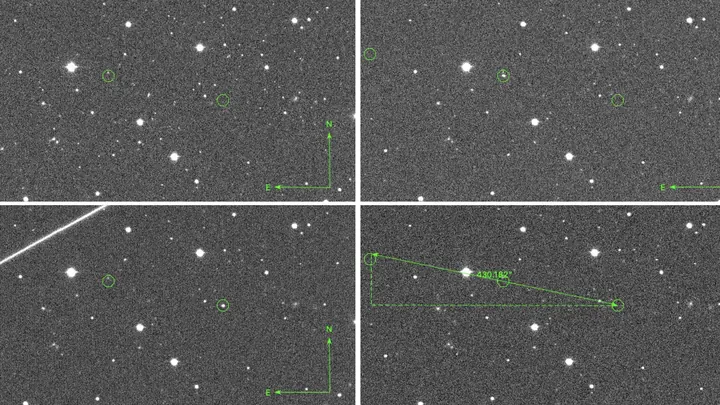
In October 2017, the Pan-STARRS telescope in Hawaii spotted an object moving too fast to belong to the solar system. It was 1I/ʻOumuamua, the first interstellar visitor ever recorded by astronomers. Since then, two more have joined it: comet 2I/Borisov and object 3I/ATLAS.