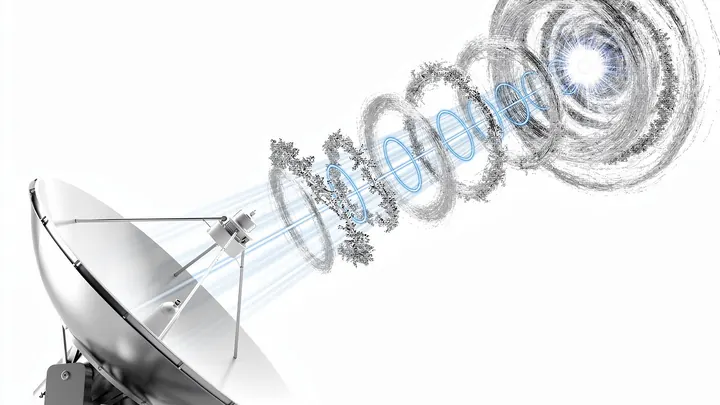
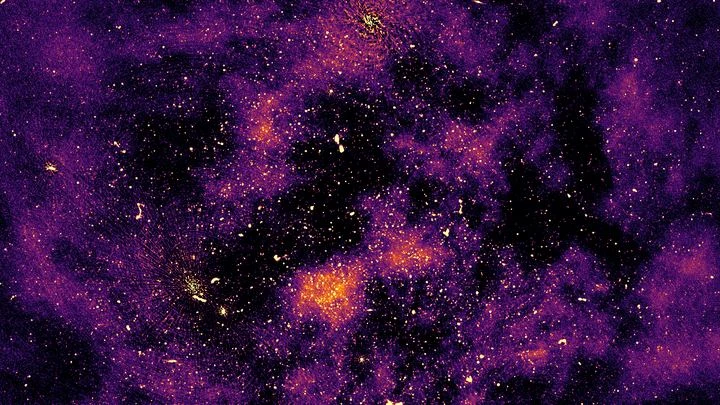
MeerKAT is a radio telescope array located in the Karoo region of South Africa, consisting of 64 interlinked dishes. It is a precursor to the Square Kilometre Array (SKA), the world's largest radio astronomy project. MeerKAT observes radio waves from astronomical sources, allowing scientists to study phenomena such as pulsars, supernova remnants, galaxies, and the cosmic web. Its high sensitivity and resolution make it one of the most powerful radio telescopes in the world, capable of detecting faint signals from the early universe and mapping the distribution of hydrogen gas across cosmic time.
History
MeerKAT was designed and built by South Africa, with the first dish completed in 2012 and the full array operational by 2018. It was officially inaugurated in 2018 and is now part of the SKA Observatory, serving as a key component of the SKA's mid-frequency array.
How it works
MeerKAT works by combining signals from its 64 dishes using a technique called aperture synthesis. Each dish is 13.5 meters in diameter, and the array spans up to 8 kilometers. By correlating the signals from all pairs of dishes, the array synthesizes a virtual telescope with the resolution of an 8-kilometer-wide dish. The data are processed by a powerful supercomputer that converts the raw signals into images and spectra. MeerKAT operates at frequencies from 580 MHz to 14.5 GHz, covering a wide range of radio wavelengths.
In practice
MeerKAT is used for a wide range of research, including studying pulsars, fast radio bursts, galaxy evolution, and the cosmic microwave background, as well as testing technologies for the SKA.
Fun fact
MeerKAT's name is an acronym for 'Karoo Array Telescope' and also honors the meerkat, a small mongoose-like animal native to the region where the telescope is located.
At night in fog, a searchlight works worse than in daylight: tiny droplets scatter the beam, and distant objects drown in the murky haze. Much the same way, radio waves from pulsars get lost in the interstellar medium when there are many free electrons between us and the star.
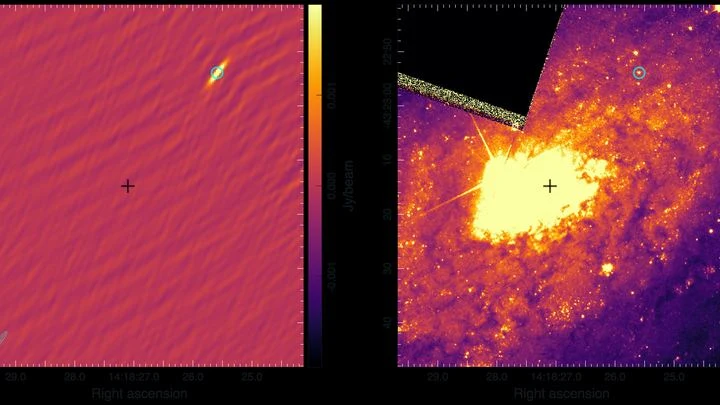
Galaxy Mrk 590 behaves like a radio receiver that sometimes picks up a signal and sometimes fades into static. Its supermassive black hole has been brightening and dimming for decades, and astronomers caught every such 'switch-on.' In 2017, the receiver came alive again, but the VLA radio telescope heard not the signal they expected.
The night sky is full of rings and bubbles, but in the radio band they look different. In data from the Australian radio telescope ASKAP, a structure has surfaced that resembles two soap bubbles blown from the same straw.
Picture a lighthouse on the shore at night. Its lamp is off almost all the time, but once every few days, for a split second, it blazes so brightly that the light is visible beyond the horizon.
Radio telescopes listen to the sky like sensitive ears: they catch the whispers of distant explosions, the hum of galaxies, the crackle of pulsars. But sometimes they pick up a sound that isn't in the catalogs. In 2003, such a sound emerged in the constellation Aquila — a spot in the sky that had been quiet until it suddenly began to speak.
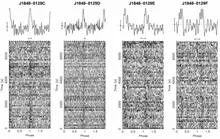
A lighthouse flashes for a fraction of a second and goes dark again. The MeerKAT telescope in South Africa catches such flashes in the radio band. During its observations, it picked up 27 new sources that no one had seen before. Neutron stars are the remnants of exploded stars, compressed to the size of a city.
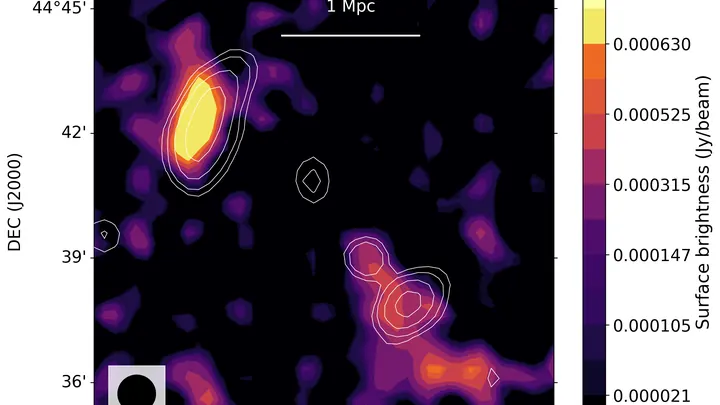
The galaxy cluster RXC J0528.9−3927 is like a city shrouded in fog: at its center, a radio halo shines brightly, but farther out, beyond the usual boundaries, astronomers have spotted a barely visible glow. It stretches for two million light-years — three times farther than the halo itself.
Pulsars are rapidly spinning neutron stars that emit radio pulses like a lighthouse. But some of them stay silent almost all the time, occasionally emitting a single pulse. Such objects are called rotating radio transients (RRATs). They were discovered nearly twenty years ago, but they remain a mystery.
A lighthouse that blinks not every second but once every few minutes or even hours. That is exactly how long-period radio transients behave — cosmic sources discovered only recently.
In 2007, astronomers heard a mysterious millisecond click from space — that's how fast radio bursts, or FRBs, were discovered. Since then, they've become a cosmic-scale detective story: as bright as an entire galaxy and compressed into an instant, these signals race through the Universe at the speed of light.
Imagine two neutron stars, compressed to the size of a metropolis yet weighing one and a half Suns each. They whirl in an unrestrained gravitational dance, drawing together and flying apart every 4.4 hours. At periastron — the point of closest approach — only a couple of light-seconds separate them, and their speed reaches three and a half million kilometers per hour.
The black hole in GRS 1915+105 behaves like a lighthouse with a shaky foundation: its jet, normally aimed in one direction, suddenly veered off by 34 degrees in just a month. Astronomers spotted this during a radio burst in 2025. It turns out that since 2023, the "beam" had been wandering within a 70-degree range, but the abrupt jump in 37 days set a record.
In 2022, astronomers began discovering strange cosmic beacons — long-period radio transients. Unlike fast pulsars, discovered by Jocelyn Bell Burnell in 1967, these objects flared with periods of tens of minutes and hours.
A lighthouse spins in dense fog. Its beam cuts through the gloom, but the fog itself remains invisible. That's roughly how astronomers search for dark matter: it doesn't emit light, yet it can affect the signals that reach us.
A vast hall where hundreds of orchestras play at once. Amid this din, you need to pick out one specific duet — two supermassive black holes circling each other in a distant galaxy. That's how pulsar timing arrays work: they listen to the "hum" of the entire sky, created by gravitational waves from many such pairs.
For decades, the search for extraterrestrial intelligence has waited for quiet, coherent signals from space — a kind of 'whistle' in the radio silence. However, our own technosphere has created a continuous radio background — the hum of a vast metropolis, emitted by all communications, radars, and broadcasting stations.
Searching for extraterrestrial signals is like trying to hear a whisper at a roaring stadium. The Green Bank Telescope listened to 70,000 stars, but 100 million bursts turned out to be earthly noise — from phones, satellites, microwave ovens.
A supernova explosion is the death of a massive star, leaving behind a gas cloud. If there's plenty of hydrogen around, the shock wave spreads like an echo from a distant gunshot.
The night sky looks calm, but if you listen in on the radio band, it's full of short clicks and rustles. Astronomers are combing the sky for solitary radio pulses — bursts lasting milliseconds that come from various corners of the Galaxy and beyond.
One such search is underway at the 100-meter radio telescope in Effelsberg, Germany.
Deep beneath Japan's Mount Ikeno sits a tank holding 50,000 tons of the purest water. Inside, it catches neutrinos — ghostly particles that zip through Earth as if it weren't there. When a star explodes in our galaxy, neutrinos arrive first, hours before the light.
On the night of August 18, 2025, the LIGO, Virgo, and KAGRA detectors felt a tremor in spacetime — as if two neutron stars had collided somewhere far away. Almost immediately, telescopes found a point of light in the same patch of sky.
Thousands of kilometers of fiber-optic cables lie on the ocean floor. They carry internet traffic, but the cables themselves sense the slightest vibrations in the water and the seabed. If you listen closely to such a cable, you can hear a blue whale singing or the ground trembling thousands of kilometers away.
Astronomers caught a signal from a cosmic lighthouse — a radio pulsar with a period of 36 minutes. Unlike ordinary pulsars (neutron stars that spin hundreds of times per second), this one barely turned. It transmitted pulses for only eight days and vanished, visible only in the radio range.
The night sky is no longer as quiet as it used to be. Thousands of satellites are whizzing overhead, and each one can accidentally emit radio waves, interfering with astronomers trying to listen to distant galaxies. To make sense of this noise, scientists pointed the 21CMA radio telescope in China at Starlink satellite passes.
For a long time, astrophysics was dominated by the belief that giant jets of radio emission, radio outbursts blasting from central regions, were the exclusive privilege of elliptical galaxies. It was thought that only their calm, featureless internal environment could allow such colossal fountains of energy, powered by supermassive black holes, to form.
When two galaxies collide, their central black holes begin a long dance of approach. Until they merge into one, we can see a pair of quasars — bright beacons that ignite as the black holes consume gas and dust. Such pairs in the sky are like two lighthouses standing close together, each shining from its own harbor.
The cosmic microwave background is faint light left over from the Big Bang. It fills the sky uniformly, but it encounters obstacles along the way. One such obstacle is galaxy clusters, which contain very hot gas. When CMB photons pass through this gas, some of them get an extra kick and change energy.
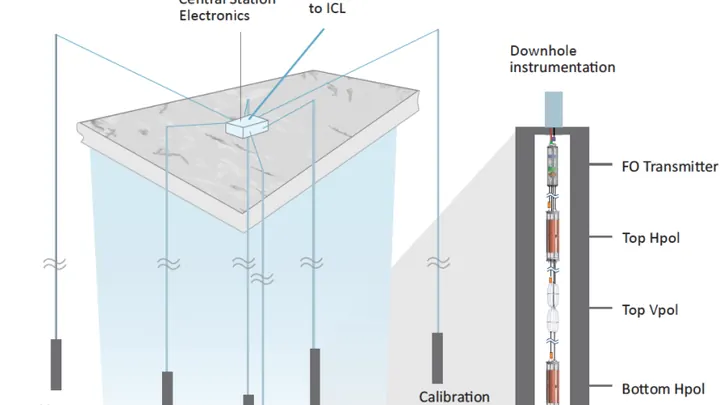
Deep within the Antarctic ice, at depths where sunlight never reaches, antennas hang suspended. They listen not for sounds but for radio waves, waiting for a signal from a particle that is nearly impossible to catch. A neutrino passes through the Earth like a bullet through fog, but occasionally, very rarely, it grazes an ice atom.
Galaxies, like giant whirlpools, sometimes collide and merge. In this chaos, gas compresses, new stars flare up, and a bright radio beacon is born at the very center. Its light — not visible to the eye, but radio waves — pierces through dust and gas like a siren through fog.
Terzan 5 is a globular star cluster, a tight swarm of hundreds of thousands of stars squeezed into a sphere a few dozen light-years across. In such a crowd, stars exchange matter and spin each other up, and some turn into pulsars — rapidly rotating neutron stars that emit radio pulses like lighthouses. New images taken with the Karl G.
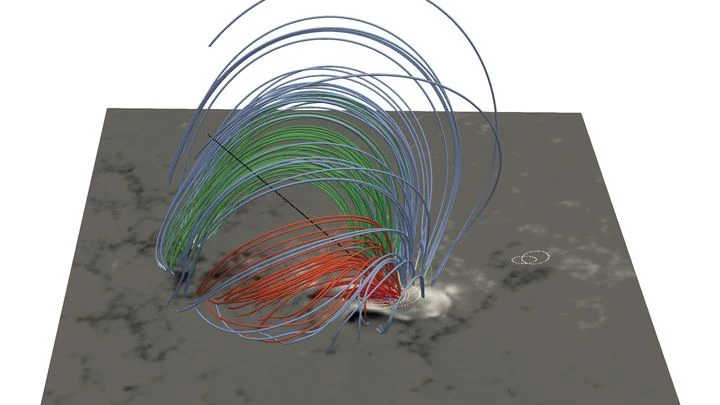
A solar flare is like thunder on a clear day: a short but powerful burst of energy. The MeerKAT radio telescope in South Africa caught one such M1.3-class flare and examined it with unprecedented clarity. Ordinary instruments see either bright details or faint ones, but not both at once.
In the neighboring galaxy, the Large Magellanic Cloud, lives the binary system A0538-66. There, a neutron star — a tiny sphere the size of a city but heavier than the Sun — spins on its axis every 69 milliseconds.
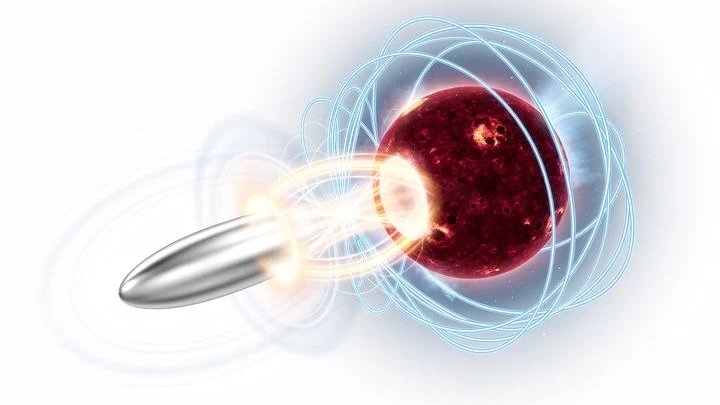
The neutron star PSR J1101-6101 is tearing through space at a breathtaking speed. It leaves behind a trail of charged particles, like a speedboat carving through water and dragging a foamy wake.
A black hole is an insatiable cook, and the star beside it is a pot of boiling soup. The cook ladles out the soup, but some spills: similarly, GX 339-4 pulls in gas from its neighboring star, but it doesn't hold onto all of it. The excess matter shoots out from the black hole's poles in two narrow jets, like splashes from an overfilled pot.
For twelve years, astronomers at the LPA radio telescope in Pushchino have been listening to the same patch of sky — the direction of the galaxy 3C 33. In that time, they caught just six short radio signals, each lasting from one to four minutes.
The black hole in the binary system V4641 Sagittarii behaves like a giant blender. It sucks in matter from its companion star and flings it back into space in two narrow jets. These jets slam into the surrounding gas like a water jet hitting sand, gradually carving out a huge cavity around the hole.
At the heart of many galaxies lies an invisible beacon — a supermassive black hole. As it devours matter, it blasts a dazzling beam of gamma rays into space. If that beam points towards Earth, astronomers see a blazar — a bright but fickle point.
The ASKAP telescope collects data on millions of radio sources in a single night. Automated algorithms confidently identify compact points but struggle with extended structures featuring jets, bridges, and bubbles.
The night of March 4, 2024. The MeerKAT radio telescope in South Africa catches a millisecond pulse: a fast radio burst coming from a depth of 17.4 gigaparsecs. This is light that traveled 10.5 billion years to reach Earth.
At a distance of 8.58 megaparsecs, the spiral galaxy M51 spins its arms, while the VLA radio telescope in its most extended configuration observes it with a resolution of 0.16×0.14 arcseconds. That is like spotting a coin on the surface of the Moon from Earth.