Light Computes in Four Dimensions express
A conventional computer sees the world flat: numbers are just points on a line. But a color image or a 3D scene demands more — four numbers that describe both position and rotation. Such quadruples are called quaternions, and until now electronics handled them clumsily, breaking them apart and reassembling them.
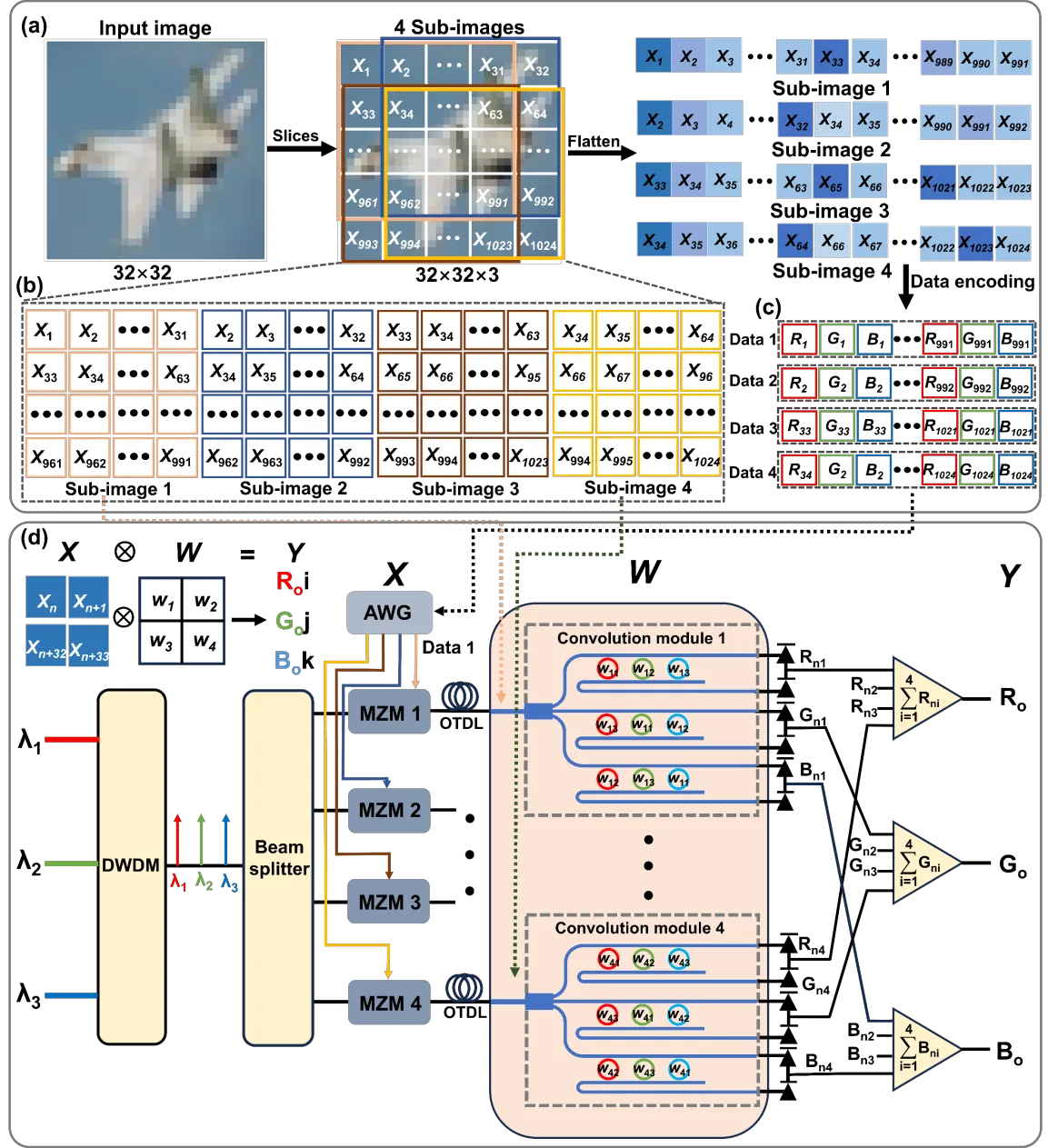
The new chip changes the approach. Instead of electrical signals, it sends beams of different colors through waveguides. Each color is a separate channel, and all four quaternion components travel in parallel, like four lanes on a highway. Light doesn't interfere with itself, so the chip processes a volumetric image or an object's rotation in a single pass.
Tests on real tasks showed the difference. A 3D point cloud, a set of coordinates from a lidar or 3D scanner, was processed with an error of less than three and a half hundredths. A color photo was recognized more accurately than by a conventional computer, while using two-thirds less computational effort. Light turned out to be not only faster but also more precise.
This isn't just a lab trick. Cameras, drones, and augmented reality glasses translate the 3D world into digital data every day. A chip that does this in light without extra steps brings technology closer to natural vision — fast, volumetric, and colorful.
Original abstract
as written by the authors arXiv:2601.01399
Optical computing chips have emerged as a transformative computing technology due to their high computational density, low energy consumption, and compact footprint. While real- and complex-valued computing chips have been well developed, their fundamental limitations in representing high-dimensional data significantly constrain their applicability in modern signal processing. Quaternions enable direct operations on three- and four-dimensional data, powering high-dimensional processing in data analytics and artificial intelligence. Here we demonstrate a quaternion optical computing chip (QOCC) for the first time and benchmark its performance in several typical application scenarios: three-dimensional point cloud processing, RGB chromatic transformation, and quaternion convolutional neural network for color image recognition. The QOCC harnesses high parallelism of light by wavelength-division multiplexing, processing high-dimensional data simultaneously through multiple optical wavelength channels. Compared to the electronic computing counterpart, our QOCC achieves higher computational fidelity (root mean square error < 0.035) and substantially reduced computational load (2/3 lower). It paves the way towards next-generation optical computing, overcoming the limitations of traditional computing systems in high-dimensional data processing.
Quaternions are used in spacecraft control systems to avoid 'gimbal lock'—the loss of one rotational axis at certain angles.