A graphics processing unit (GPU) is a specialized processor originally designed to accelerate the rendering of images and graphics. Unlike a central processing unit (CPU), which has a few powerful cores optimized for sequential tasks, a GPU contains thousands of smaller cores that can perform many simple arithmetic operations simultaneously. This makes GPUs exceptionally well-suited for parallel workloads, such as matrix multiplications, which are fundamental to scientific computing, machine learning, and data analysis.
History
The first GPUs emerged in the late 1990s for gaming and graphics. In the mid-2000s, researchers realized their potential for general-purpose computing, leading to the development of GPGPU (general-purpose GPU) programming. NVIDIA introduced CUDA in 2007, making it accessible to a wider audience.
How it works
GPUs use a single-instruction, multiple-data (SIMD) architecture: many cores execute the same operation on different pieces of data at the same time. This is ideal for tasks like comparing thousands of genome sequences, where each comparison is independent. In modern computing, GPUs are programmed using frameworks like CUDA (NVIDIA) or OpenCL, which allow developers to write code that runs on the GPU's parallel cores. The GPU's memory hierarchy is also optimized for high bandwidth, enabling rapid movement of large datasets.
The world's fastest supercomputers today rely on GPUs for most of their computing power; for instance, the Fugaku supercomputer uses ARM CPUs, but many others like Summit and Sierra use NVIDIA GPUs to achieve exascale performance.
A radio telescope with thousands of antennas is like a giant ear that hears the whole sky at once. But an ear cannot draw a picture: signals from every pair of antennas must be multiplied, and in an array of ten thousand elements there are already fifty million pairs. A classical correlator does exactly that, and its complexity grows as the square of the number of antennas.
A quantum computer is like an orchestra where each instrument is a qubit and the conductor is the control processor. The conductor must not only set the tempo but also change the score on the fly if a soloist plays something unexpected.
The brain doesn't just react to the world: it's constantly guessing what will happen next. This principle is called predictive coding: neurons compare expectations with reality and update their internal picture when an error occurs. But how such a complex system could be wired into the living tissue of the cortex remained unclear.
14 seconds. That’s all it takes for a new code to weave the full spectrum of a star, from ultraviolet to near-infrared. This spectrum is not just a rainbow but a detailed tapestry of thousands of dark absorption lines, each left by a specific atom in the star's atmosphere.
In a three-dimensional scene, each point is like a candy whose color changes depending on the viewing angle. To describe this play of shades, dozens of numbers are stored for each point — a special mathematical function invented by Joseph Fourier. Memory fills up instantly.
A child exploring an unfamiliar apartment crawls from object to object and remembers what is visible from each corner. This is how the brain builds a mental map — an internal model of space. The gradCSCG algorithm works on the same principle: it receives a video stream from a camera and independently draws a map of the room, relying only on the changing images.
Fiber optics transmit data with light of different colors. These beams race at nearly the speed of light. Normally, all signals go the same way, creating a jam and interference, like an orchestra where musicians are trying to outshout each other.
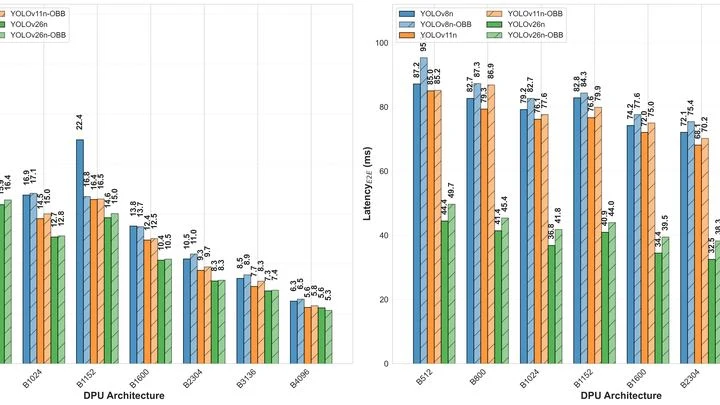
Modern machine vision systems are gaining autonomy: engineers have managed to implement an image recognition algorithm directly on a miniature chip, freeing the camera from having to send data to a bulky computer.
Tomographs don't produce ready-made pictures. They collect numerous 'shadows' — projections of innards from different angles or using various signals — and mathematically reconstruct a 3D picture from them.
A large neural network like Whisper masters hundreds of languages and resembles the standard model of the universe: everything is balanced. But training on a rare language disrupts this equilibrium — it turns into a black hole, pulling in all training resources. The network starts forgetting the other languages.
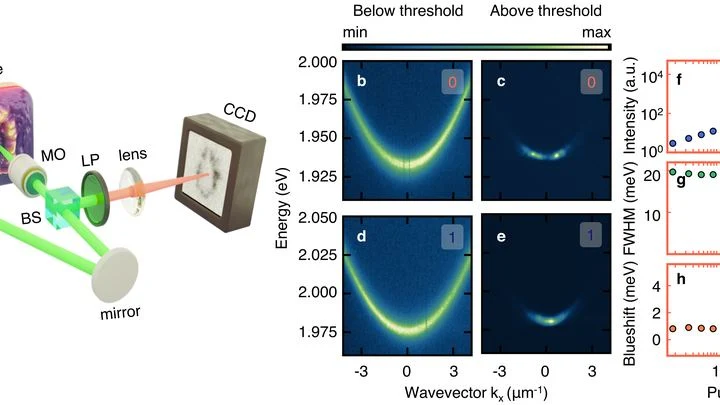
Generative neural networks that create images typically rely on digital randomness. But a team of researchers built a system where randomness is born not in code, but in a tiny optical cavity filled with an organic dye.
A person hunting for keys mentally runs through places where they might be. A bird that tucked hundreds of seeds into crevices in autumn retrieves them flawlessly in winter. How can a brain hold so many addresses when all birds have roughly the same number of neurons? The answer lies in geometry.
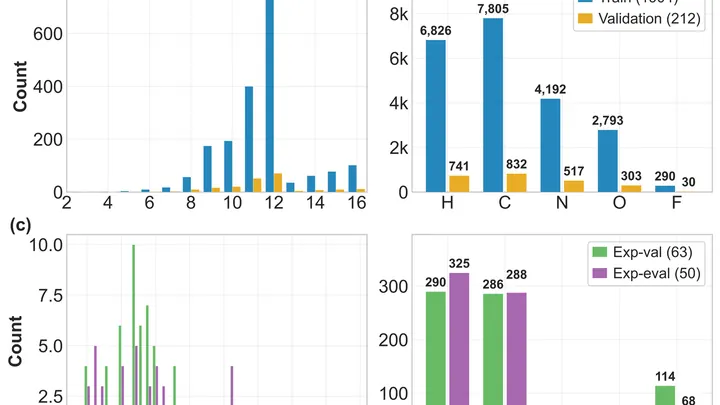
Every carbon atom in a molecule carries a passport — the energy with which its deepest electrons sit in their orbitals. This energy is sensitive to neighbors: add an oxygen nearby or a double bond, and the number in the passport changes. Chemists have long measured such energies with X-rays, but calculating each new molecule takes hours of machine time.
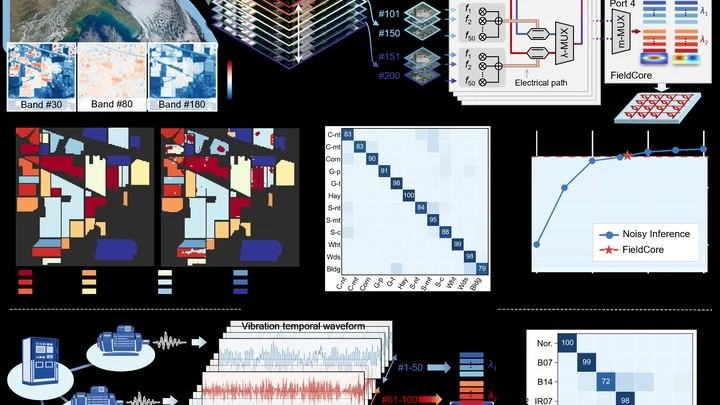
A typical computer shuttles electricity along copper traces, and every operation is a queue: first one thing, then another. Light works differently. In a single beam, you can mix dozens of signals without them interfering, like different voices in a choir, singing at once but each heard distinctly.
The new FieldCore chip uses five such "voices" at once.
A quantum computer holds atoms in light traps, like marbles in dimples. To read out the answer, you need to photograph each atom and determine whether it's glowing or not. Previously, analyzing such an image took so long that the computer sat idle. Now, engineers have created a specialized board that looks at the photo and instantly finds all the atoms.
Light passing through ripples on a water surface paints dancing patterns on the bottom of a pool. Engineers have used a similar idea to make light compute. They fabricated a tiny plate with a wavy relief: each ridge and groove deflects rays in its own way. When an image falls on such a surface, the light transmitted through it converges at different points behind it.
Light races through a maze of mirrors and beam splitters, but at the end of its journey, it doesn't just flash on a detector: it transforms itself. In the new photonic computer, nonlinear modules have been added to the familiar linear circuits, and now light can perform any quantum operation, not just a subset.
Proteins in a cell communicate like people in a bustling city: some pass signals, others put on the brakes, and still others just hang around. A graph neural network sees the map of these connections, who's linked to whom, but to it, they're just lines.
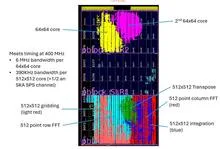
At India's Gauribidanur Radio Observatory, 32 antennas that look like giant TV dishes are listening to the sky. They catch radio waves from pulsars — dead stars that spin at breakneck speed and blink like lighthouses. Previously, signals from these antennas were processed slowly and awkwardly.
At the Large Hadron Collider, protons smash into each other like two trucks full of confetti. The debris, dozens of new particles, scatters in all directions. The detector records their tracks, and then the real work begins: piecing together a complete picture of the collision from those tracks.
Previously, this was done by a set of rules devised by physicists.
Inside every cell, chemical reactions are constantly underway, like a tiny kitchen where protein chefs whip up essential compounds. But seeing exactly how a chef prepares a dish is tricky when you're surrounded by a crowd of other molecules.
A light pulse in an optical fiber is like a starter's pistol shot: short, sharp, and unmistakable against the silence. It is exactly such pulses that the new artificial neuron, built on a silicon chip, produces.
A conventional computer sees the world flat: numbers are just points on a line. But a color image or a 3D scene demands more — four numbers that describe both position and rotation. Such quadruples are called quaternions, and until now electronics handled them clumsily, breaking them apart and reassembling them.
The new chip changes the approach.
In 2019, a group of theorists asked a simple question: what would happen if you embedded a single irreversible element into an ordinary quantum computer, a gate that slightly "eats" probability? The answer was devastating. Any such gate, no matter how weak, instantly turns the machine into a device capable of solving problems in the class PostBQP = PP.
A supercomputer simulating laser plasma is like a kitchen where hundreds of chefs are preparing a single dish. If ten people crowd around one stove while another stands empty, the work grinds to a halt. The same happens in simulations: plasma particles bunch up in certain regions of space, leaving others nearly empty.