Popular

Gravity Without Dark Matter: The Entropic Approach Triumphs ⚡ экспресс

Original: "Comparison of MOND and Verlinde's emergent gravity in dwarf spheroidals"
arXiv:2601.01715v1 · 2026-01-05 · CC BY 4.0 · ⏱ 1 min · General Relativity Cosmology Galaxies
Dwarf galaxies have shown that gravity may not be fundamental, but emerges from the informational structure of the cosmos.
Abstract

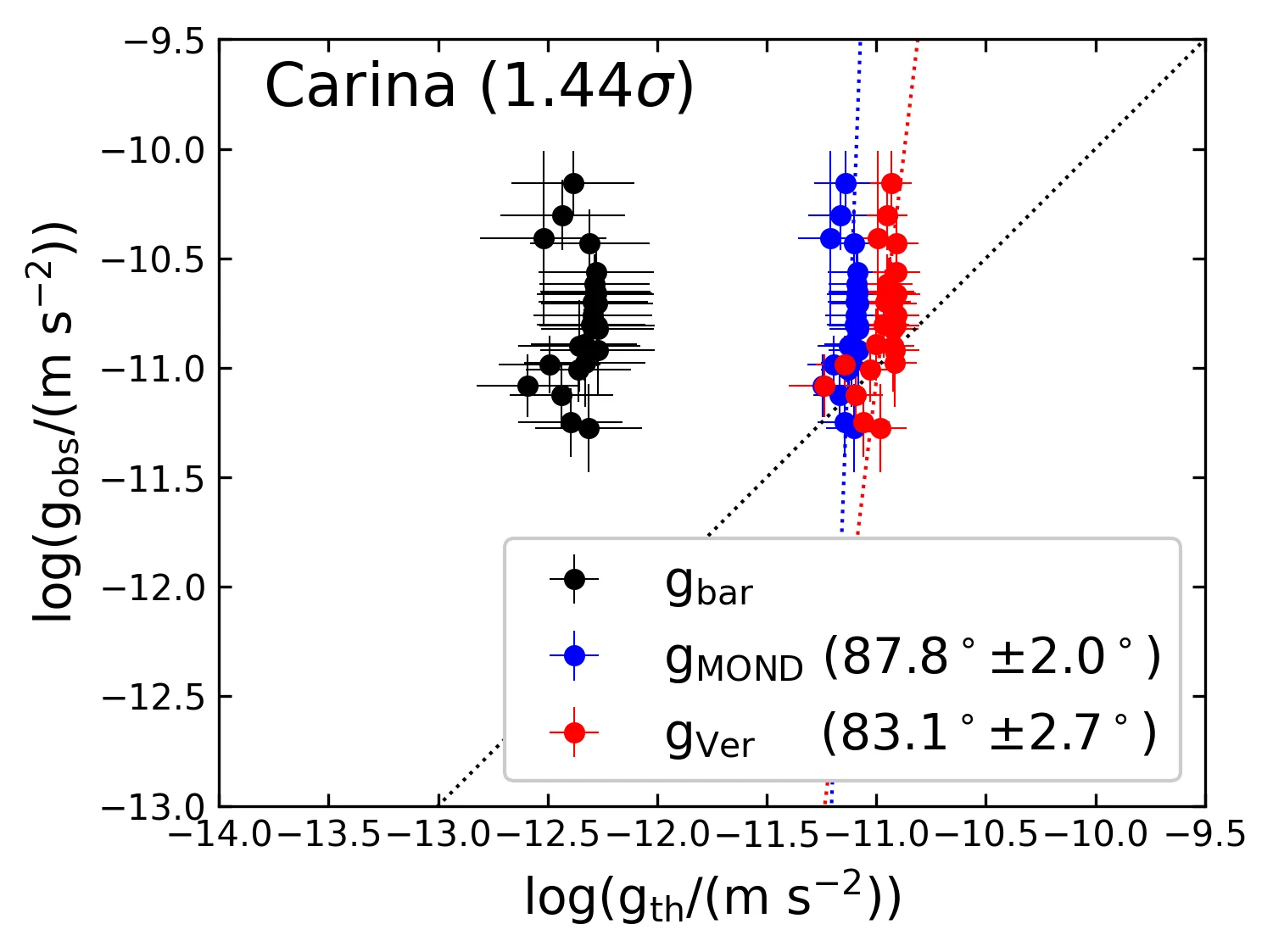
Scientists compared two theories of gravity without dark matter — MOND and Verlinde's emergent gravity — using 23 dwarf galaxies. The emergent theory, where gravity arises from microscopic information, better describes the movements of stars in 21 out of 23 cases. The overall statistical advantage was 5.2σ, which strongly favors the emergent approach. It's like the hunch that heat isn't a special fluid but the motion of particles: then the analogue of dark matter would be phlogiston.

Links in the knowledge graph 1

📄 Showing the "Simple" version — "Popular" is not ready yet. Add it to favorites to help prioritize it.

In tiny satellite galaxies, stars on the outskirts rotate faster than visible matter allows. It’s as if a pattern appears on the fabric of space for which there aren’t enough threads. The explanation is either to add an invisible framework of dark matter (an idea by Fritz Zwicky and Vera Rubin), or to accept gravity not as a foundation, but as an emergent property — it’s “embroidered” from how space packages information. This emergent hypothesis was proposed by Erik Verlinde, building on Bekenstein.

A test on 23 galaxies showed: in 21 cases, the information model predicted stellar motion more accurately than modified Newtonian dynamics (MOND).

These are ideal proving grounds — there are few stars, but dark matter (if it exists) should be abundant.

The statistical significance of 5.2σ equates to a one-in-a-million chance that this is a fluke.

And as if to confirm that the visible world is merely a superficial pattern: inside such a galaxy, the naked eye would spot only a handful of nearby stars, even though there are millions; the rest of the sky is blacker than coal.

🎯 If you found yourself inside such a galaxy, the naked eye would make out only a few stars — the entire rest of the sky would remain inky black.

Scientists
Albert EinsteinFritz ZwickyVera RubinJacob BekensteinStephen HawkingLudwig Boltzmann
Tags
dark matter galaxy entropy
Laws
second law of thermodynamicsgravitational lensingBekenstein-Hawking entropyBoltzmann distributionfirst law of thermodynamicsvirial theorem
Original: arXiv:2601.01715v1 · CC BY 4.0 · bridge42worlds