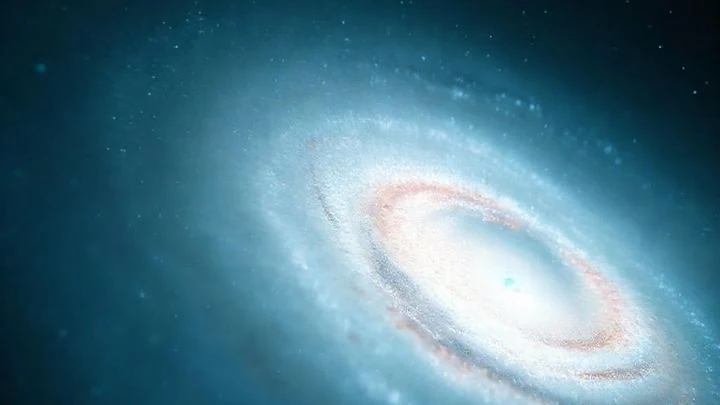
Modified Newtonian dynamics (MOND) is a hypothesis that proposes an alternative to dark matter by modifying Newtonian gravity at very low accelerations, such as those found in the outskirts of galaxies. Instead of invoking invisible mass, MOND suggests that the gravitational force law changes when acceleration falls below a critical threshold, leading to the observed flat rotation curves of galaxies without dark matter. This idea challenges the standard cosmological model and has sparked ongoing debates about the nature of gravity and the universe's mass budget.
History
MOND was introduced by Mordehai Milgrom in 1983 as an alternative to dark matter. It has been refined over the decades, with relativistic extensions like TeVeS proposed by Jacob Bekenstein in 2004.
How it works
MOND posits that for accelerations below a universal constant (about 10^-10 m/s^2), the effective gravitational force becomes stronger than Newtonian prediction, scaling as the square root of the product of mass and acceleration. This modification causes stars in a galaxy's outer regions to orbit faster than expected, mimicking the effect of dark matter. The theory has been successful in explaining galaxy rotation curves but struggles to account for observations like the Bullet Cluster, where dark matter's gravitational lensing appears separated from visible matter.
In practice
MOND is primarily a theoretical framework used in astrophysics to test gravity models and interpret galactic dynamics, though it has not yet led to practical technologies.
Fun fact
MOND's critical acceleration is remarkably close to the speed of light times the Hubble constant, hinting at a possible connection to cosmology, though this remains speculative.
MOND function interpolating between Newtonian and deep-MOND regimes.
What is in the formula
g_N
variable
Newtonian gravitational acceleration — acceleration metre per second squared
ν
variable
MOND interpolation function
a_0
constant
Characteristic acceleration scale of Modified Newtonian Dynamics, below which deviations from Newtonian gravity appear. — mond acceleration scale = 1.2e-10metre per second squared
An orchestra without a conductor: each musician tunes to a neighbor, and out of that comes a well-coordinated melody. In the world of microscopic magnets, the role of that orchestra is played by a tiny neodymium sphere levitating above a superconducting film.
As planets orbit the Sun, they don't just follow their paths: they give each other a slight tug. It's like a dance where each partner feels the movements of the others. Scientists set out to determine how strongly this mutual attraction alters the planets' trajectories.
It turns out there are small corrections that were previously overlooked.
Think of a merry-go-round: the farther you sit from the center, the faster you're carried around. For a long time, astronomers assumed galaxies work the same way — stars at the edges should orbit more slowly than those near the center. But back in the 1970s, it turned out that in many spiral galaxies, the speed of stars barely drops with distance from the center.
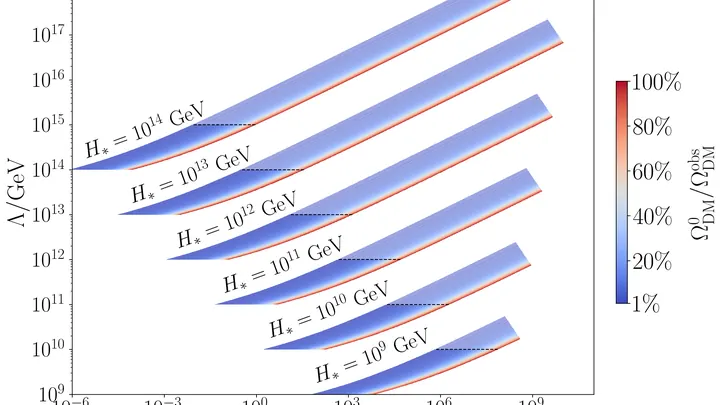
Space is expanding, and that expansion is accelerating. But what if, in the first instants after the Big Bang, gravity behaved differently? The authors of a new study added an invisible field to Einstein's equations that siphons energy from ordinary matter and radiation.
The cosmological standard model is like a recipe for a cake where everything is strictly measured: dark matter is like flour without a single lump (zero pressure), and dark energy is like the perfect leavening agent (equation of state exactly minus one). But what if the flour is a bit damp and the leavening agent has lost its oomph?
Light freezes at the edge of the abyss: that's what the event horizon of an ordinary black hole looks like. But at the center of this abyss lurks a singularity, a point where the laws of physics break down. What if, instead of a point, there were a hard shell?
A gravastar is not a black hole.
Imagine a pot of boiling water. Toss in a handful of pasta, and it quickly overcooks and clumps into a sticky mess. But in a huge restaurant kettle where the pasta floats freely, each piece stays separate.
Two figure skaters on a lake frozen to the horizon. They are so far apart that their silhouettes turn into dots, and their mutual attraction becomes almost an article of faith. By Newton's law, they should circle in an unimaginably slow waltz. But telescopes see otherwise.
A lead sphere hangs above another lead sphere. According to the usual laws of gravitation, they attract each other exactly along the vertical — along the line connecting their centers.
In the first moments of the universe's life, there was not even a hint of dark energy — the very force that today pushes galaxies apart ever faster. But if you look deeper, down to the Planck scale (billions upon billions of times smaller than an atomic nucleus), spacetime ceases to be smooth.
A teaspoon of neutron star matter weighs as much as a mountain. But this mountain may have an invisible twin.
Deep inside a neutron star, ordinary matter is compressed to unimaginable densities. There, protons and neutrons can dissolve into a quark soup.
The universe is expanding at an accelerating rate, like dough that keeps rising faster even though the yeast ran out long ago. For twenty years, astronomers have been searching for the cause and call it dark energy. But what it is remains a mystery.
New work proposes an unexpected source: the vacuum inside the atomic nucleus.
Since the end of the 20th century, we've known: the expansion of the Universe is accelerating — galaxies are flying apart faster and faster. The discovery brought a Nobel Prize to Adam Riess, Saul Perlmutter, and Brian Schmidt.
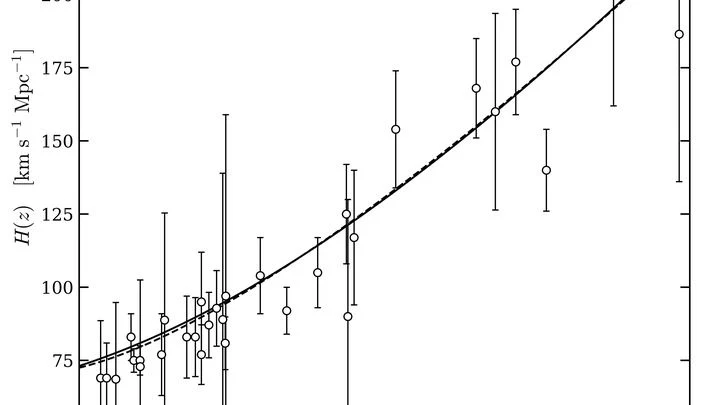
The universe is expanding faster and faster thanks to dark energy. But measurements of the rate give contradictory results. A new explanation: in the past, dark energy acted as a brake, slowing the galaxies' recession, and then switched to acceleration. Like a car that first rolls backward and then lunges forward.
For nearly a century, astronomers have watched galaxies spin as if held together by invisible mass. Fritz Zwicky first noticed it, and Vera Rubin precisely measured the speeds of stars at the edges.
A galaxy is like a cosmic highway where stars, like cars, race along circular orbits. Their speed is set by the invisible "cargo" of mass enclosed within the orbit: the more massive the central region, the faster the stars at the periphery.
Two heavy balls orbit on the surface of a pond. Ripples spread from them: these are gravitational waves. As the balls spiral closer, the waves carry away energy, and the ripples become more frequent.
Gas falls onto a neutron star — the ultra-dense remnant of an exploded star. This gas accumulates at the magnetic poles and forms a mountain. But a mountain on a neutron star is not like one on Earth: it is held not by rock but by magnetic field lines, like iron filings on a magnet.
When there is too much gas, the mountain begins to break apart.
Two galaxy clusters collided like two swarms of bees flying through each other. One of them is the famous "Bullet." After the collision, the hot gas, which makes up most of the ordinary matter, slowed down and stayed in the center, while the galaxies, like small dense pebbles, flew on.
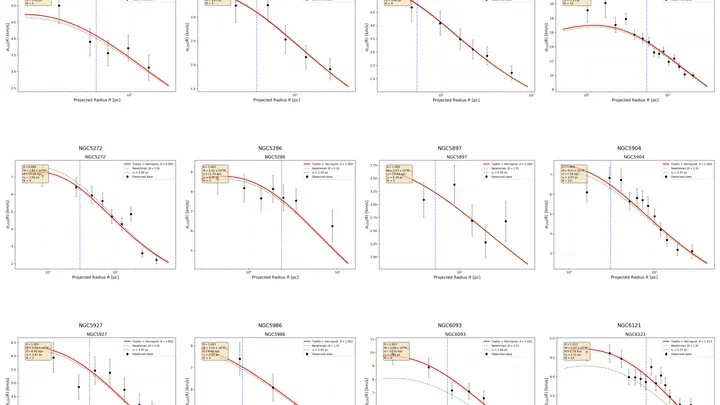
When stars at the edges of galaxies rotate faster than calculations based on visible mass predict, standard cosmology invokes the hypothesis of hidden dark matter — invisible substance that reveals itself only through gravity. A new study offers an alternative that requires no new particles.
Back in the last century, Vera Rubin discovered that stars on the outskirts of galaxies rotate too fast, as if held by some invisible substance. Since then, dark matter has remained a puzzle. Usually, its origin is linked to new particles or forces. But a new study points to a simpler source — the geometry of space itself.
Astronomers, including Vera Rubin, noticed that stars on the outskirts of galaxies rotate faster than visible mass allows. To explain this, they invented dark matter — an invisible ballast. But there's another possibility: gravity isn't always the same.
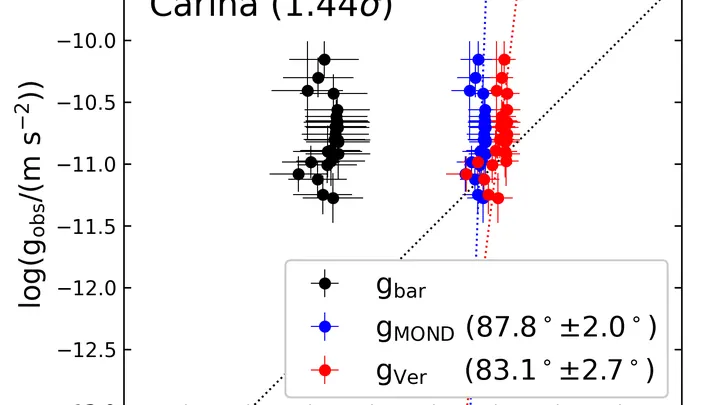
In tiny satellite galaxies, stars on the outskirts rotate faster than visible matter allows. It’s as if a pattern appears on the fabric of space for which there aren’t enough threads.
An ultracold atomic cloud, resembling fog, hints that gravity might not work as Newton said. On the outskirts of galaxies stars move faster than expected, and MOND theory tweaks the law of gravitation over large distances, removing the need for dark matter.
The universe is putting on a show, and the lead role goes to dark energy. For a long time, the actor seemed unchanging: the cosmological constant (the vacuum energy that accelerates cosmic expansion) set the same tone throughout.