Modified gravitysingularities are exotic solutions in extended theories of gravity, where the standard black hole singularity is replaced or supplemented by other structures like wormholes, monopoles, or naked singularities. In general relativity, a black hole's center is a point of infinite density where physics breaks down. Modified theories—such as loop quantum gravity, string theory, or higher-order curvature models—often smooth out this singularity, leaving behind a finite, traversable region or a horizon that behaves differently from the classical picture.
History
The concept of naked singularities was discussed by Roger Penrose in the 1960s as part of the cosmic censorship hypothesis. Modified gravity solutions with wormholes and regular black holes emerged in the 1980s and 1990s, particularly in string theory and loop quantum gravity, and remain an active area of theoretical research.
How it works
In these theories, the gravitational field is described by more complex equations that include quantum corrections or additional curvature terms. These corrections can prevent the collapse to a point, creating a 'bounce' that forms a wormhole or a regular core. A naked singularity is a singularity without an event horizon, meaning it is visible to distant observers—something general relativity forbids but some modified theories allow. The stability of these structures depends on the specific theory and the balance of forces near the core.
In practice
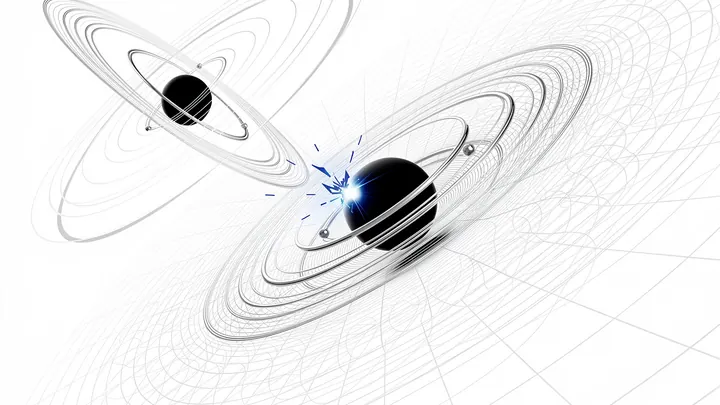
These models are used to predict gravitational wave signatures from black hole mergers, as the 'ringdown' phase would differ if the object has a wormhole or a modified horizon instead of a classical black hole.
When two heavy balls merge into one, ripples spread across the water's surface for a long time. A black hole behaves similarly: after a merger, it 'rings' for a while, emitting special gravitational oscillations — quasinormal modes. Usually, this ring fades quickly, like an echo dying out in an empty hall.
Somewhere in the center of a galaxy, a black hole is spinning. It doesn't hang in a void — around it swirls an invisible swarm of dark matter particles. Until now, this swarm was described for non-rotating holes, but in reality, holes always rotate.
A black hole spun up almost to its limit is like an athlete balancing on the edge of a record. The most interesting action isn't inside the hole itself, but in the thinnest film of spacetime at its horizon. It's there that tiny corrections to Einstein's gravity can suddenly swell to gigantic proportions.
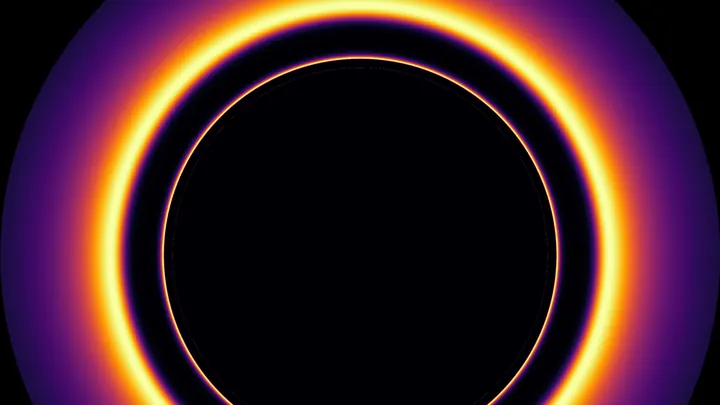
A black hole's shadow isn't just a black circle. Usually, we see a dark void surrounded by a glowing ring of hot gas. But if a black hole wasn't born from a dying star but has existed forever, its shadow might hide a surprise.
An eternal black hole is a solution to Einstein's equations with no past and no collapse.
A black hole that swallows matter might not just evaporate over billions of years: it could pop like a soap bubble and turn into its opposite: a white hole. This scenario emerged from numerical experiments in semiclassical gravity.
A translator gets distracted by every rustle in the hall, and a one-hour meeting stretches into two. A single wrong intonation changes the meaning beyond recognition. That's roughly how a particle with spin 3/2—the gravitino — behaves. It cannot exist in isolation: its "speech" must be perfectly coordinated with its surroundings, or the whole structure falls apart.
An old house. The facade is freshly painted, the stairs don't creak. A pretty picture. But try to move in heavy furniture, and the floorboards give way. The beauty of the facade says nothing about the strength of the floors.
It's much the same with black holes without singularities.
Light freezes at the edge of the abyss: that's what the event horizon of an ordinary black hole looks like. But at the center of this abyss lurks a singularity, a point where the laws of physics break down. What if, instead of a point, there were a hard shell?
A gravastar is not a black hole.
A black hole is like a perfectly smooth sphere. It has no features — only mass, charge, and spin. This rule is called "no-hair." But nature loves to complicate things: sometimes a cloud of a scalar field (a special field described by a single number at each point) spontaneously appears around a black hole.
A black hole is not just an abyss. It is a seething cauldron whose temperature rises as it evaporates. The authors of the study found that when the heat reaches a critical threshold, the hole seems to boil. It emits superheavy particles — the very ones that exist on a scale where any theory of gravity collapses.
A black hole devours everything, even light. Yet it obeys the laws of physics: it possesses entropy — a measure of the hidden information an object 'remembers.' In the 1970s, Jacob Bekenstein and Stephen Hawking discovered a strange pattern: a black hole's entropy grows not with its volume, but…
A stone falls into still water — ripples spread across the surface. A black hole behaves similarly when something falls into it or when it merges with another black hole. The hole begins to oscillate, and these oscillations propagate through space as gravitational waves.
In 1973, Jacob Bekenstein proposed that black hole possess entropy — a measure of hidden disorder. Stephen Hawking later confirmed this by adding radiation, but the microscopic origin of entropy remained obscure.
Hot tea cools down, a pendulum comes to rest — nature loves equilibrium. But a charged black hole can reach a special, extreme state: the mass becomes minimal, and the temperature drops to zero.
After a hit, a black hole rings like a bell. But instead of sound, it emits gravitational waves whose frequency rapidly decays: these are called quasinormal modes. From such a 'ring,' you can infer the hole's mass, spin, and other properties.
A black hole sitting on a thin cosmic membrane (brane) resembles a heavy ball stretching an elastic sheet. In classical physics, it is bald — only mass, charge, and rotation. But add a scalar field (an invisible substance like temperature), and the hole can spontaneously grow 'fur' from this field.
A campfire burns steadily and long. But when the wind blows, the flame flickers out, leaving only embers. A similar story plays out with the gravastar — a hypothetical object that was supposed to replace the black hole.
An ordinary black hole hides a singularity — a point where the laws of physics break down.
Gravity is the invisible glue that holds stars and planets together. But what if this glue has a tiny mass? In massive gravity, the carrier particles (called gravitons) weigh a minuscule but nonzero amount. This changes the rules near black holes.
The authors of the new study built on a mathematical tool — eigenvalue decomposition.
At the center of attention is a black hole of unusual shape. Its geometry resembles a spindle: a slight elongation is added to the usual rotation. The parameter B measures this deformation.
The spindle deformation is not just a mathematical toy.
A black hole usually hides its singularity behind an event horizon — an invisible boundary from which not even light can escape. But sometimes this 'cloak' is absent, and the singularity, a point where familiar physics breaks down, is exposed to an outside observer.
An ordinary black hole hides a singularity at its center — a point where density and curvature become infinite and the laws of physics break down. The authors of the new work built a model of a rotating black hole that, instead of a singularity, contains a calm "core" resembling ordinary flat space.
At the center of a classical black hole lurks a singularity — a point where the density and curvature of spacetime become infinite. Physics goes silent there.
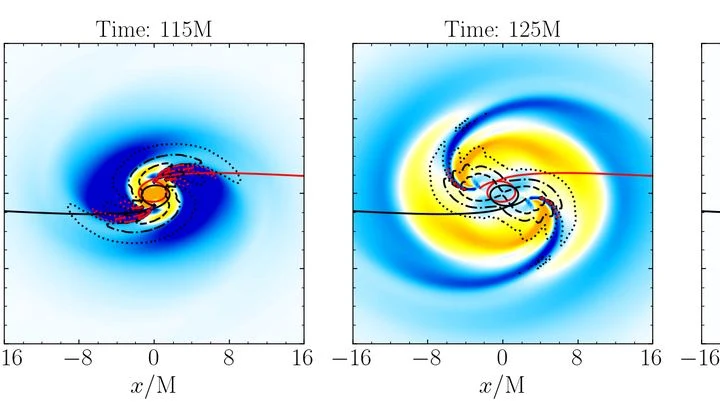
A black hole merger is not a silent impact. The newborn hole quivers and decays, emitting gravitational waves — ripples in space itself. This signal is called the 'ringdown,' and it resembles the fading chime of a bell: it has a fundamental tone and several overtones.
A black hole is not just a dark spot. It rotates, drags space along with it, and can carry imprints of the quantum world. To describe such a hole, one must solve gravitational field equations.
In classical theory, a black hole is where matter collapses to a point of infinite density. Such a 'singularity' looks like an error in the equations: nature hardly tolerates infinities. Many physicists seek ways to 'smooth out' this flaw, and one idea is to modify the theory of gravity itself at small distances.
Gas passing through a narrow valve can heat up or cool down: this is the Joule–Thomson effect, which powers refrigerators and air liquefiers. It turns out black holes can do the same.
At the heart of almost every galaxy slumbers a supermassive black hole — the invisible conductor of a stellar orchestra. When galaxies collide, their central monsters draw closer, entwining in a gravitational dance. Sometimes a third partner joins the duo, and then a triple waltz begins, its outcome unpredictable.
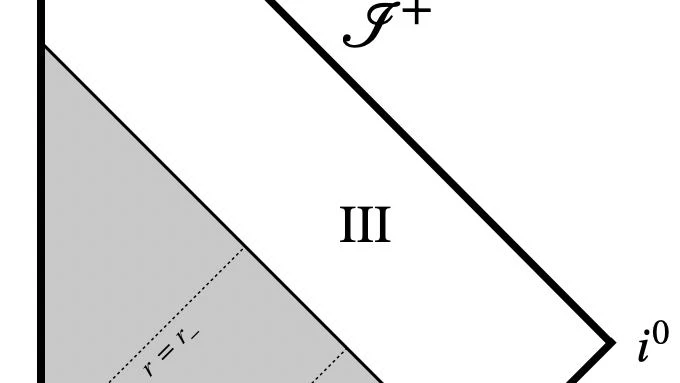
When a giant star runs out of fuel, it collapses into a black hole. Such a hole has an outer boundary — the event horizon, beyond which even light cannot escape. But many black holes also have an inner boundary — a second horizon that separates the outer layers from the singularity core.
At the center of a black hole, classical theory paints a point where density and spacetime curvature shoot to infinity — like an infinitely sharp needle. But quantum corrections, tracing back to the work of Karl Schwarzschild, add a tiny “pillow”: space cannot collapse to zero.
An ordinary black hole is surrounded by a thin photon sphere — a place where light can loop around before falling in or escaping. In the new work, this region has puffed up into a whole layer packed with massless particles that zip around at nearly the speed of light and don't press against the walls.
The universe hasn't always been expanding. In some models, it first contracted, nearly empty and flat, and then, upon reaching a limit, bounced back and started growing, like the world we know. This scenario is called bouncing cosmology.
Two black holes race past each other like Formula 1 cars on opposite lanes. In standard general relativity, they remain 'bald'—no extra fields appear around them. But if you add a scalar field to the equations (something like an invisible fog permeating space), the rules change.
The space we live in appears three-dimensional. But when physicists try to reconcile gravity with quantum mechanics, familiar dimensions start behaving strangely. In a new study, scientists showed that to describe a massive particle while accounting for quantum gravitational effects, it is natural to add two more dimensions.
A cosmic ray approaches a black hole almost tangentially. Instead of falling straight in, it lingers on an unstable orbit, like an acrobat balancing on a tightrope over an abyss. After a few loops, the light finally escapes toward a distant observer. Such rays produce multiple images of the same source, known as higher-order images.
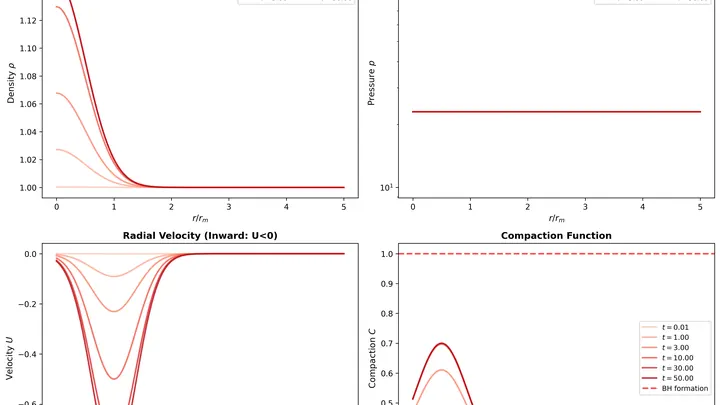
In the first moments after the Big Bang, the universe was filled with a hot, nearly uniform plasma. But in some places, the density could randomly be slightly higher. If such a clump gained critical mass, it collapsed into a black hole: this is how primordial black holes were born.
Gravitational-wave detectors picked up a strange burst — the signal GW241011. Two black holes merged, but the pair looked unusual: one hole was about three times lighter than the other, and the system as a whole was spinning rapidly. Such a combination is a rare guest in the catalogs.
A classical black hole has a temperature and other thermodynamic properties. When physicists began accounting for changes in the cosmological constant, the energy of empty space, a strange coupling emerged in the equations.
The boundary sets the rules
Quantum gravity is like a theater where spacetime is the stage and fields are the actors. When the stage has an edge, you need to know exactly what happens at the boundary; otherwise, the play falls apart. In 2018, Edward Witten proposed an elegant recipe for such a case.
Light passing near a massive body slightly changes its path — gravity pulls even on rays. In ordinary situations, a beam of light from a distant star is squeezed as if drawn together by an invisible rubber band. This property is called the null convergence condition: gravity makes light trajectories converge rather than diverge.
The Schwarzschild black hole is the simplest model in general relativity. But when you switch to teleparallel gravity (TEGR), where torsion replaces curvature, the horizon develops a problem. Some quantities built from torsion tend to infinity.