Gravity Without Dark Matter: The Entropic Approach Triumphs express
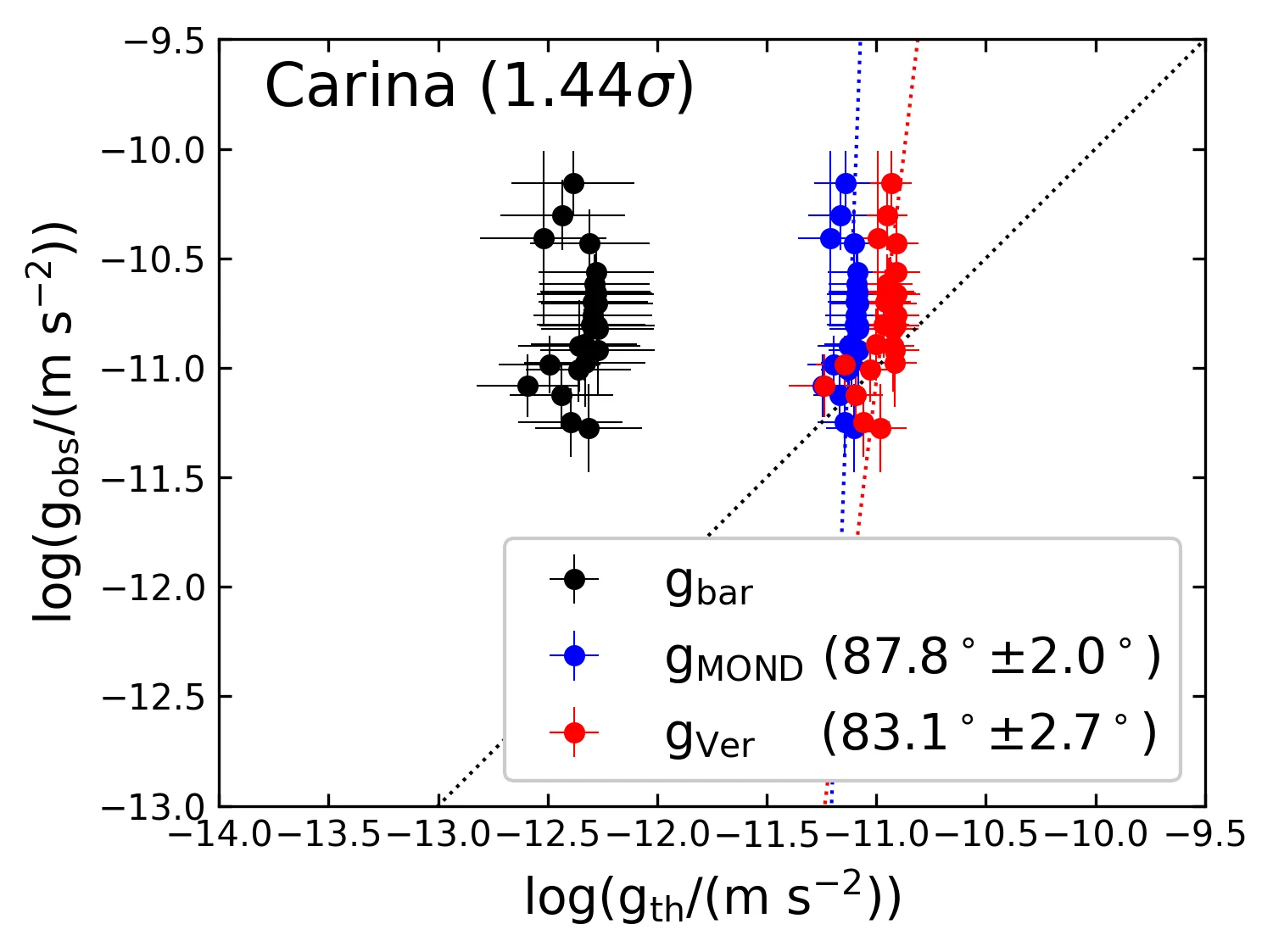
In tiny satellite galaxies, stars on the outskirts rotate faster than visible matter allows. It’s as if a pattern appears on the fabric of space for which there aren’t enough threads. The explanation is either to add an invisible framework of dark matter (an idea by Fritz Zwicky and Vera Rubin), or to accept gravity not as a foundation, but as an emergent property — it’s “embroidered” from how space packages information. This emergent hypothesis was proposed by Erik Verlinde, building on Bekenstein.
A test on 23 galaxies showed: in 21 cases, the information model predicted stellar motion more accurately than modified Newtonian dynamics (MOND).
The statistical significance of 5.2σ equates to a one-in-a-million chance that this is a fluke.
And as if to confirm that the visible world is merely a superficial pattern: inside such a galaxy, the naked eye would spot only a handful of nearby stars, even though there are millions; the rest of the sky is blacker than coal.
If you found yourself inside such a galaxy, the naked eye would make out only a few stars — the entire rest of the sky would remain inky black.