Modified gravity theories are alternative frameworks that seek to explain the observed effects attributed to dark matter without invoking an invisible particle. Instead of adding mass to galaxies and clusters, these theories modify the laws of gravity on large scales, such as by altering the inverse-square law or introducing additional fields. The most prominent example is Modified Newtonian Dynamics (MOND), which posits that gravitational acceleration deviates from Newtonian predictions below a certain threshold.
History
MOND was proposed by Mordehai Milgrom in 1983. Relativistic extensions were developed later, notably by Jacob Bekenstein in 2004 with TeVeS. The idea remains controversial, as it struggles to match observations of galaxy clusters and the cosmic microwave background without some form of dark matter.
How it works
In modified gravity, the gravitational force or the metric of spacetime is adjusted so that the rotation curves of galaxies flatten without extra mass. For instance, MOND introduces a characteristic acceleration scale below which gravity becomes stronger than Newtonian. Relativistic versions, like Tensor-Vector-Scalar (TeVeS) gravity, embed this idea into a full cosmological framework, aiming to reproduce gravitational lensing and cosmic expansion without dark matter.
In practice
Modified gravity theories are primarily used in theoretical cosmology and astrophysics to test alternatives to dark matter, guiding observational campaigns that look for deviations in gravitational lensing or galaxy dynamics.
Fun fact
Some modified gravity models predict that the gravitational field of a black hole could differ subtly from general relativity, potentially altering the shape of its shadow — an effect that could be tested with the Event Horizon Telescope.
A stone falls into still water — ripples spread across the surface. A black hole behaves similarly when something falls into it or when it merges with another black hole. The hole begins to oscillate, and these oscillations propagate through space as gravitational waves.
Two figure skaters on a lake frozen to the horizon. They are so far apart that their silhouettes turn into dots, and their mutual attraction becomes almost an article of faith. By Newton's law, they should circle in an unimaginably slow waltz. But telescopes see otherwise.
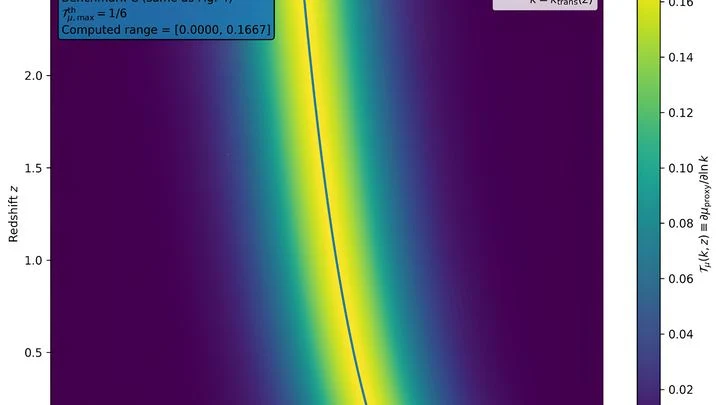
In the depths of space, gravity is mastering the art of disguise. For a quarter century, astrophysicists have been trying to decipher the nature of dark energy, which makes the Universe expand at an accelerating rate.
A lead sphere hangs above another lead sphere. According to the usual laws of gravitation, they attract each other exactly along the vertical — along the line connecting their centers.
The vacuum is not as empty as it seems. If an observer moves with acceleration, the vacuum around them heats up: this was predicted by William Unruh back in the 1970s. The effect is akin to black hole radiation, but in flat space.
A dead star with a magnetic field billions of times stronger than Earth's is a magnetar. Its crust cracks, sending a powerful X-ray burst into space. But some of that light doesn't reach us in its usual form. In an ultra-strong field, photons can turn into gravitational waves — the trembling of space itself.
A galaxy is like a cosmic highway where stars, like cars, race along circular orbits. Their speed is set by the invisible "cargo" of mass enclosed within the orbit: the more massive the central region, the faster the stars at the periphery.
When light swings past a massive body like a black hole, its path warps — an effect predicted by Einstein. New research has taken into account that near such objects, clouds of hadrons often swirl — the very particles we know from protons and neutrons in atomic nuclei.
The merger of two black holes is like a dance that ends in a powerful burst — a gravitational wave. This wave carries the imprint of how spacetime is curved around the objects. If the geometry differed from what we're used to, as if a ball rolled not on a flat floor but on wavy linoleum, the signal would be different.
In the dark depths of space lurks invisible matter. It doesn't shine, but its pull holds galaxies together. Usually, we assume dark matter obeys the same laws of gravity as tables and chairs. A new study offers a different perspective: dark matter might subtly alter gravity itself.
Astronomers, including Vera Rubin, noticed that stars on the outskirts of galaxies rotate faster than visible mass allows. To explain this, they invented dark matter — an invisible ballast. But there's another possibility: gravity isn't always the same.
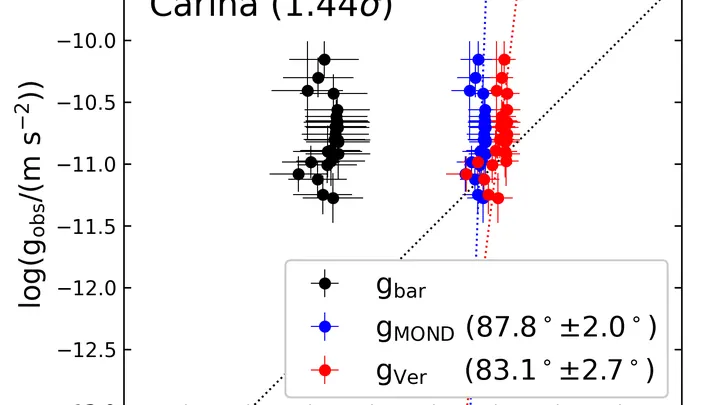
In tiny satellite galaxies, stars on the outskirts rotate faster than visible matter allows. It’s as if a pattern appears on the fabric of space for which there aren’t enough threads.
An ultracold atomic cloud, resembling fog, hints that gravity might not work as Newton said. On the outskirts of galaxies stars move faster than expected, and MOND theory tweaks the law of gravitation over large distances, removing the need for dark matter.