Dark Dance: How Energy and Matter Swap Roles express
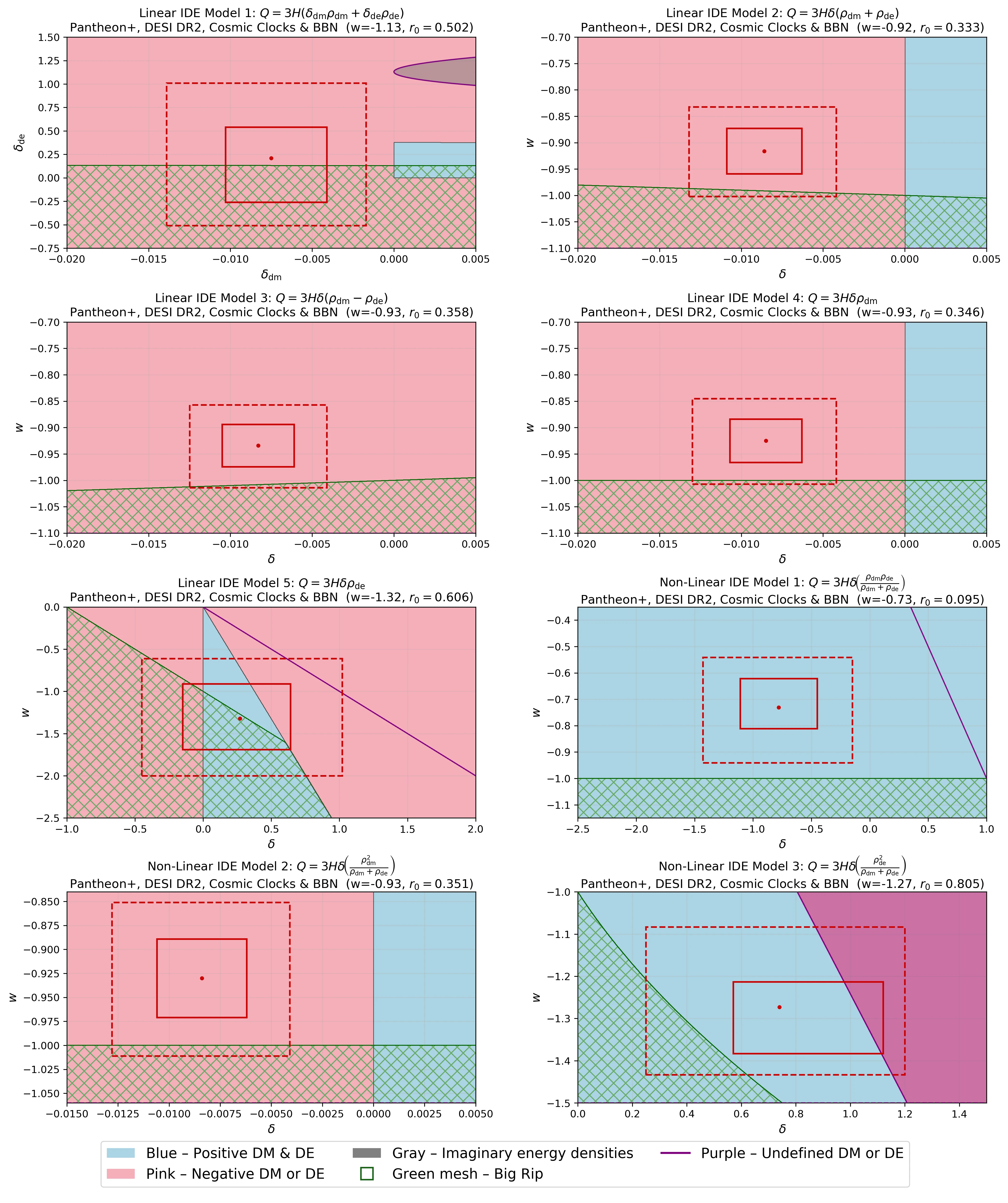
In the cosmic dance, dark energy and dark matter exchange energy. For a long time, dark energy was thought to be a constant force accelerating the universe — an insight that earned the Nobel Prize for Riess, Perlmutter, and Schmidt. But new data show the dance is changeable.
Researchers examined eight interaction models. It turns out that right now dark energy is giving energy to dark matter, while in the past it was the opposite. But in some versions, dark energy's density became negative, as if a dancer spends more than they have.
Original abstract
as written by the authors arXiv:2601.03122v1
In this study, we present observational constraints on a class of phenomenological interacting dark energy (IDE) models that admit analytical solutions for the Hubble parameter $$H(z)$$. We consider a set of five linear and three non-linear IDE scenarios, encompassing both interactions proportional to the dark matter and/or dark energy densities, as well as non-linear combinations of the two. For all eight IDE models, we find a better fit than $$\Lambda$$CDM from a $$\Delta\chi^2$$ analysis for both combinations of datasets considered. When using the Akaike Information Criterion ($$\Delta$$AIC), we find a similarly improved fit in all cases, except for one dataset combination in $$Q=3H\delta\rho_{\rm de}$$. Our analysis also shows a preference for sign-switching interactions, with energy transfer from dark energy to dark matter at low redshift, reversing direction at higher redshift. These results should be interpreted with caution, as the latter direction of energy transfer is accompanied by negative dark energy densities in the past, which may be unphysical. Models that do not allow sign-changing behaviour instead show a preference for energy flow from dark matter to dark energy, and hence negative dark energy densities. The only exceptions are $$Q=3H\delta\rho_{\rm de}$$ and $$Q=3H\delta\left(\tfrac{\rho_{\rm de}^2}{\rho_{\rm dm}+\rho_{\rm de}}\right)$$, which exhibit energy flow in the opposite direction. Furthermore, for all interactions considered, we find a phantom-divide crossing in the effective dark energy equation of state $$w^{\rm eff}_{\rm de}$$, with the dark energy density decreasing ($$w^{\rm eff}_{\rm de}>-1$$) at present and at low redshift, while increasing ($$w^{\rm eff}_{\rm de}<-1$$) in the past at high redshift. These results highlight the promising, but problematic, nature of dark sector interactions, as well as the need to extend the analysis using early-time physics and datasets.
In some models, dark energy's density was negative in the past, the dancer seemed to borrow energy. This baffles physicists.