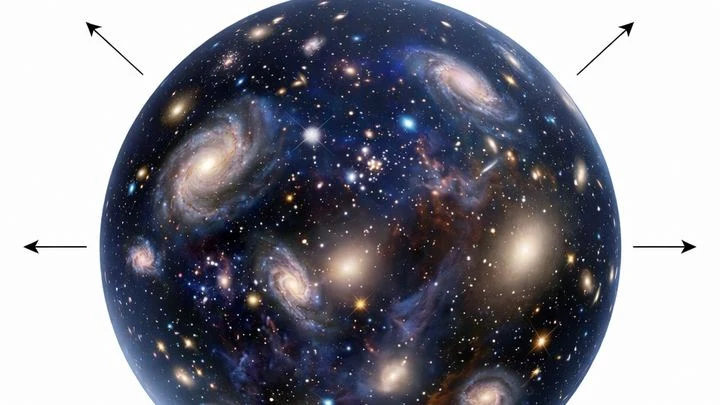
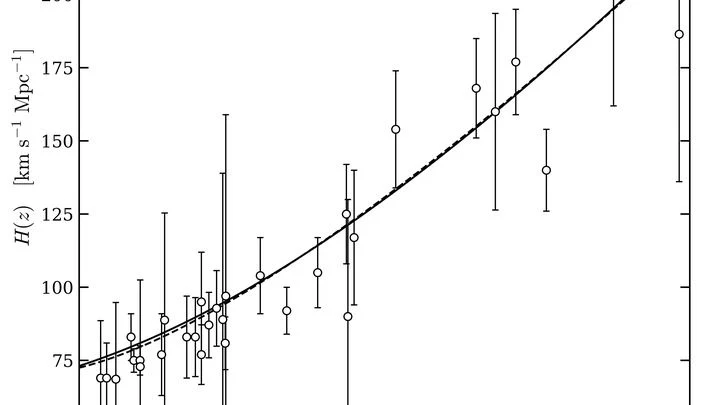
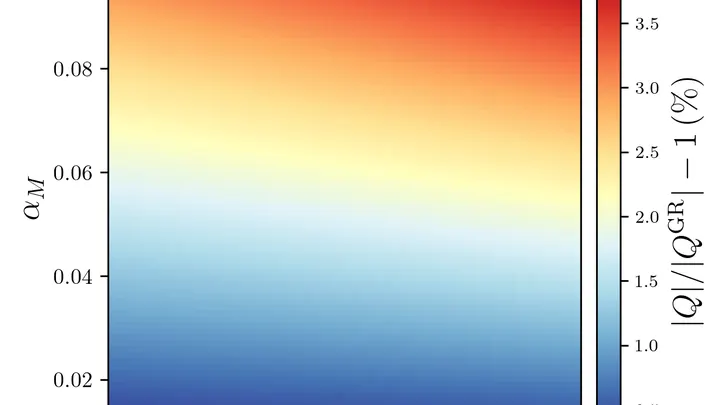
Dark energy alternatives are theoretical frameworks that attempt to explain the observed accelerated expansion of the universe without invoking a cosmological constant or a dynamic dark energy field. The standard model of cosmology (ΛCDM) attributes this acceleration to dark energy, which makes up about 68% of the universe's energy density. However, alternatives propose mechanisms such as modified gravity theories, where the laws of gravity change on cosmic scales, or models where particle creation from the vacuum drives acceleration. These alternatives are motivated by the fine-tuning problem of the cosmological constant and by the desire to unify cosmic acceleration with other cosmological phenomena like the formation of large-scale structure.
History
The idea that cosmic acceleration might not be due to a cosmological constant dates back to the late 1990s, shortly after the discovery of acceleration. Modified gravity theories like f(R) gravity were developed in the 2000s, and particle creation models have been explored since the 1980s but gained renewed interest in the 2010s.
How it works
One class of alternatives modifies Einstein's general relativity, for example by adding terms that become significant at low curvatures (f(R) gravity) or by introducing extra dimensions. Another class involves 'running vacuum' models, where the vacuum energy density slowly decreases over time, or 'particle creation' models, where the expansion of the universe continuously creates particles, effectively acting as a negative pressure. These models are designed to reproduce the same expansion history as ΛCDM but with different underlying physics, which can be tested by precise measurements of the cosmic microwave background, supernovae, and baryon acoustic oscillations.
In practice
These alternatives guide observational programs in cosmology, such as the Euclid satellite and the Dark Energy Survey, which aim to distinguish between dark energy and modified gravity by measuring the growth of cosmic structures.
Fun fact
Some dark energy alternatives predict that the acceleration of the universe will eventually cease, leading to a future where the expansion slows down again — a scenario that is impossible in the standard ΛCDM model.
The universe is like dough rising in an oven. Galaxies are flying apart, and the rate of this expansion is accelerating. To explain the accelerating expansion, cosmologists came up with dark energy — a mysterious force that pushes space apart from within. The standard recipe, called Lambda-CDM, works pretty well, but it has its inconsistencies.
Space is expanding, and that expansion is accelerating. But what if, in the first instants after the Big Bang, gravity behaved differently? The authors of a new study added an invisible field to Einstein's equations that siphons energy from ordinary matter and radiation.
A scale that weighs not a body, but the very space around it. That's how Einstein's equations work in general relativity: they link the curvature of spacetime to what resides within it.
Light from the hottest stage of the universe has been traveling toward us for nearly 14 billion years. This is the cosmic microwave background — a faint glow filling the entire sky.
Light freezes at the edge of the abyss: that's what the event horizon of an ordinary black hole looks like. But at the center of this abyss lurks a singularity, a point where the laws of physics break down. What if, instead of a point, there were a hard shell?
A gravastar is not a black hole.
In 1998, physicists caught neutrinos doing something astonishing: the particle changes its type on the fly. That is only possible if it has mass. This became the only laboratory proof of physics beyond the Standard Model. But exactly how much a neutrino weighs remains a mystery.
Cosmic ripples begin with tiny clumps. 380,000 years after the Big Bang, the universe was nearly homogeneous — density fluctuations were only one part in 100,000. But gravity turned these weak ripples into galaxies, clusters, and giant voids.
A cold, black mirror — that's what the sea of dark energy, the invisible substance driving the expansion of the universe, looked like for billions of years. But the DESI spectrograph has caught a faint ripple.
The universe is a grand orchestra, with dark energy conducting the expansion. Ten billion years ago, the conductor changed its gesture: the negative pressure that had been holding back galaxy assembly gave way to accelerating expansion — the very phenomenon discovered by [scientist:Saul…
A drama is brewing in cosmology: two principal musical instruments, the orchestra of the early Universe and the chamber ensemble of the modern cosmos, play the same symphony of expansion at different tempos.
In the first moments of the universe's life, there was not even a hint of dark energy — the very force that today pushes galaxies apart ever faster. But if you look deeper, down to the Planck scale (billions upon billions of times smaller than an atomic nucleus), spacetime ceases to be smooth.
The Universe is an orchestra playing the symphony of the Big Bang. For a long time, the conductor was thought to be dark energy — an unwavering metronome setting the pace of expansion.
The universe is expanding at an accelerating rate, like dough that keeps rising faster even though the yeast ran out long ago. For twenty years, astronomers have been searching for the cause and call it dark energy. But what it is remains a mystery.
New work proposes an unexpected source: the vacuum inside the atomic nucleus.
The Universe behaves like a soap bubble swelling in a multidimensional foam. The dark bubble model explains why it's expanding ever faster: the spacetime bubble grows, and its membrane gains a tiny thickness — about a micron, like a bacterium. At such distances, gravity 'blurs' across this thickness and weakens.
Since the end of the 20th century, we've known: the expansion of the Universe is accelerating — galaxies are flying apart faster and faster. The discovery brought a Nobel Prize to Adam Riess, Saul Perlmutter, and Brian Schmidt.
The universe is expanding faster and faster thanks to dark energy. But measurements of the rate give contradictory results. A new explanation: in the past, dark energy acted as a brake, slowing the galaxies' recession, and then switched to acceleration. Like a car that first rolls backward and then lunges forward.
The late-stage Universe can be thought of as a crowd dispersing after a concert. In the standard cosmological model ΛCDM, people shuffle away quietly, not bothering each other. But what if thousands of concertgoers suddenly start gently nudging their neighbors?
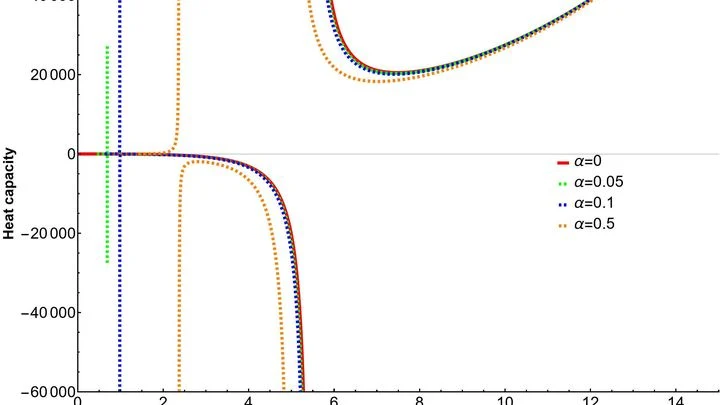
An ordinary black hole is like a stove that heats up more as its mass shrinks. A tiny hole should glow at unimaginable temperatures and evaporate in an instant. But that scenario ignores quantum corrections — what happens when the very fabric of spacetime begins to tremble.
Quantum noise, like the hiss of an untuned radio, filled the infant Universe. Alan Guth showed that superfast expansion (inflation) caused this ripple to freeze, giving rise to clumps of matter — the seeds of galaxies.
A new method extends this picture to any theory of gravity.
The cosmic vacuum is not emptiness but a living ocean: its energy swells and subsides, echoing the expansion. Like a lunar tide, vacuum density sensitively responds to Hubble’s tempo — the conductor’s baton of the universe.
For almost a century, cosmologists have been grappling with the mystery: what makes the Universe expand ever faster? The standard answer — dark energy — creates a monstrous discrepancy between the theoretical vacuum density and observations. But there's another path, one that turns causality on its head.
A compressed spring can sit for years without moving. It seems frozen forever, but inside the metal, atoms slowly rearrange, and one day the spring clicks, settling into a new, more relaxed position.
A blacksmith forges a sword. With each hammer blow, the red-hot metal flattens, but the hammer, the anvil, and the surrounding air all warm up slightly. Part of the impact energy is irreversibly lost as heat — a trade-off familiar to anyone who has ever driven a nail, and it turns out to be the key to the biggest mysteries of the cosmos.
An inflating balloon starts out slowly, then suddenly expands faster and faster, as if someone is pumping it up from inside. That's roughly how our universe behaves: galaxies are receding with acceleration. The culprit behind this acceleration is called dark energy.
Cosmology is going through strange times. On one hand, the standard model with dark matter and dark energy beautifully describes the large-scale structure. On the other, it's cracking at the seams.
For a long time, dark energy, the mysterious force prodding the expansion of the Universe, was considered eternal and unchanging, like yeast that never loses its activity. But explaining such constancy through the laws of the microcosm proved impossible, and scientists began to suspect that the “leaven” might be going flat.
Imagine inflating a balloon. It expands quickly at first, then slows down, and then suddenly speeds up again, as if someone gave the pump another squeeze. That's what seems to be happening to our universe.
The Universe is like an inflating balloon. Quantum mechanics forbids measuring exactly how big it is and how fast it's inflating at the same time. This principle permeates the cosmos: a new equation states that the Universe's expansion and its size are linked by a fundamental uncertainty.
You're inflating a balloon, but with each pump of the bulb, the rubber doesn't just stretch: it subtly changes its elasticity. Gravity works similarly in the new model: not as a rigid stage for the cosmic play, but as a living material that responds to every speck of matter.
A balloon inflates on its own, even though no one is blowing it up. That's roughly how the accelerated expansion of the universe looks, and to explain it, scientists usually invoke dark energy, an invisible and poorly understood force. But what if the balloon expands because new air molecules are continuously appearing inside it?
If space is a canvas, then brushstrokes cannot be infinitely thin. There's a tiniest segment, shorter than which there's no point in measuring. This quantum 'graininess' alters the geometry itself: the motion of galaxies and the growth of large-scale structures bear its mark.
The universe is expanding faster and faster, and scientists blame it on dark energy. Its origin is explained in a new way: dark energy isn't eternal, but appears only after dark matter clumps together into lumps — future galaxies.
The mechanism works like a pump that turns on when pressure drops.
Dark energy is usually seen as an innate property of the cosmos, at work from the very first moments. But a new model suggests it behaved like water on the verge of boiling: long unnoticed, then suddenly kicking in at a critical moment. This scenario is called 'late activation': around 5–7 billion years ago, a shift occurred, and the universe’s expansion began to accelerate.
An attempt to suppress room background noise by adding anti-sound turns into speaker howl if the circuit has an error. A similar glitch occurred with a theory that set out to remove the main cosmic hum — the inexplicably weak dark energy.
The Universe is expanding faster and faster. We used to chalk that up to dark energy — a mysterious force working alone. But the latest measurements seem to have eavesdropped on a private conversation: it appears dark energy is not silent but whispering back and forth with dark matter.
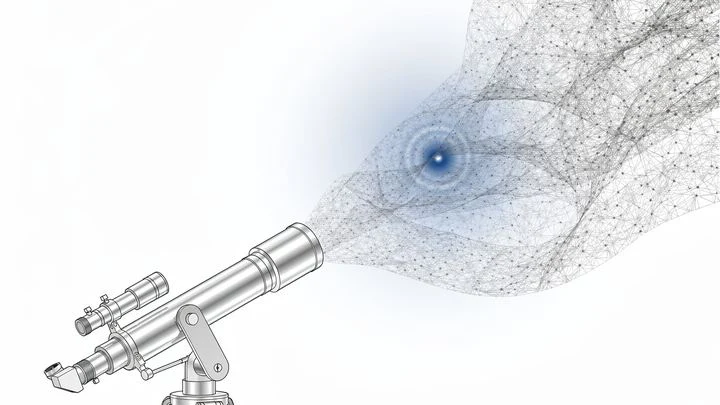
Light from distant galaxies, passing through clusters of matter, gets distorted — much like the bottom of a pool breaks up into ripples of water. Astronomers measure these barely perceptible bends in shape and create a map of gravitational ‘ripples.’ This is weak lensing — a natural detector of invisible matter.
In the cosmic dance, dark energy and dark matter exchange energy. For a long time, dark energy was thought to be a constant force accelerating the universe — an insight that earned the Nobel Prize for Riess, Perlmutter, and Schmidt.
Data from the DESI galaxy survey hint: dark energy was more powerful in the past than today. This 'phantom' behavior threatens the Universe with a Big Rip — a finale where even atoms disintegrate. But the KMIX model explains this as an illusion. Two fundamental fields — like a distorting mirror — warp our picture: constant energy appears variable.