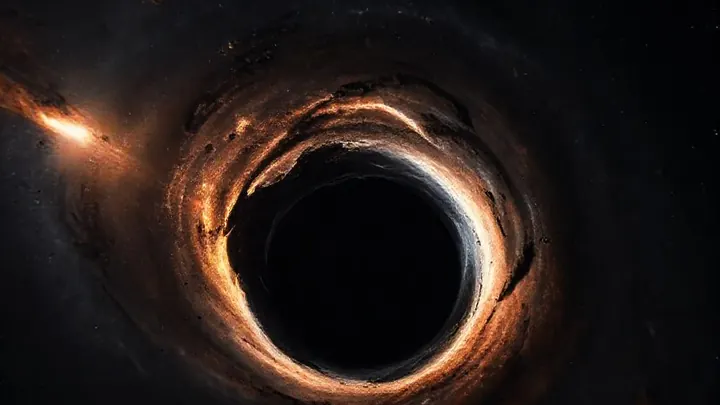
Dark energy, the mysterious force driving the accelerated expansion of the universe, does not just stretch the cosmos — it also leaves subtle fingerprints on the most extreme objects in it: black holes. The interaction between dark energy and black holes is a frontier topic in modern cosmology, exploring how a smooth, pervasive energy field can influence the growth, tidal forces, and even the observable shadows of these gravitational monsters. In an expanding universe, dark energy alters the spacetime backdrop against which black holes evolve, potentially changing how they accrete matter and how they merge.
History
The idea that dark energy could affect black holes gained traction in the early 2000s, following the discovery of cosmic acceleration in 1998. Theoretical work by cosmologists and relativists explored how a cosmological constant modifies black hole solutions, building on the classic Schwarzschild and Kerr metrics.
How it works
Dark energy is often modeled as a cosmological constant — a uniform energy density that remains constant as space expands. Around a black hole, this constant energy density contributes to the spacetime curvature, slightly modifying the geometry near the event horizon. In more dynamic models, such as quintessence, dark energy can vary over time and space, creating a 'dark energy atmosphere' around black holes that affects tidal forces on infalling matter and the rate at which the black hole's mass grows. These effects are tiny but could be observable through precise measurements of black hole shadows or the gravitational waves emitted during mergers.
In practice
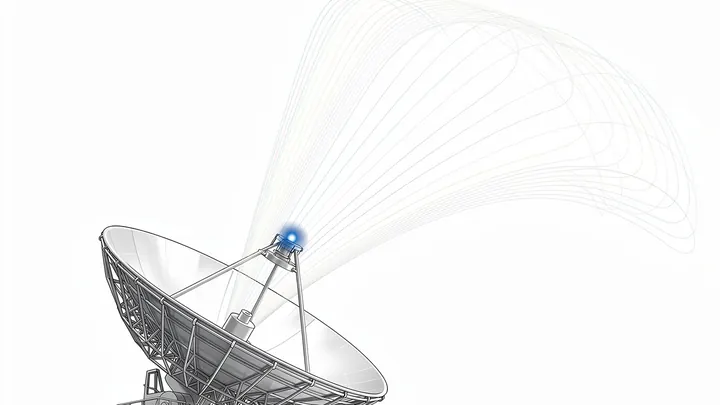
This research informs the interpretation of black hole observations from telescopes like the Event Horizon Telescope and gravitational wave detectors like LIGO and Virgo, helping to constrain the nature of dark energy.
Fun fact
In some models, dark energy can act as a 'cosmic hair' on black holes, leaving a subtle imprint on their gravitational wave signals that could be detected with future space-based observatories.
When you blow up a balloon too quickly, its surface starts to quiver. Something similar happened to space in the first moments after the Big Bang: the universe expanded rapidly, and the very fabric of space began to ripple.
The universe is a vast, dark ocean. We see only the glowing foam on its surface — stars and galaxies. But hidden in the depths are two invisible forces: dark matter, which with its gravity keeps galaxies from flying apart, and dark energy, which, on the contrary, pushes space itself apart, making the universe expand faster and faster.
Cosmic ripples begin with tiny clumps. 380,000 years after the Big Bang, the universe was nearly homogeneous — density fluctuations were only one part in 100,000. But gravity turned these weak ripples into galaxies, clusters, and giant voids.
At the center of many galaxies lurks an invisible cloud — a halo of dark matter. If this matter is cold and light enough, it behaves like a superfluid: it flows without friction, and any rotation in it twists into tiny quantum vortices — threads the size of an atomic nucleus.
The standard model of cosmology, based on the field equations proposed by Einstein, describes the Universe as a cocktail of dark matter (discovered thanks to Vera Rubin) and dark energy in roughly a 1:3 ratio.
Imagine a cosmic orchestra performing a symphony from the Big Bang to the present day. The conductor, dark energy, long seemed an impassive metronome: the cosmological constant Λ motionless, like a baton frozen in mid-air.
The Universe is an orchestra playing the symphony of the Big Bang. For a long time, the conductor was thought to be dark energy — an unwavering metronome setting the pace of expansion.
In a recent study, astrophysicists showed how pre-recombination physics, particularly early dark energy, affects the spectral running $$α_s$$ and, consequently, the viability of scenarios forming primordial black holes from an ultra-slow-roll (USR) phase during inflation.
In the late 1990s, the night sky delivered a surprise: Saul Perlmutter and Adam Riess found that the expansion of the Universe is accelerating. Ever since, the greatest riddle has been dark energy — a substance making up nearly 70% of the cosmos, yet evading laboratory study.
When a car on cruise control hits a bump, the speed jumps for a moment, but the engine runs smoothly. Something similar was recently noticed with dark energy — the force that makes the Universe expand faster and faster.
A swarm of mirrors and antennas envelops a black hole like bees around a hive. But instead of honey, this structure collects energy enough to power a consciousness the size of a galaxy. These very 'Dyson minds' were the topic of a recent meeting at MIT. The idea traces back to [scientist:F. J.
When two black holes collide, they send out gravitational waves and ring like a massive bell. The fading sound, or ringdown, carries the imprint of the final black hole. But if dark energy, the force accelerating the universe, changes over time, it can cling to the black hole like a thin paint layer.
Galaxies are flying apart, but the expansion rate measured from the afterglow of the Big Bang and from supernova explosions doesn't match: this problem has been called the Hubble tension. It's like two dancers losing their rhythm because they can't feel each other.
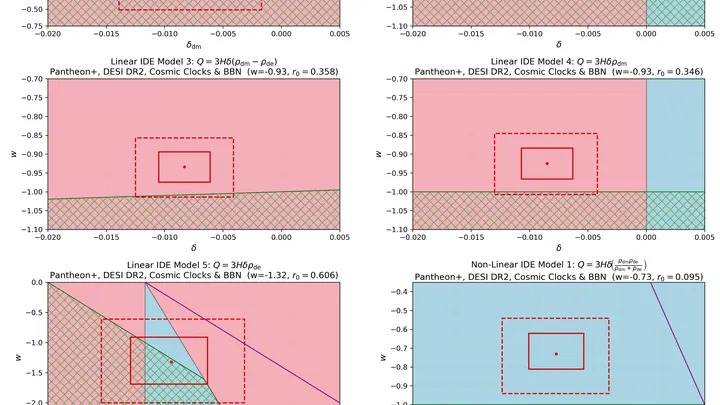
The Universe is expanding faster and faster. We used to chalk that up to dark energy — a mysterious force working alone. But the latest measurements seem to have eavesdropped on a private conversation: it appears dark energy is not silent but whispering back and forth with dark matter.
Dark energy and dark matter are the invisible conductors of the cosmos. Usually considered independent, new research proposes seeing them as dance partners. The lead — dark energy — changes the mass of dark matter particles. Like a dancer who lifts and lowers their partner, dark energy increases or decreases the weight of dark matter.
In the cosmic dance, dark energy and dark matter exchange energy. For a long time, dark energy was thought to be a constant force accelerating the universe — an insight that earned the Nobel Prize for Riess, Perlmutter, and Schmidt.