Early dark energy is a hypothetical form of dark energy that was significant in the first few hundred thousand years after the Big Bang, rather than only in the recent universe. It is proposed to resolve the 'Hubble tension' — a persistent discrepancy between measurements of the universe's expansion rate from the early universe (cosmic microwave background) and the late universe (local distance ladder). By adding a burst of extra energy density in the early universe, it changes the sound horizon scale and reconciles the two measurements.
History
The idea of early dark energy was proposed in the late 2000s by several cosmologists, including Eric Linder and Robert Caldwell, and gained prominence after the Hubble tension became statistically significant around 2019. The specific 'two-flavor' variant mentioned in the corpus is a recent development from 2024.
How it works
In the standard cosmological model, dark energy is constant and negligible in the early universe. Early dark energy models introduce a scalar field or a modified vacuum energy that is dynamically important only around the epoch of recombination (redshift ~1000). This extra energy accelerates expansion briefly, which alters the acoustic oscillations in the primordial plasma and shifts the apparent size of the sound horizon. As a result, the inferred Hubble constant from CMB data increases, matching local measurements. The field must then decay or dilute rapidly so that it does not interfere with later structure formation.
In practice
Early dark energy is a key input for cosmological parameter estimation, and it guides observational strategies for upcoming surveys like Euclid and the Vera Rubin Observatory, which aim to measure the expansion history with high precision.
Fun fact
Early dark energy is sometimes called 'the universe's coffee break' because it briefly speeds up expansion right before the cosmic microwave background is released, then disappears without a trace.
A campfire that doesn't go out all at once but smolders for hours because the wood inside still holds the heat of the past flame. That's roughly how the memory effect works for black holes. Normally, a tiny black hole with the mass of a mountain should evaporate in fractions of a second, scattering particles like sparks.
Six runners sprint down the track, and officials time their speed without noticing a tailwind. The wind blows at their backs, and the stopwatches show a better result than the truth. Roughly this is how six megamasers — natural cosmic lasers in distant galaxies — misled astronomers measuring the expansion rate of the universe.
A black hole is not an eternal vacuum cleaner. It slowly loses mass by emitting particles, much like a heated stone cooling as it radiates heat. This process, discovered by Stephen Hawking, is barely noticeable for large holes, but for tiny ones, with masses comparable to a mountain, it becomes a violent evaporation.
In 1929, Edwin Hubble pointed his telescope at distant galaxies and discovered they were receding. Ninety years later, two measurements of this recession rate, from ancient light and from nearby stars, stubbornly disagree. A 9% discrepancy cannot be chalked up to error. It is as if the Universe in its youth and in its maturity runs on different clocks.
Cosmology has landed in an interesting pickle. The two main ways to look back into the universe's past, via the early glow (the cosmic microwave background) and via later objects like supernovae, yield different numbers for the expansion rate (the Hubble constant) and for how clumpy matter is distributed.
Through three minutes after the Big Bang, the Universe played its first symphony. It was the big bang nucleosynthesis — the formation of light nuclei, where each element sounded its own note, and the tempo was set by the expansion of space.
The universe cooled like a giant bathtub after a hot start. At 400 000 years after the Big Bang, hydrogen was ready to recombine — protons capturing electrons to become neutral atoms. But somewhere in this dark water, a tap kept dripping.
The cosmological debate is like two craftsmen measuring the same wall but getting different lengths. One uses a tape measure, applying it to nearby landmarks — Cepheids (pulsating beacon stars) and Type Ia supernovae (flashes of dying stars). He finds the wall is stretching at 73.5 arbitrary units.
A drama is brewing in cosmology: two principal musical instruments, the orchestra of the early Universe and the chamber ensemble of the modern cosmos, play the same symphony of expansion at different tempos.
Imagine a cosmic orchestra performing a symphony from the Big Bang to the present day. The conductor, dark energy, long seemed an impassive metronome: the cosmological constant Λ motionless, like a baton frozen in mid-air.
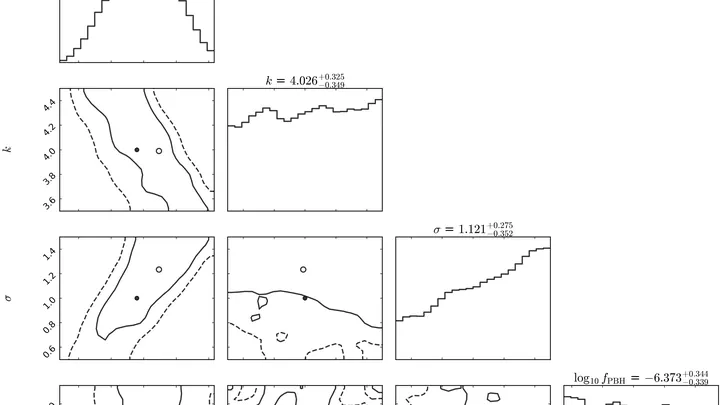
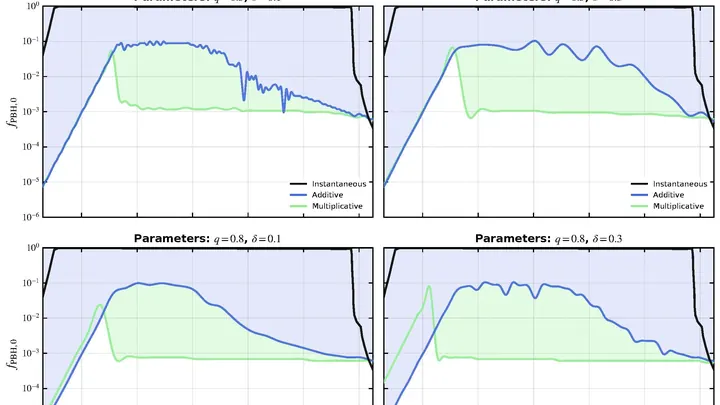
In a recent study, astrophysicists showed how pre-recombination physics, particularly early dark energy, affects the spectral running $$α_s$$ and, consequently, the viability of scenarios forming primordial black holes from an ultra-slow-roll (USR) phase during inflation.
Cosmology is like an orchestra where different sections suddenly start playing out of sync. Measurements of the universe's expansion rate (the Hubble constant) from the early and late universe give different numbers.
In the late 1990s, the night sky delivered a surprise: Saul Perlmutter and Adam Riess found that the expansion of the Universe is accelerating. Ever since, the greatest riddle has been dark energy — a substance making up nearly 70% of the cosmos, yet evading laboratory study.
The universe is a vast orchestra playing the score of expansion. Galaxies race apart to the beat of inaudible music of dark energy. But here's the trouble: the conductor's baton held by Edwin Hubble, Adam Riess, and Vera Rubin sets two incompatible tempos.
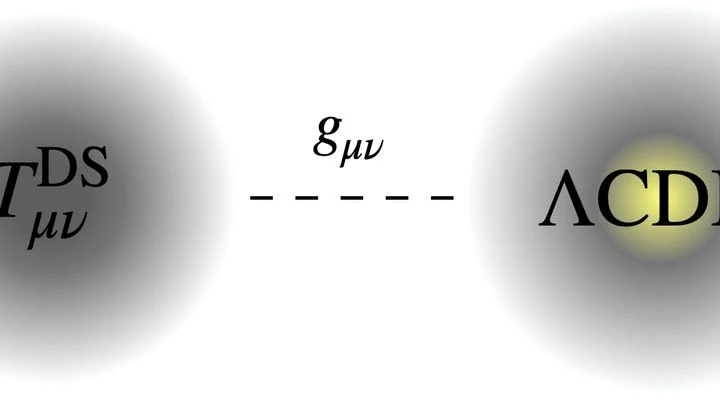
Einstein’s cosmological constant — a blunder or a boomerang insight? The universe’s acceleration caught physicists off guard: ΛCDM works, but why is the vacuum energy so absurdly tiny? Imagine an ocean heaving with quantum fluctuations, yet on the surface only a microscopic ripple.
For decades, two independent methods of measuring the rate at which galaxies are flying apart, the Hubble constant, have given conflicting numbers. The situation resembled a room with two thermometers showing different temperatures.
Two rulers show slightly different lengths for the same table. That's roughly the situation in cosmology with the Hubble constant — the number that tells how fast the universe is expanding.
The origin of the hot Big Bang is one of the greatest mysteries. The familiar picture: after inflation, the inflaton field transfers energy to ordinary particles, reheating the Universe. Yet dark matter and dark energy hint that nature has hidden sectors.
An acoustic black hole is a fluid flow faster than sound, so sound waves can't escape. The boundary, the surface where the flow speed reaches the speed of sound, spawns pairs of phonons: sound quanta, one flying away, the other plunging inward.
A blacksmith forges a sword. With each hammer blow, the red-hot metal flattens, but the hammer, the anvil, and the surrounding air all warm up slightly. Part of the impact energy is irreversibly lost as heat — a trade-off familiar to anyone who has ever driven a nail, and it turns out to be the key to the biggest mysteries of the cosmos.
On the kitchen counter, there's a flour scale and a measuring cup for water. Individually, they're precise, but when you bake bread, the recipe calls for the perfect ratio. Astronomers have a similar dispute about the universe's expansion rate.
The universe is expanding, and its history features two puzzling episodes that don't fit into a simple picture. The first is a brief period in its youth when everything flew apart faster than expected, as if someone had floored the gas pedal. The second is today's acceleration, as if the same pedal were pressed again, but more gently.
A pendulum swings in thick syrup. In the first fractions of a second, it moves quickly, but the syrup slows it down, and then suddenly the syrup becomes thinner, and the pendulum speeds up again. Something similar might have happened to our universe.
A tiny black hole, no larger than an atomic nucleus, hovers in a cloud of hydrogen. It doesn't swallow everything around it; instead, it slowly radiates away, losing mass with every moment.
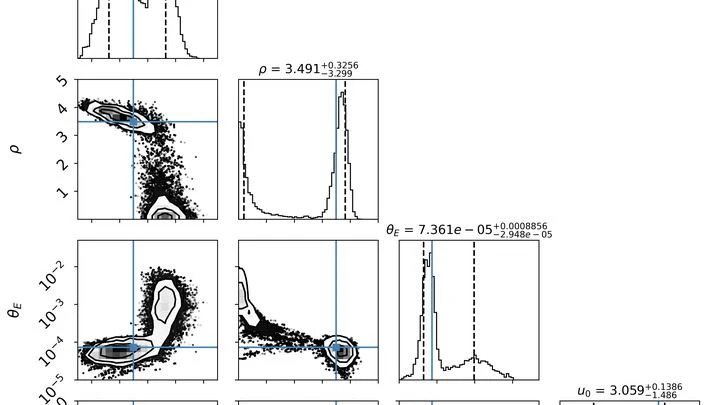
A spotlight shines through a dark hall. Between the lamp and the wall, an invisible lens drifts by, and the spot of light briefly brightens and shifts. That is exactly what the DECam telescope, aimed at the Large Magellanic Cloud, a satellite galaxy of our Milky Way, was watching for five consecutive nights.
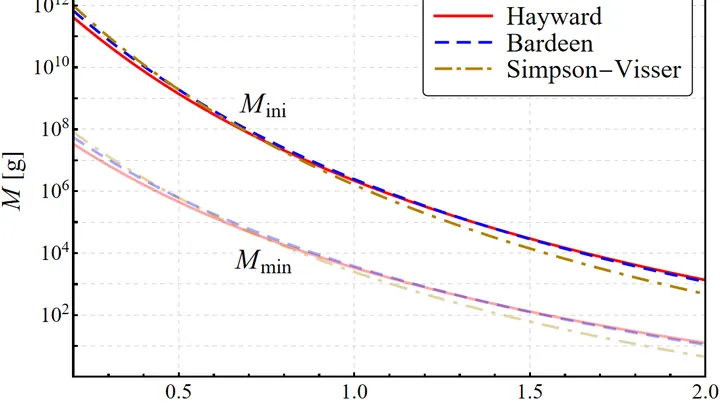
A sugar cube weighs about a gram. But a black hole that could hide inside such a cube would weigh as much as a small mountain — billions of tons. Yet even such tiny things, born in the first instants after the Big Bang, should have vanished long ago.
Imagine a huge layered cake, where the layers of dough are space and the filling is a special region resembling an invisible wall. This wall is not made of bricks but of energy, and it could be as thick as the entire universe. If such a wall exists, it should stretch the dough layers differently: those lying along it spread apart faster, while those across it spread slower.
A tiny black hole the size of an atomic nucleus but with the mass of a mountain emerged in the first moments after the Big Bang, when random clumps of energy collapsed into such objects.
The mystery of dark matter, first glimpsed in the stellar whirlpools by Vera Rubin, has been tormenting physics for nearly a century. One of the boldest hypotheses: primordial black holes, born in the scalding broth of the early universe.
Right after the Big Bang, the Universe expanded incredibly fast — this phase was called inflation. In some microscopic regions, matter randomly clumped so much that it collapsed into primordial black holes. They are tiny — the size of a proton, yet as massive as an iceberg.
A pond with ripples spreading from a fallen stone. So it is on cosmic scales: a sudden burst of energy in the dark sector, an invisible substance that emits no light, creates ripples in the fabric of space. These ripples alter the path of light particles traveling to us from the very birth of the cosmos.
The authors of the new study built a mathematical framework to describe these distortions.
Gravitational wave detectors pick up a low-frequency hum, like the sound of a distant waterfall. The Webb telescope finds galaxies in the early universe with black holes that seem too massive for such a young age.
Two clocks tell different times. One sits on our desk, the other lies far in the past, in the glow left over from the Big Bang. The first, looking at nearby galaxies, ticks off the expansion rate of the universe — about 73 kilometers per second per megaparsec of distance. The second, peering into ancient light, gives a noticeably lower value — roughly 67.
A tiny black hole — the size of an atom but as massive as a mountain. It wasn't born from a star but in the first instants after the big bang, and it has been quietly losing mass ever since, radiating heat.
The cosmological dispute resembles two craftsmen measuring the same room with different tape measures. One, looking at distant galaxies, gets one number. The other, peering into the ancient glow (the cosmic microwave background, the cooled light of the Big Bang) gets another, smaller number.