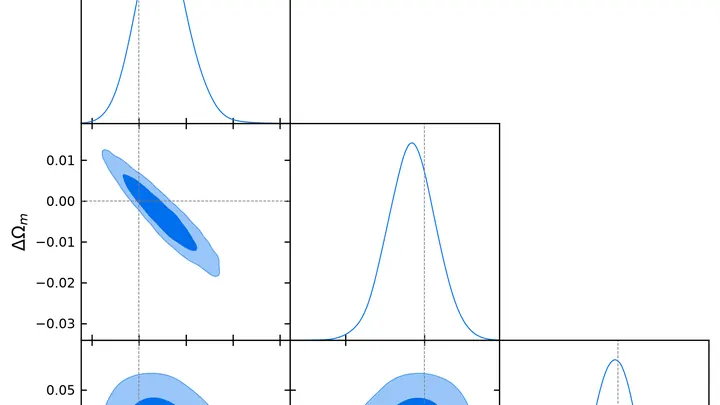
The eCDM model is a cosmological framework that extends the standard Lambda-Cold Dark Matter (ΛCDM) model by allowing the dark energy density to vary over time, specifically transitioning from negative to positive values. In the standard model, dark energy is a constant positive energy density that drives the accelerated expansion of the universe. The eCDM model introduces a dynamical component that can be negative in the early universe, potentially affecting the growth of structure and the expansion history, and then becomes positive at later times, matching observations of cosmic acceleration.
History
The eCDM model is a relatively recent theoretical proposal, emerging in the 2020s as a response to tensions in cosmological measurements, such as the Hubble constant discrepancy. It is not attributed to a single author but has been explored by several research groups.
How it works
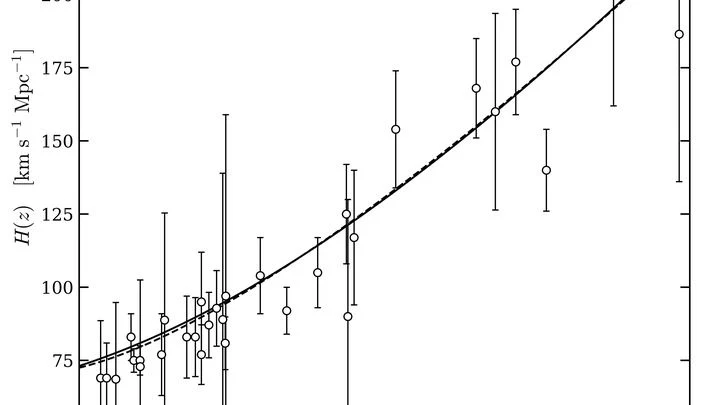
In the eCDM model, the dark energy is described by a scalar field or a modified equation of state that permits a sign change. In the early universe, a negative dark energy density would act like a repulsive gravity that slows down expansion or even causes a contraction, which could alter the formation of galaxies and clusters. As the universe expands, the field evolves, crossing zero and becoming positive, which then drives the accelerated expansion we observe today. This transition can be tuned to fit cosmological data, such as supernova distances, cosmic microwave background fluctuations, and galaxy clustering.
In practice
It is used in cosmology to test alternative explanations for dark energy and to address anomalies in standard cosmological observations, potentially refining our understanding of the universe's evolution.
Fun fact
In the eCDM model, the universe might have experienced a period of 'anti-gravity' in its infancy, which could leave subtle imprints on the distribution of galaxies that telescopes like Euclid might detect.
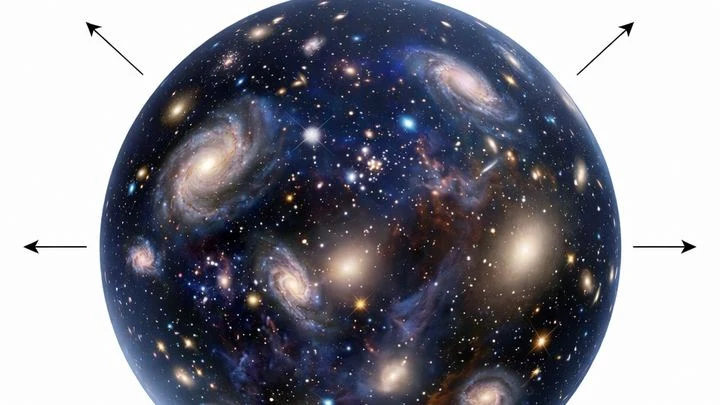
The universe is like dough rising in an oven. Galaxies are flying apart, and the rate of this expansion is accelerating. To explain the accelerating expansion, cosmologists came up with dark energy — a mysterious force that pushes space apart from within. The standard recipe, called Lambda-CDM, works pretty well, but it has its inconsistencies.
The universe is constantly sending us signals, but many are too faint to notice. Relic neutrinos, particles left over from the Big Bang, pass through Earth by the billions every second, yet catching even one is a feat on the edge of possibility. We need a detector that can sense energy a thousand times smaller than what it takes to move a speck of dust.
Space is expanding, and that expansion is accelerating. But what if, in the first instants after the Big Bang, gravity behaved differently? The authors of a new study added an invisible field to Einstein's equations that siphons energy from ordinary matter and radiation.
An invisible scaffold holds galaxies together, keeping them from flying apart. This is dark matter — matter that doesn't shine and barely interacts with ordinary stuff. Astrophysicists have long debated what it's made of.
The cosmological standard model is like a recipe for a cake where everything is strictly measured: dark matter is like flour without a single lump (zero pressure), and dark energy is like the perfect leavening agent (equation of state exactly minus one). But what if the flour is a bit damp and the leavening agent has lost its oomph?
The standard cosmological model ΛCDM (which includes dark energy and cold dark matter) is the score of a cosmic symphony. It describes how space expanded after the big bang. How dark matter clumped together. How galaxies ignited. For a long time, everything played flawlessly.
In 1929, Edwin Hubble pointed his telescope at distant galaxies and discovered they were receding. Ninety years later, two measurements of this recession rate, from ancient light and from nearby stars, stubbornly disagree. A 9% discrepancy cannot be chalked up to error. It is as if the Universe in its youth and in its maturity runs on different clocks.
The universe is a vast, dark ocean. We see only the glowing foam on its surface — stars and galaxies. But hidden in the depths are two invisible forces: dark matter, which with its gravity keeps galaxies from flying apart, and dark energy, which, on the contrary, pushes space itself apart, making the universe expand faster and faster.
In 1998, physicists caught neutrinos doing something astonishing: the particle changes its type on the fly. That is only possible if it has mass. This became the only laboratory proof of physics beyond the Standard Model. But exactly how much a neutrino weighs remains a mystery.
Cosmology has landed in an interesting pickle. The two main ways to look back into the universe's past, via the early glow (the cosmic microwave background) and via later objects like supernovae, yield different numbers for the expansion rate (the Hubble constant) and for how clumpy matter is distributed.
Through three minutes after the Big Bang, the Universe played its first symphony. It was the big bang nucleosynthesis — the formation of light nuclei, where each element sounded its own note, and the tempo was set by the expansion of space.
Cosmic ripples begin with tiny clumps. 380,000 years after the Big Bang, the universe was nearly homogeneous — density fluctuations were only one part in 100,000. But gravity turned these weak ripples into galaxies, clusters, and giant voids.
A cold, black mirror — that's what the sea of dark energy, the invisible substance driving the expansion of the universe, looked like for billions of years. But the DESI spectrograph has caught a faint ripple.
To capture every detail of a statue's shape, you could break it into millions of tiny cubes and describe each one — slow, heavy, and your computer's memory would groan at the seams. That's how 3D medical scans are usually handled: a CT or MRI is a huge array of such cubes (voxels), and to create or improve an image, the machine has to plow through all of them.
The universe is a grand orchestra, with dark energy conducting the expansion. Ten billion years ago, the conductor changed its gesture: the negative pressure that had been holding back galaxy assembly gave way to accelerating expansion — the very phenomenon discovered by [scientist:Saul…
Since Saul Perlmutter and his colleagues discovered the accelerated expansion of the universe, physicists have been scratching their heads over the nature of dark energy.
A drama is brewing in cosmology: two principal musical instruments, the orchestra of the early Universe and the chamber ensemble of the modern cosmos, play the same symphony of expansion at different tempos.
In the first moments of the universe's life, there was not even a hint of dark energy — the very force that today pushes galaxies apart ever faster. But if you look deeper, down to the Planck scale (billions upon billions of times smaller than an atomic nucleus), spacetime ceases to be smooth.
The Universe is an orchestra playing the symphony of the Big Bang. For a long time, the conductor was thought to be dark energy — an unwavering metronome setting the pace of expansion.
The universe hasn't always been expanding. In some models, it first contracted, nearly empty and flat, and then, upon reaching a limit, bounced back and started growing, like the world we know. This scenario is called bouncing cosmology.
At the center of attention are tiny stellar cities: ultra-faint dwarf galaxies. They resemble sparse swarms of fireflies circling within a vast invisible cloud. This cloud is a halo of ultralight dark matter. Its particles are so light that they behave not like billiard balls but like waves.
A teaspoon of neutron star matter weighs as much as a mountain. But this mountain may have an invisible twin.
Deep inside a neutron star, ordinary matter is compressed to unimaginable densities. There, protons and neutrons can dissolve into a quark soup.
The story began with a missing mass. In the 1930s, Fritz Zwicky, measuring velocities in galaxy clusters, first suspected the presence of invisible matter. Later, Vera Rubin showed that the outskirts of spiral galaxies rotate too fast for the visible matter.
In the late 1990s, the night sky delivered a surprise: Saul Perlmutter and Adam Riess found that the expansion of the Universe is accelerating. Ever since, the greatest riddle has been dark energy — a substance making up nearly 70% of the cosmos, yet evading laboratory study.
Einstein’s cosmological constant — a blunder or a boomerang insight? The universe’s acceleration caught physicists off guard: ΛCDM works, but why is the vacuum energy so absurdly tiny? Imagine an ocean heaving with quantum fluctuations, yet on the surface only a microscopic ripple.
The cosmological kitchen is full of invisible ingredients. Dark matter, like an invisible scaffold, keeps galaxies from flying apart, while dark energy, like yeast in dough, makes space expand ever faster.
The universe is expanding at an accelerating rate, like dough that keeps rising faster even though the yeast ran out long ago. For twenty years, astronomers have been searching for the cause and call it dark energy. But what it is remains a mystery.
New work proposes an unexpected source: the vacuum inside the atomic nucleus.
The Universe behaves like a soap bubble swelling in a multidimensional foam. The dark bubble model explains why it's expanding ever faster: the spacetime bubble grows, and its membrane gains a tiny thickness — about a micron, like a bacterium. At such distances, gravity 'blurs' across this thickness and weakens.
For decades, two independent methods of measuring the rate at which galaxies are flying apart, the Hubble constant, have given conflicting numbers. The situation resembled a room with two thermometers showing different temperatures.
A giant cloud of invisible matter acts like a funhouse mirror — distorting the light from a distant galaxy. From these distortions, astronomers can weigh the cloud and peer into its depths.
Since the end of the 20th century, we've known: the expansion of the Universe is accelerating — galaxies are flying apart faster and faster. The discovery brought a Nobel Prize to Adam Riess, Saul Perlmutter, and Brian Schmidt.
The Universe grows like a metropolis: galaxies skyscrapers are erected on an invisible scaffold of dark matter: its gravity pulling in construction material. Meanwhile, dark energy makes the city itself continuously expand.
The universe is expanding faster and faster thanks to dark energy. But measurements of the rate give contradictory results. A new explanation: in the past, dark energy acted as a brake, slowing the galaxies' recession, and then switched to acceleration. Like a car that first rolls backward and then lunges forward.
The late-stage Universe can be thought of as a crowd dispersing after a concert. In the standard cosmological model ΛCDM, people shuffle away quietly, not bothering each other. But what if thousands of concertgoers suddenly start gently nudging their neighbors?
An ordinary black hole is like a stove that heats up more as its mass shrinks. A tiny hole should glow at unimaginable temperatures and evaporate in an instant. But that scenario ignores quantum corrections — what happens when the very fabric of spacetime begins to tremble.
In the late 1990s, astronomers including Saul Perlmutter discovered that the universe is expanding at an accelerating rate. The cause was dubbed dark energy — an invisible force stretching the cosmos.
The cosmic vacuum is not emptiness but a living ocean: its energy swells and subsides, echoing the expansion. Like a lunar tide, vacuum density sensitively responds to Hubble’s tempo — the conductor’s baton of the universe.