Comet Dust Puts on a Celestial Show ✛
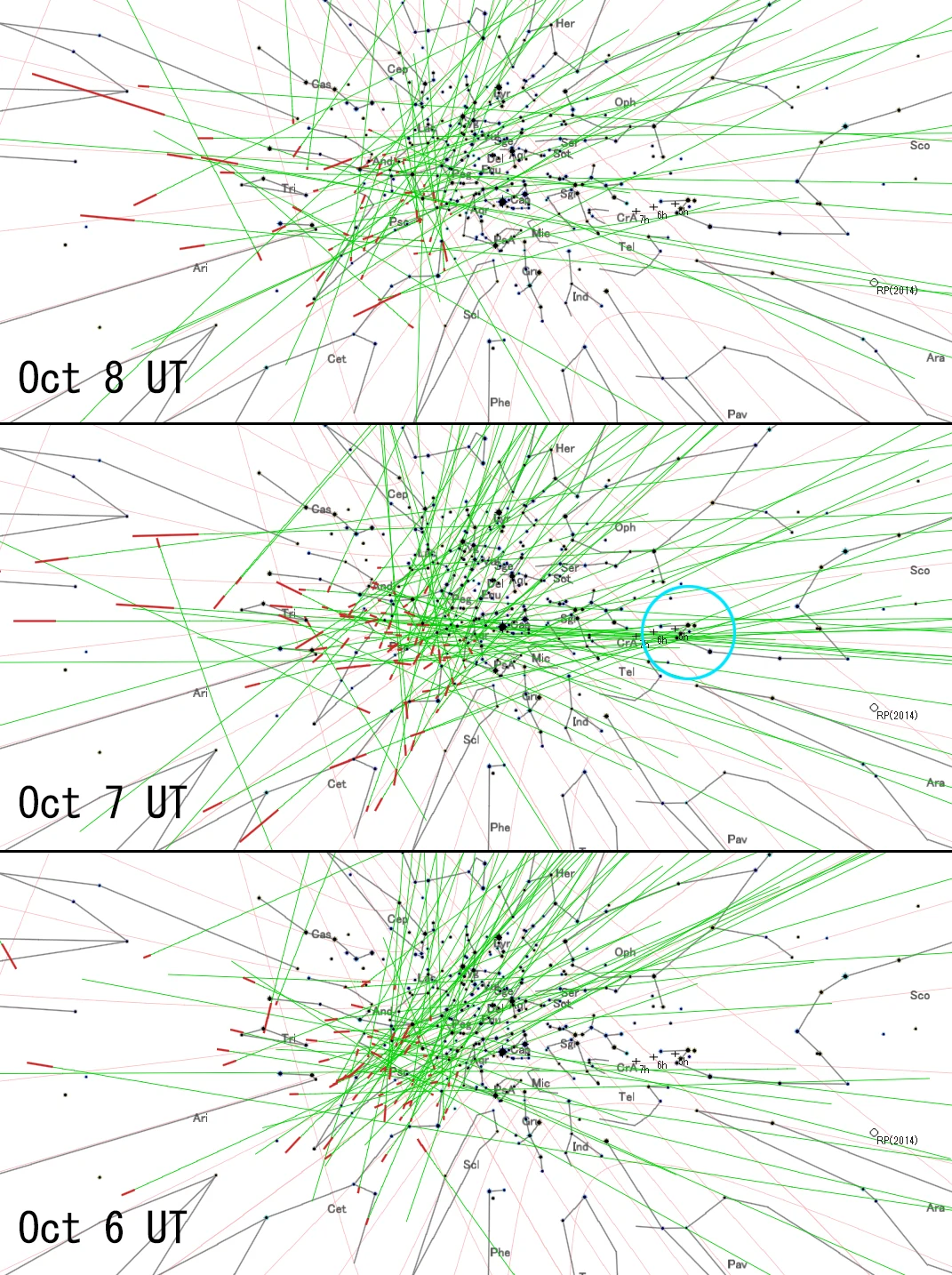
A comet is a chunk of ice that, as it approaches the Sun, heats up and releases gas and dust. The dust stretches along its orbit like an invisible trail. When Earth flies through such a trail, dust grains slam into the atmosphere and burn up: we see shooting stars. In 2014, comet 15P/Finlay suddenly brightened by a factor of a hundred and ejected dust faster than usual — about 67 meters per second. Models showed that this cloud would meet Earth seven years later.
And that's exactly what happened. On October 6, 2021, a camera on the Subaru Telescope in Hawaii was pointed at the sky. Volunteers counting through the footage spotted 24 meteors from the expected point in an hour and a half — six times more than on a typical night. An automated detector confirmed that noise, lasers, and car headlights were not to blame. The meteors were slow and faint, but a few left short glowing trails.
Previously, it was unclear whether such fast ejections could produce observable showers. Now it's clear they can, and you don't need huge telescopes to see them. A sensitive camera and attentive eyes are enough. In the future, such observations will help build a map of dust in the Solar System and assess how dangerous encounters with it might be for spacecraft.
The Aridis radiant lies in the constellation Ara, which from Hawaii is visible very low above the southern horizon — no higher than 13 degrees. That's like observing an object hanging at arm's length above the roof of a neighboring house: the atmosphere barely interferes thanks to the exceptional sky transparency at 4150 meters.
In the novel 'Lucifer's Hammer' (Larry Niven, Jerry Pournelle), a comet falls to Earth, causing a global catastrophe. Real observations of Aridis remind us that cometary dust is not just a beautiful spectacle but part of the complex dynamics of small bodies that humanity is only beginning to calculate.