A Dusty Barrier: How Astronomers Caught a Ghostly Meteor Shower Over Maunakea ✛
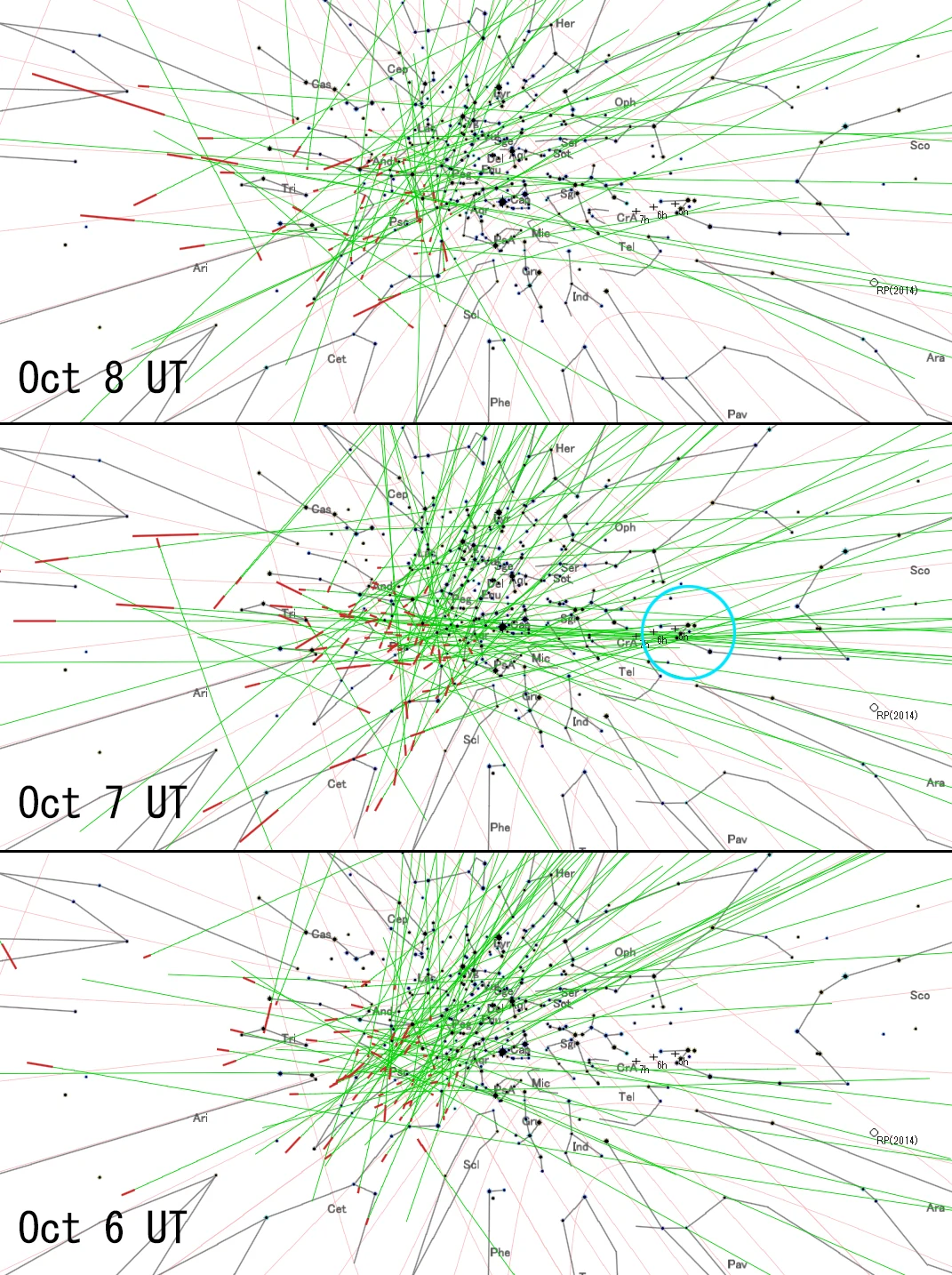
October 6, 2021, 8:30 PM Hawaii time. The StarCam camera on the dome of the Subaru Telescope gazes impassively at the sky, streaming the view on YouTube. Four and a half hours earlier, somewhere far away, Earth passed through an invisible trail — the dust tail of comet 15P/Finlay. Models predicted a peak, but would anyone see these 'shooting stars'? The radiant, the point in the sky from which the shower's meteors appear to emanate, hung just 13 degrees above the southern horizon, buried in dense atmospheric layers.
A comet's dust trail is an invisible cosmic train that Earth crosses like a barrier, collecting 'passengers' as flashes in the atmosphere. Until 2021, no one knew if this train would arrive on schedule. In 2014, comet 15P/Finlay experienced a powerful outburst, brightening a hundredfold and ejecting a cloud of dust at about 67 m/s. Modeling showed that particles could catch up with Earth seven years later. But confirming this is like hearing the echo of a distant explosion. And then, in the recordings from October 7, volunteers counted 24 candidate meteors from the radiant in 90 minutes, compared to only 4 and 5 on control days. The automated detector, which filters out noise, lasers, and car headlights, yielded 18, 3, and 2, respectively. The excess over background was sixfold, with a statistical significance of about 9 sigma. No doubt: the barrier had been triggered.
Modeling the dust tails of the comet, conducted by Mikiya Sato and Jun-ichi Watanabe, not only predicted the encounter: it allowed a glimpse into the past. We learned that the 2014 outburst ejected material at anomalously high speeds, and this dust, traveling through interplanetary space, retained its group identity. Previously, it was unclear whether such short-lived events could produce observable showers. Now it's clear: they can, and even a modest camera sensitive down to 7th magnitude can catch them, if volunteers and algorithms join forces.
This discovery is not just a checkmark on the list of new meteor showers. It provides a method: sensitive survey cameras at good astronomical sites can become a regular monitoring tool. Automated detection algorithms will improve, lowering the detection threshold in brightness and speed. Citizen science will remain a key element: the human eye is still better than machines at recognizing unexpected patterns. In the future, we could build a three-dimensional map of dust distribution in the solar system, calibrate models for assessing meteoroid hazards, and design missions to comets. For now, we await the next return of comet 15P/Finlay, to hear the echo of that distant explosion again, but this time, fully prepared.
The Aridis radiant lies in the constellation Ara, which from Hawaii is visible very low above the southern horizon — no higher than 13 degrees. That's like observing an object hanging at arm's length above the roof of a neighboring house: the atmosphere barely interferes thanks to the exceptional sky transparency at 4150 meters.
In the novel 'Lucifer's Hammer' (Larry Niven, Jerry Pournelle), a comet falls to Earth, causing a global catastrophe. Real observations of Aridis remind us that cometary dust is not just a beautiful spectacle but part of the complex dynamics of small bodies that humanity is only beginning to calculate.