Hunting the Ghost Stream: How a New Meteor Shower Was Caught Above Mauna Kea ✛
Context
Meteor showers are dust trails left by comets. When Earth passes through such a trail, particles enter the atmosphere and burn up, creating 'shooting stars.' Predicting a new shower is a complex task: you need to calculate how the dust was scattered by planetary gravity and the solar wind. Comet 15P/Finlay has long attracted attention: its orbit passes close to Earth's, but no meteors from it had been observed. In 2014, the comet unexpectedly flared up, becoming a hundred times brighter, and models showed that the dust ejected then could intersect Earth in 2021. Confirming this would test our understanding of how cometary dust moves in space and capture the birth of a new shower—a rare event that happens once in decades.
Methods
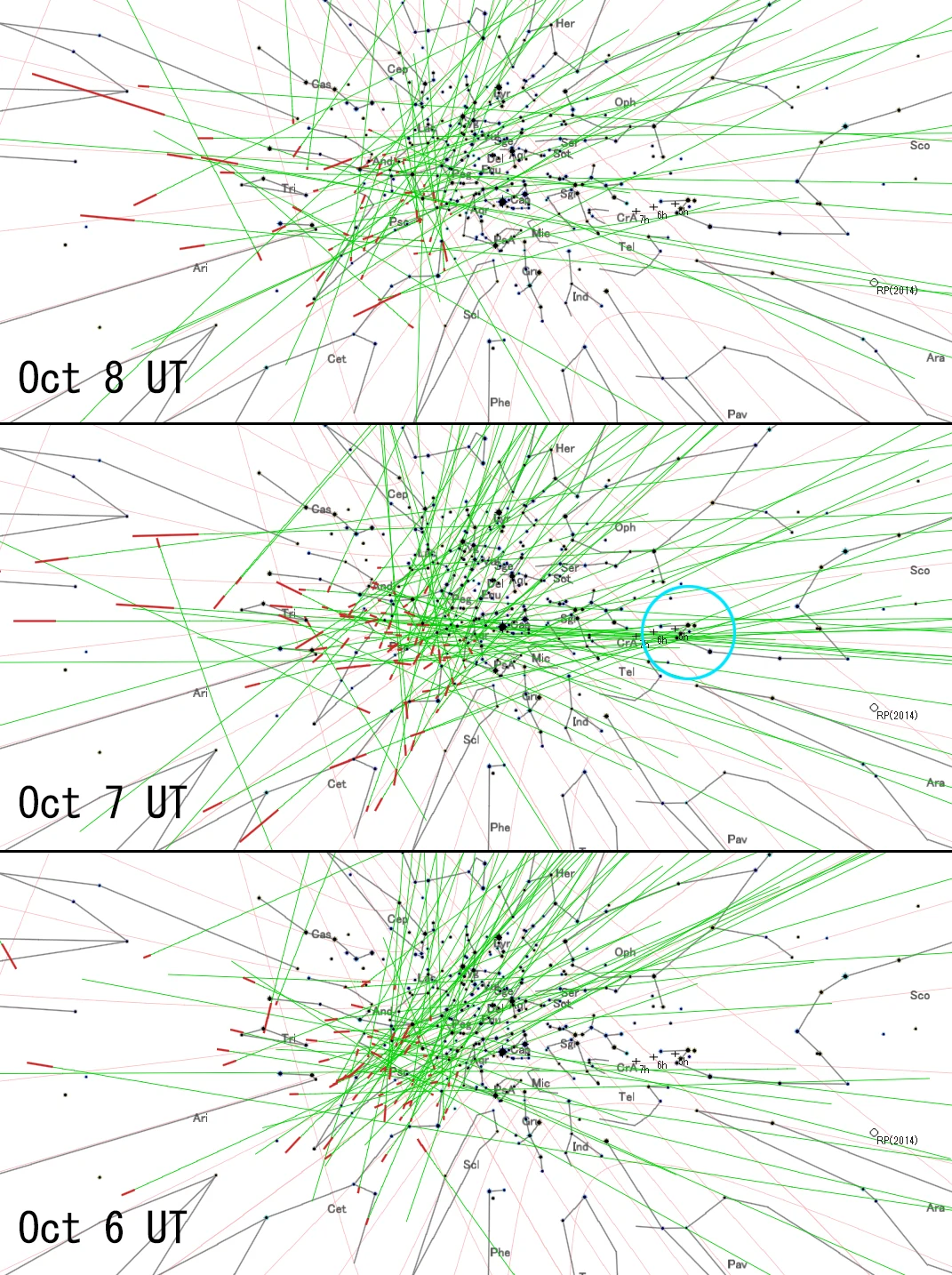
On the dome of the Subaru Telescope at an altitude of 4150 meters, a StarCam camera is installed with a field of view of 70×40 degrees and sensitivity down to 7th-magnitude stars. It streams the sky on YouTube around the clock. For the Aridis hunt, recordings from October 5, 6, and 7, 2021 (Hawaiian time) were split into half-hour segments and distributed to seven volunteers. They marked all meteors that visually emerged from the calculated radiant in the constellation Ara and counted random 'sporadic' meteors. The same videos were then run through an automatic detector: it identified moving objects, filtered out noise, lasers, and car headlights, and then calculated how close each trajectory was to the radiant. Both methods provided independent estimates of the shower's meteor count.
Results
The visual count showed 24 Aridis candidates in 90 minutes on October 7, versus 4 and 5 on control days. The automatic detector counted 18, 3, and 2, respectively. In both cases, the excess over background was about sixfold, corresponding to a statistical significance of about 9 sigma. This is a robust detection. The meteors were slow (geocentric speed about 10.5 km/s) and faint, but a few left short trails. Activity was recorded 4–5 hours after the predicted peak, when, according to radio observations, it had dropped to one-tenth of its maximum. If the camera had been looking at the peak, the shower could have been twice as strong as the famous Geminids. Modeling of dust tails of comet 15P/Finlay showed that the observed particles were ejected at high speed—about 67 m/s—during the powerful outburst of 2014. The scenario of a quiet return in 2008 requires equally fast ejections, which is unlikely given low activity.
Implications
The discovery of Aridis confirmed that models of cometary dust dynamics can predict new meteor showers. For the first time, a specific cometary outburst was linked to an observed meteor shower. This strengthens our understanding of how comets lose material and how dust evolves in interplanetary space. Furthermore, the work showed that even a modest camera installed for science outreach can contribute to serious discoveries when combined with citizen science and modern algorithms.
Future development
We can expect that sensitive survey cameras at good astronomical sites will become a regular tool for monitoring meteor activity. Automatic detection algorithms will improve, lowering the detection threshold in brightness and speed. This will allow us to capture ever fainter showers, including those from long-period comets, and build a three-dimensional picture of dust distribution in the solar system. Citizen science will remain an important element: the human eye is still better than machines at recognizing unexpected patterns.
Impact
The results are important for meteor astronomy and planetary science: they help calibrate dust tail models used in assessing meteoroid impact hazards. They are also useful for designing future missions to comets and asteroids, where understanding the distribution of particles near the nucleus is essential.
Next steps
Plans include re-observing Aridis at the next returns of comet 15P/Finlay to refine dust ejection parameters and the long-term evolution of the shower. An absolute calibration of the camera's sensitivity will be performed to move from counting estimates to physical meteor fluxes.
Key open problems
This work directly addresses an unsolved problem in meteor astronomy: how to predict the intensity and duration of new meteor showers based on cometary activity data. An open question remains about how universal the link is between dust ejection speed and comet outburst brightness, and how exactly dust is scattered by solar radiation pressure and planetary perturbations over timescales of decades.
The knowledge machine's view
This section is addressed to the author of the paper and their colleagues. Neighbouring works were found by meaning-based search across our archive, not by word overlap. We do not review: we show the field around the work.
What the work does
The paper reports the confirmation of the predicted Arids meteor shower from comet 15P/Finlay, based on observations with the StarCam camera on Mauna Kea on October 5–7, 2021. It includes visual and automated meteor counts, background comparison, and dust-tail modeling to identify the ejection source—the 2014 outburst.
Where its strength is
A convincing detection of a new meteor shower with high statistical significance and a link to a specific cometary event, supporting dust dynamics models.
Where it could go next
- It might be interesting to compare the obtained dust ejection data with results from modeling cometary outburst activity, as presented in the paper on how a comet sneezes dust.based on: How a Comet Sneezes Dust arXiv:2606.25070
- A related study on the influence of wind on the fate of meteorites could help clarify how solar wind pressure and radiation forces affect the long-term evolution of dust trails like the Arids.based on: Freo Doctor: How Wind Governs the Fate of Meteorites arXiv:2606.07144v1
- To test the link between outbursts and meteor showers, approaches from the paper on the perturbation of the Oort cloud by a passing star, which analyzes the dynamics of small bodies under external influence, may be useful.based on: A Stellar Visitor Stirred Up the Comet Cloud arXiv:2606.25069
Worth trying
- Apply the dust ejection model from the paper on cometary outbursts to 15P/Finlay data to estimate the parameters of the 2014 outburst.
- Use methods for calculating orbital evolution of dust under non-gravitational forces from the paper on wind and meteorites to refine predictions of future Arids activity.
- Compare the recorded Arids activity with forecasts based on models of perturbations from stellar passages to assess the shower's sensitivity to external factors.
Why this may matter
Confirming predictions of meteor showers from cometary outbursts is important for understanding the evolution of cometary dust and may improve forecasting of future meteor events, including those potentially hazardous to spacecraft.
Nearby works in our archive
- A Stellar Visitor Stirred Up the Comet Cloudsimilarity 0.56
- Freo Doctor: How Wind Governs the Fate of Meteoritessimilarity 0.56
- Cosmic Rain Will Improve Hurricane Forecastssimilarity 0.55
- Moon Shadows Cast by Giant Cosmic Rayssimilarity 0.55
- Bubbles in Cosmic Foam: A New Look at the Breathing of Starssimilarity 0.54
- Icy Visitor from Another Systemsimilarity 0.54
- How a Comet Sneezes Dustsimilarity 0.54
The archive is sparse around this work: the closest review is only 0.56, against a usual 0.64. It looks like few have drilled nearby.
Original abstract
as written by the authors arXiv:2601.05412v1
We report the successful detection of the "Arid" Meteor Shower (IAU\#1130 ARD), predicted to emerge for the first time in 2021, using a publicly accessible YouTube live camera developed by us. This live camera, installed on the Subaru Telescope dome in the summit region of Maunakea, Hawai'i, features a wide field of view (70 deg by 40 deg) and high sensitivity, capable of observing stars fainter than 6th magnitude. Meteor detection was performed in two ways: visual inspection by citizen viewers and subsequent validation through automated detection. As a result, we confirmed that the number of meteors appearing from near the predicted radiant increased by more than six times (~9 sigma) compared to the preceding and following days. Our observation time was 4-5 hours after the predicted peak (solar longitude = 193.9 deg), providing clear data indicating that the activity had not yet declined. Optical observations at this time from the Northern Hemisphere are extremely limited and unique, making our observation point valuable. The meteors are characterized as slow and faint appearance, but several brighter meteors with wakes were also observed. Simulations tracing the dust trails from the parent body, Comet 15P/Finlay, suggest that our detection can be explained by either the dust trails released in 2008 or 2014, both requiring high ejection velocities. However, during the comet's 2008 return, its activity was exceptionally quiet, making a high-velocity dust ejection questionable. On the other hand, multiple large outbursts were observed during the 2014 return, at which time a certain amount of high-velocity dust release is expected. We conclude that the dust source of the meteor shower detected in Hawai'i this time is likely attributable to high-velocity (~67 m s-1) dust ejected during the 2014 outburst.
The Aridis radiant lies in the constellation Ara, which from Hawaii is visible very low above the southern horizon — no higher than 13 degrees. That's like observing an object hanging at arm's length above the roof of a neighboring house: the atmosphere barely interferes thanks to the exceptional sky transparency at 4150 meters.
In the novel 'Lucifer's Hammer' (Larry Niven, Jerry Pournelle), a comet falls to Earth, causing a global catastrophe. Real observations of Aridis remind us that cometary dust is not just a beautiful spectacle but part of the complex dynamics of small bodies that humanity is only beginning to calculate.
Key numbers
- excess of meteor numbers over background: ≈6 times
- statistical significance: ≈9σ
- dust ejection speed in 2014: ≈67 m/s
- geocentric speed of meteors: 10.5 km/s
- camera altitude above sea level: 4150 m