The Subaru Telescope is an 8.2-meter optical-infrared telescope located at the summit of Mauna Kea in Hawaii, operated by the National Astronomical Observatory of Japan. Its name comes from the Japanese word for the Pleiades star cluster. It is renowned for its exceptionally wide field of view — a single exposure can cover an area of sky about nine times the size of the full Moon — making it ideal for surveys of faint objects and transient events.
History
The Subaru Telescope was built by the National Astronomical Observatory of Japan and saw first light in January 1999, after about eight years of construction.
How it works
The telescope uses a thin, lightweight primary mirror made of ULE glass, which is supported by 261 actuators that actively adjust its shape to compensate for gravitational deformation as it moves. This active optics system, combined with a corrector lens, delivers sharp images across a 30-arcminute field. Its instruments include wide-field cameras and spectrographs that can capture light from the near-ultraviolet to the mid-infrared, allowing it to study everything from nearby asteroids to galaxies at the edge of the observable universe.
In practice
It is used for deep-sky surveys, discovering supernovae and gamma-ray bursts, studying the formation of planets around young stars, and mapping the structure of the Milky Way's halo.
Fun fact
The Subaru Telescope's primary mirror is so precisely polished that if it were scaled up to the size of the Earth, the largest imperfection would be only about 2.5 centimeters high.
Beyond Neptune's orbit lies an ocean of icy islands that has remained nearly unchanged for four billion years. These islands, known as trans-Neptunian objects, hold the recipe for planet formation. Until recently, astronomers could only see the large ones, while the small, city-sized ones stayed invisible.
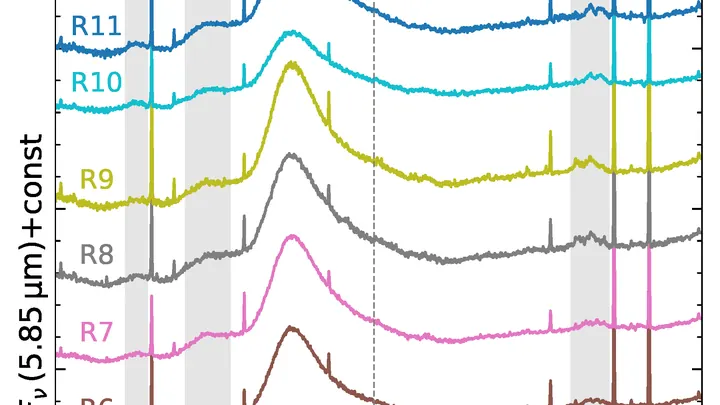
The Tarantula Nebula is a giant stellar nursery in a neighboring galaxy. Hundreds of thousands of stars are born there, and their light illuminates clouds of dust. This dust glows in the infrared, and its spectrum shows mysterious bands. For a long time, astronomers debated which molecules produce them.
The night sky is like an ocean: the longer you stare, the more faint lights you notice in the depths. That's how astronomers, peering into the outskirts of the Milky Way, found Aquarius IV — a tiny stellar system that had been hiding in the dark until now.
The system was spotted in images from an early survey by the future Vera Rubin Observatory.
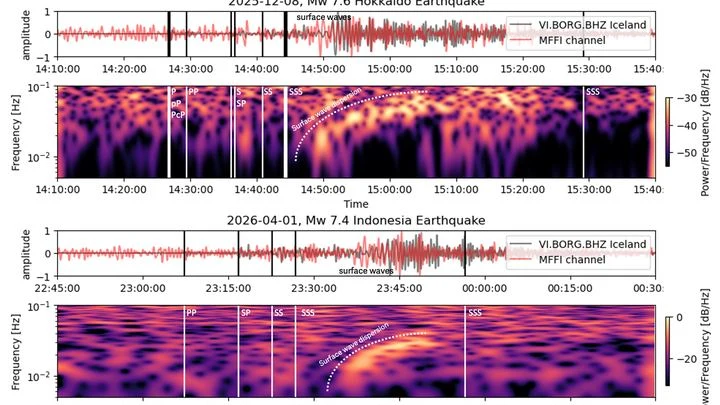
The planet-spanning web of undersea internet cables acts like a giant ear. The glass thread inside responds to water movements: currents, tides, and distant earthquakes bend the cable. Light traveling along the thread takes slightly longer: this delay is measured on shore against a reference. That’s how the speed of light reveals itself.
At the center of the Milky Way lurks something invisible but extremely massive — about four million times heavier than the Sun. It is usually called a black hole and designated Sagittarius A*. But astronomers are not letting their guard down: what if it is not a hole but something more exotic, like a giant ball of ultralight particles — a boson star?
On the outskirts of our Galaxy, far beyond the familiar stellar disk, the Subaru Telescope has spotted something unexpected: a scattered cloud of stars spanning an area of one hundred square degrees across the sky.
For nearly a century, astronomers have been searching for dark matter — an invisible scaffold that keeps galaxies from flying apart. Fritz Zwicky first proposed it, and Vera Rubin proved its existence by showing that stars on the outskirts of galaxies move too fast.
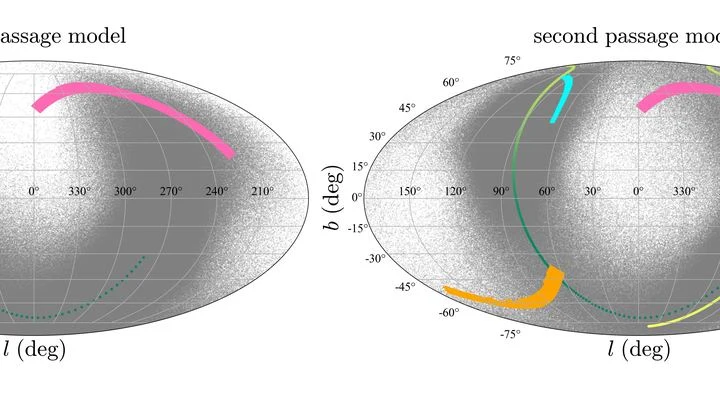
On the outskirts of galaxy M83, also known as the Southern Pinwheel, a river of ancient stars drifts through the void. It stretches 81 kiloparsecs — roughly 264,000 light-years, two and a half times the diameter of our Milky Way.
Deep in the Swiss Alps, there is a vertical shaft that plunges 800 meters down, like two skyscrapers stacked on top of each other. A railway tunnel runs nearby, and trains thunder through it every day. But inside the shaft, it is as quiet as a library at night.
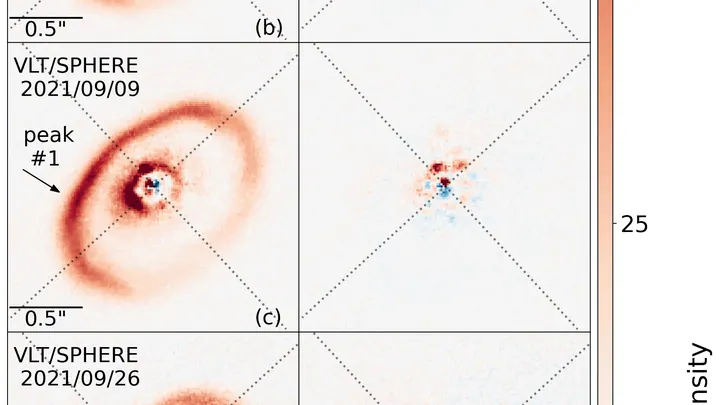
Around young stars, flat clouds of gas and dust swirl — the building material for future planets. Starlight reflects off these clouds, and astronomers see them as faint disks. But sometimes bright spots or dark bands appear in such disks. Fresh observations with the Subaru Telescope show these patterns can change within a matter of months.
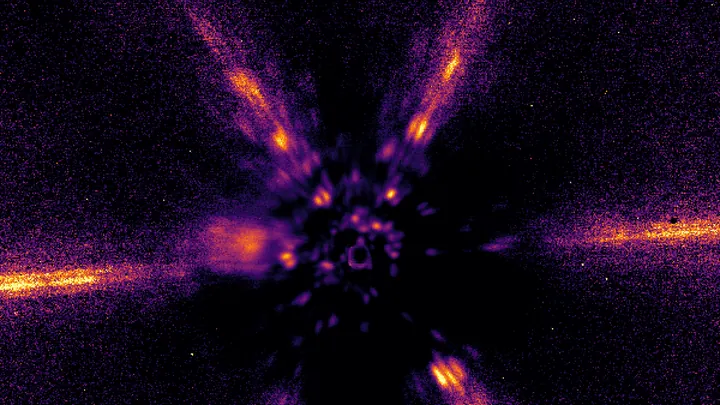
In the dark clouds of gas and dust where new stars are just igniting, the Keck Telescope in Hawaii picked out two faint points of light next to young stellar objects. These aren't stars but their companions — too light to shine on their own.
A warm cup or a human hand emits invisible light — mid-infrared radiation. Every substance absorbs this light in its own way, leaving a unique 'fingerprint'. From this fingerprint, you can tell what an object is made of without touching it.
Previously, seeing this fingerprint required huge lasers that fired very short pulses. They were expensive and complex.
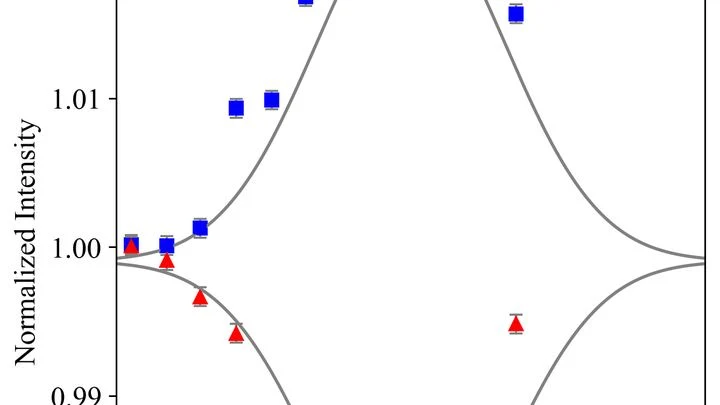
In a dark room, two flashlights shine on a wall. Usually, their beams simply add up, and the spot becomes brighter. But if the flashlights emit light in special packets, photons, then under certain conditions they can behave differently. Instead of independently hitting different spots, two photons 'agree' and only come out together, as a pair, from a single output.
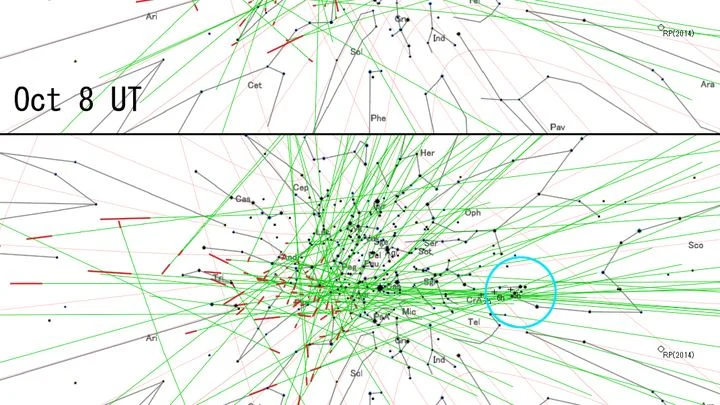
October 6, 2021, 8:30 PM Hawaii time. The StarCam camera on the dome of the Subaru Telescope gazes impassively at the sky, streaming the view on YouTube. Four and a half hours earlier, somewhere far away, Earth passed through an invisible trail — the dust tail of comet 15P/Finlay. Models predicted a peak, but would anyone see these 'shooting stars'?
In 2022, the Subaru telescope photographed a point of light 100 astronomical units from the star AB Aurigae. The point was named planet AB Aur b, but debates did not subside: what exactly is glowing, the planet itself or dust around it?
Deep in the Siberian taiga, there are a hundred light traps: each about the size of a small table, but together they cover a square kilometer. At night, these traps gaze at the sky, catching faint flashes of light born when cosmic particles slam into the atmosphere. The setup is called TAIGA-HiSCORE, and it usually works as a giant "eye" for such particles.