Seeing the Heart's Flicker in Two Mirrors at Once express
The heart doesn't beat like a metronome but like a jazz drummer: sometimes it stumbles, skips beats, or races. Atrial fibrillation is one of the most insidious glitches: the atria quiver instead of contracting, and blood can pool, forming clots. Doctors catch this glitch on an ECG — a recording of the heart's electrical signals. But the signal is finicky: it looks different in different people, on different machines, in different hospitals.
Typical algorithms look at an ECG either as a line over time or as a set of frequencies — a spectrum. The first view catches pauses and spikes; the second, rhythmic patterns. But on their own, they're like two witnesses who saw an incident from different angles. The authors combined these views into one algorithm. Two "translators"—time and frequency — work as a pair: each refines what the other noticed, and together they give a more reliable picture.
The second key is contrastive learning. The algorithm is shown pairs of ECGs: "these two are from the same condition, and these are from different ones." So it learns not just to memorize examples but to understand what distinguishes a healthy rhythm from a sick one. It's like teaching a child to tell a cat from a dog by showing not just pictures but also explaining: "see, this one's ears are perky, and that one's tail is up."
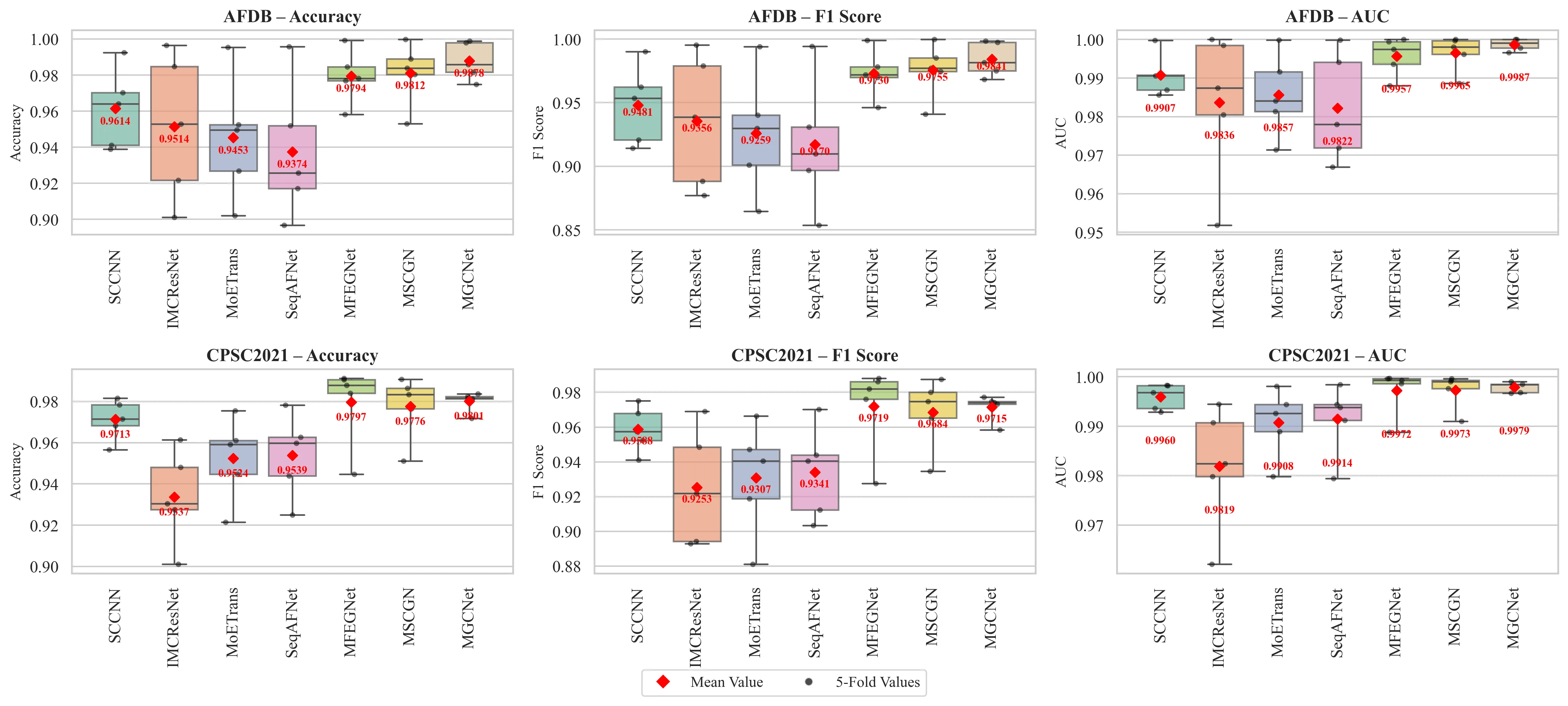
Testing showed the algorithm works reliably even on data from other clinics, recorded with different devices. That's important because in real life, an ECG from a neighborhood clinic and one from a cardiology center look different. The method is also fast: it can run right on a small device at the patient's bedside, without waiting for a powerful computer.
So the two witnesses who used to argue now cross-check their accounts and together see what each missed alone. The heart stops being a puzzle to the algorithm, and the doctor gains a reliable assistant that never tires and never gets distracted.
Original abstract
as written by the authors arXiv:2601.10202
Atrial fibrillation (AF) is a common cardiac arrhythmia that significantly increases the risk of stroke and heart failure, necessitating reliable and generalizable detection methods from electrocardiogram (ECG) recordings. Although deep learning has advanced automated AF diagnosis, existing approaches often struggle to exploit complementary time frequency information effectively, limiting both robustness under intra-dataset and generalization across diverse clinical datasets. To address these challenges, we propose a crossmodal deep learning framework comprising two key components: a Bidirectional Gating Module (BGM) and a Cross modal Supervised Contrastive Learning (CSCL) strategy. The BGM facilitates dynamic, reciprocal refinement between time and frequency domain features, enhancing model robustness to signal variations within a dataset. Meanwhile, CSCL explicitly structures the joint embedding space by pulling together label consistent samples and pushing apart different ones, thereby improving interclass separability and enabling strong cross dataset generalization. We evaluate our method using five fold crossvalidation on the AFDB and CPSC2021 datasets. Furthermore, to assess cross dataset generalization, we conduct bidirectional cross dataset experiments across AFDB, CPSC2021, LTAF, and SHDBAF by training on one dataset and testing on another. Results show consistent improvements over state of the art methods across multiple metrics, demonstrating that our approach achieves both high intra dataset robustness and excellent crossdataset generalization. We further demonstrate that our method achieves high computational efficiency and anti interference capability, making it suitable for edge deployment.
A human heart beats about three billion times over a lifetime, like a metronome ticking nonstop for 80 years.