Particle Physics Accelerates Molecules express
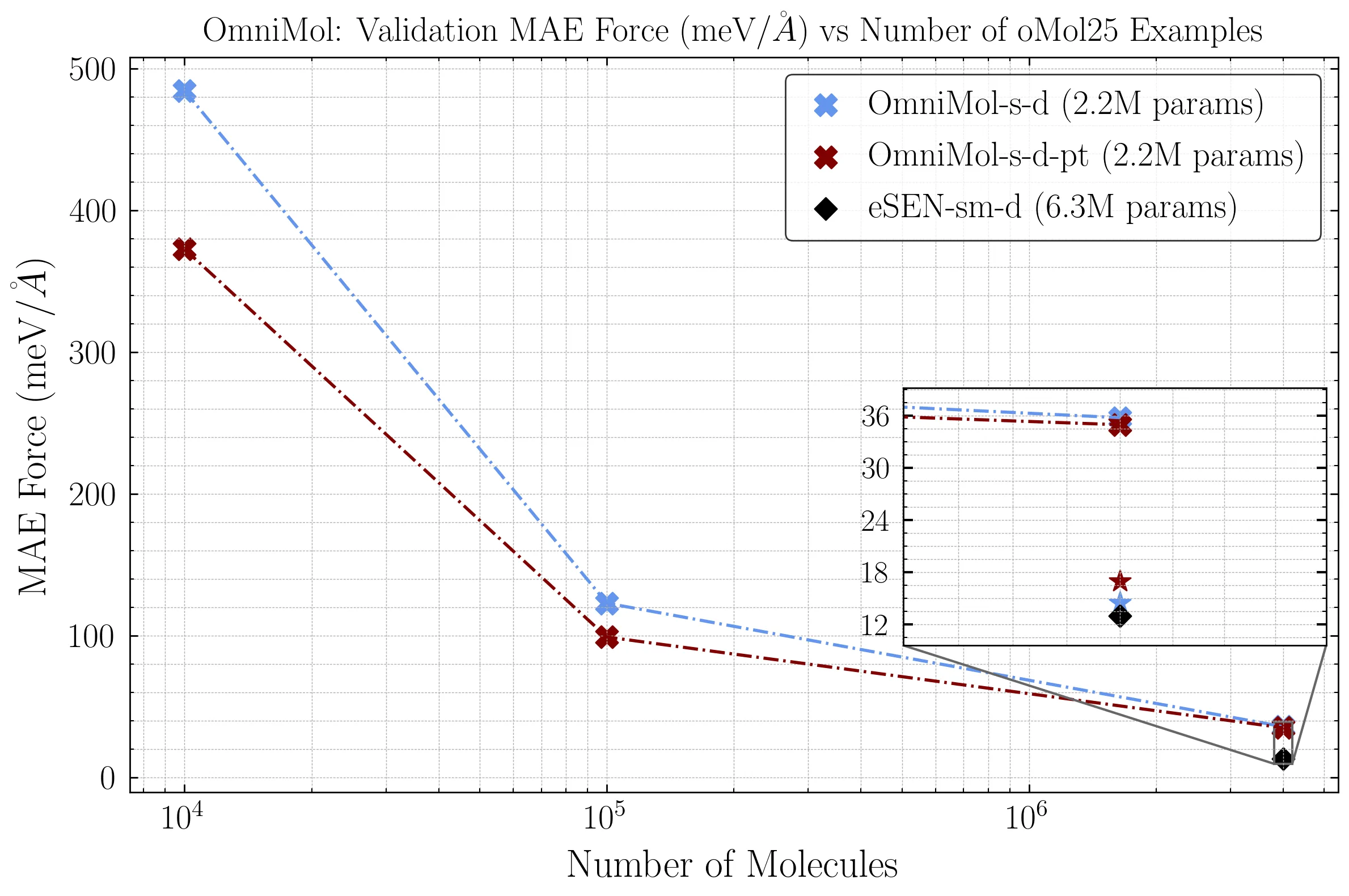
In the Large Hadron Collider's detector, each proton collision leaves thousands of points — tracks of flying particles. A neural network learned to spot patterns in this scatter and predict what happened at the moment of impact. Now the same network has been trained to look at molecules: instead of particle tracks, it sees atomic positions, and instead of a collision, it predicts how those atoms will move and interact.
The trick is that the model has a built-in rule: atoms close to each other influence each other more than distant ones. It's like how neighbors on the same stairwell notice each other more than residents of different districts. Thanks to this, the network doesn't just memorize pictures: it senses the physics of interactions. Tests showed that even after a small fine-tuning, the model predicts molecular behavior excellently and computes noticeably faster than its counterparts.
Such knowledge transfer from high-energy physics to chemistry is rare. But if it works, we have a universal tool: the same architecture understands both subatomic particles and drug molecules. That means the search for new materials and medications could speed up manyfold.
Original abstract
as written by the authors arXiv:2601.10791
We present OmniMol, a state-of-the-art all-to-all transformer-based small molecule machine-learned interatomic potential (MLIP). OmniMol is built by adapting Omnilearned, a foundation model for particle jets found in high-energy physics (HEP) experiments such as at the Large Hadron Collider (LHC). Omnilearned is built with a Point-Edge-Transformer (PET) and pre-trained using a diverse set of one billion particle jets. It includes an interaction-matrix attention bias that injects pairwise sub-nuclear (HEP) or atomic (molecular-dynamics) physics directly into the transformer's attention logits, steering the network toward physically meaningful neighborhoods without sacrificing expressivity. We demonstrate OmniMol using the oMol dataset and find excellent performance even with relatively few examples for fine-tuning. Further, due to architectural transfer from Omnilearned, we demonstrate uniquely fast inference. This study lays the foundation for building interdisciplinary connections given datasets represented as collections of point clouds.
The model was originally trained on a billion 'snapshots' of particle collisions, like learning a billion photos of fireworks to later distinguish snowflake patterns.
In the series 'Foundation,' Hari Seldon predicted the future of civilizations from vast data sets — here, a similar approach works for individual molecules.