The Electron-IonCollider (EIC) is a planned particle accelerator designed to smash electrons into protons and heavier atomic nuclei. Unlike earlier colliders that probed the internal structure of matter with point-like particles, the EIC will provide a uniquely clean and precise view of the strong nuclear force — the interaction that binds quarks and gluons inside protons and neutrons. It aims to answer fundamental questions about how mass emerges from the energy of these particles and how the properties of ordinary matter arise from their complex dance.
History
The concept was developed over decades, with the design converging in the 2010s. The project was officially endorsed by the U.S. National Academies in 2018, and Brookhaven National Laboratory was selected as the site in 2020.
How it works
The EIC will accelerate two beams in opposite directions: one of electrons, the other of protons or nuclei. When they collide, the electron acts as a fine probe, scattering off the internal constituents of the nucleon. By varying the collision energy and detecting the scattered electron and other debris, physicists can map the distribution of quarks and gluons with unprecedented precision, including their spins and momenta.
In practice
Beyond fundamental physics, the EIC's detector and accelerator technologies will advance medical imaging, materials science, and high-performance computing.
Fun fact
The EIC will be the first collider to use polarizedelectrons and polarized protons, allowing scientists to study how the spin of the proton is carried by its internal quarks and gluons.
In the shaft leading to the Large Hadron Collider, an unusual tenant may soon move in: a hundred-meter vertical tube where clouds of strontium atoms will be dropped. Each cloud is cooled to near absolute zero, so the atoms move slowly and in sync, like dancers in slow motion.
The 21-kilometer ring near Protvino was once planned to accelerate protons. Today, the same tunnel could host a very different machine — a muon collider. The muon is a heavy cousin of the electron, and that's its strength. On a curve, an electron radiates like a searchlight, losing precious energy. A muon radiates a billion times less.
In absolute silence, you need to hear a feather drop. But someone keeps rustling a plastic bag. For the space-based LISA observatory, that 'rustling' will come from charged particles in space.
At accelerators, by smashing heavy nuclei, physicists briefly create a quark-gluon plasma — a state of matter where quarks and gluons are not confined inside particles but are free. For a long time, it was imagined as a gas, but experiments showed it's an almost perfect liquid.
The world's most accurate pendulum isn't a steel rod: it's a tiny atomic nucleus. The isotope thorium-229 has a special excited state: to nudge the nucleus into it, you need surprisingly little energy — about what an ultraviolet laser delivers.
Atomic nuclei are not always like billiard balls. Some are elongated, like cigars, others are flattened. But xenon-129 resembles a potato — a bumpy triaxial ellipsoid.
On a scorching afternoon, a stifling haze hangs over the city, and not a single cloud is on the horizon. Usually, in such weather, all you can do is wait for nature to take pity and send some cool relief. But what if shade and rain could be switched on schedule, like a light in a room?
The Standard Model is a set of rules for all known particles. But it says nothing about dark matter, which makes up a quarter of the Universe. To find it, you don't need to build city-sized colliders. Radioactive molecules act like sniffer dogs: their incredible 'scent' picks up the faintest traces of unknown forces that slip past giant machines.
A pot of boiling soup bubbles away, and you'd love to know how hot individual droplets are inside. But you can only dip your thermometer at the edge, where things are calmer. Laser fusion is a bit like that: a powerful laser pulse hits a target, creating a cloud of fast protons.
A detector filled with superfluid helium-4 is like a perfectly still lake. The liquid doesn't slosh or bubble: it's frozen in a single quantum state. An invisible guest, a dark matter particle, flies through it. It doesn't shine or leave a track. But sometimes it nudges a helium nucleus.
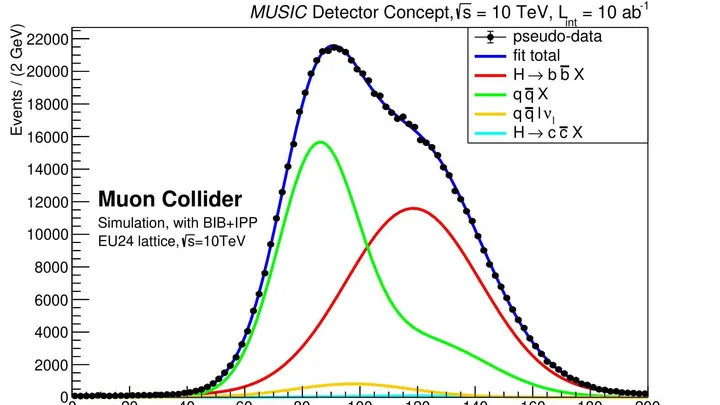
The Higgs boson is like a conductor that gives mass to all other particles. Without it, electrons would be massless and atoms would fall apart. But how does the conductor interact with itself? That is the key question a future muon collider aims to answer.
A neural network trained on collisions of protons and electrons transferred its skills to a completely different experiment — catching neutrinos. Like a chef who learned French cuisine and then, without preparation, baked an excellent Uzbek plov.
In a giant particle accelerator, particles smash into each other, and sometimes after the collision only two photons, particles of light, remain. Physicists can predict how often this happens, but their calculations have long disagreed with what detectors see. Each refinement of the theory changed the answer, and there was no consensus.
When two particles fly at almost the same speed in the same direction, their signals in the detector merge, like two voices in unison. Telling a duet from a soloist is an art in itself.
Blue is the most finicky part of any screen. Producing it takes a lot of energy, and the light often comes out dull. Chemists have long searched for molecules that glow deep blue brightly and for a long time. Now they've come up with a new design based on europium, a rare-earth metal that can deliver pure blue light.
When heavy nuclei collide in accelerators, a multitude of particles is produced, and physicists want to understand how electric charge moves through this chaos. Two trains crash into each other: the passengers (quarks) scatter, but their luggage (charge) may end up far from the crash site.
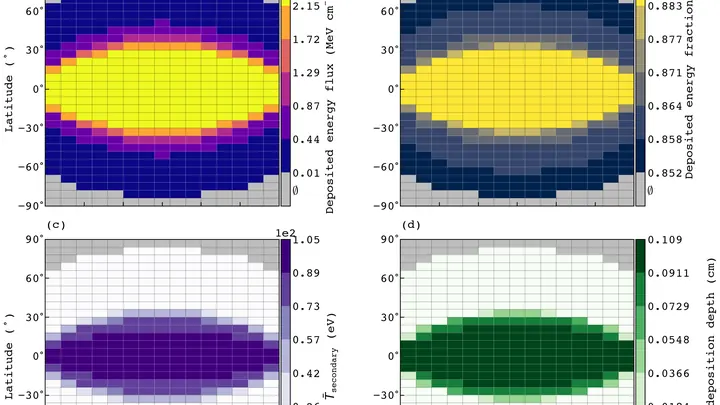
Europa's surface is an icy armor continuously bombarded by charged particles from Jupiter's magnetosphere. Electrons slam into the ice's crystal lattice, lose energy, and kick off chemical reactions. Until now, there was no tool to show how deep such bombardment pierces the ice.
In an underground ring 27 kilometers in circumference, protons are accelerated to nearly the speed of light and smashed head-on. At the collision point, conditions briefly recreate those of the first trillionth of a second after the birth of the universe.
A quantum computer is like an orchestra, where each qubit is a musician playing their part. But every now and then, a cosmic ray bursts into the hall, and the violinist flinches, losing the rhythm. These particles from deep space pierce the chip, knock out extra electrons, and spoil the delicate quantum music.
Hidden inside a zinc oxide crystal is a quantum duo: a tin atom and a lithium atom sitting side by side. Their bond is so tight that the electron captured by this pair seems to live on the tin, while the lithium merely plays along. This complex was long sought after, but only now has it been deliberately created and identified by its characteristic glow.
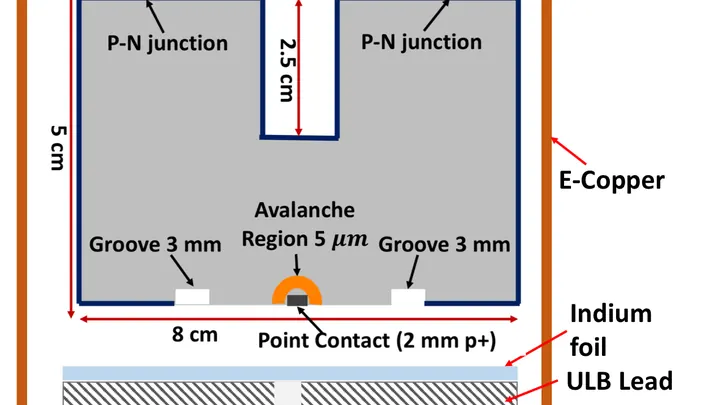
In an ultra-pure germanium crystal cooled to near absolute zero, a single electron can trigger a whole avalanche of charges, like a small pebble dislodged from a slope that sweeps down a stream of snow. Such internal signal amplification is a dream for detectors of dark matter or rare decays.
A dark matter detector is like a room where you're trying to hear a whisper while static electricity crackles nearby. This crackle is produced by radon atoms — a radioactive gas that seeps out from materials and air.
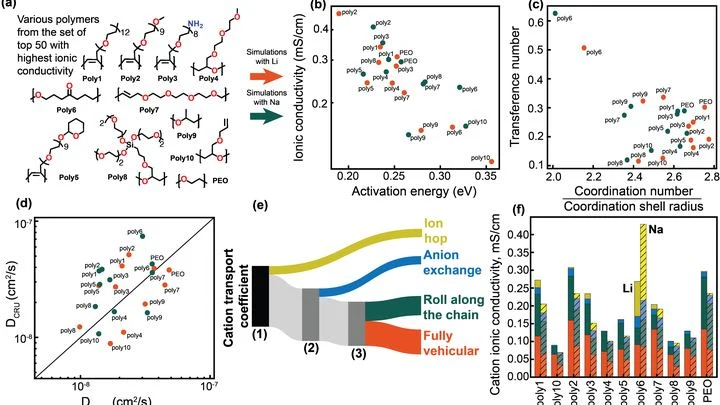
Modern batteries with liquid electrolytes can leak or catch fire. Polymer electrolytes (solid, plastic-like materials) solve that problem, but ions move through them more slowly, so the battery loses power.
Researchers set up a virtual assembly line: a computer program generated new polymer structures the way a chef experiments with new dough recipes.
Ordinary atomic clocks tick when an electron jumps between energy levels. But external fields and jolts can disrupt this rhythm. Highly charged ions, atoms stripped of many electrons, barely notice such disturbances: their electrons sit deep and tight. That makes them ultra-stable 'pendulums.'
The Cf17+ ion is a curium atom that has lost 17 electrons.
Dark matter is invisible, but you can catch it on the rebound. Hydrogen embedded in a carbon film acts like a billiard ball: when a dark matter particle hits it, the proton flies out. That ejection is the signal you're looking for.
The proton is not a smooth ball but a tangle of smaller particles in constant motion. To peek inside, physicists fire electrons at protons and watch how they bounce off. The new machine, the Electron-Ion Collider, will do this with unprecedented accuracy.
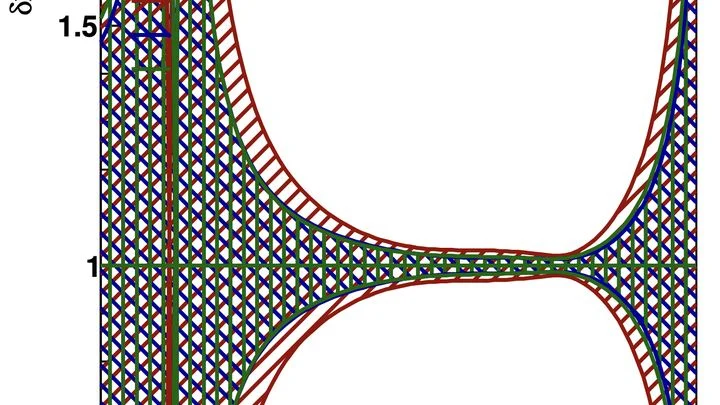
Scientists have run simulations to see what would happen if data were collected at different energies.
In giant particle accelerators, particles fly at nearly the speed of light and smash head-on. But sometimes one beam is slightly denser than the other, like someone stepping onto a packed escalator the wrong way. Then collisions become uneven, and detectors start 'flickering,' throwing off measurements.
In a collider detector, each proton collision leaves a trail of dozens of particles, like the splash from a stone thrown into water. Making sense of that splash and understanding what exactly happened at the moment of impact is a task that humans can no longer handle alone.
A catalyst is a substance that speeds up a chemical reaction without being consumed itself. The best catalyst is one where every metal atom counts: the finer the particles, the more atoms are on the surface and the more active the material.
In the Large Hadron Collider's detector, each proton collision leaves thousands of points — tracks of flying particles. A neural network learned to spot patterns in this scatter and predict what happened at the moment of impact.
At Jefferson Lab, electrons are accelerated to 12 GeV and smash into protons to pry out their secrets. But existing detectors are like cameras with a narrow field of view: you either see a lot but dimly, or brightly but only a tiny patch. Electron scattering is the main tool, but statistics are insufficient for subtle effects.