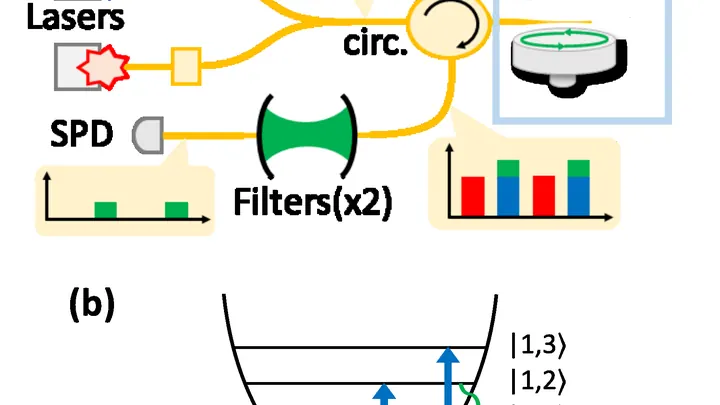
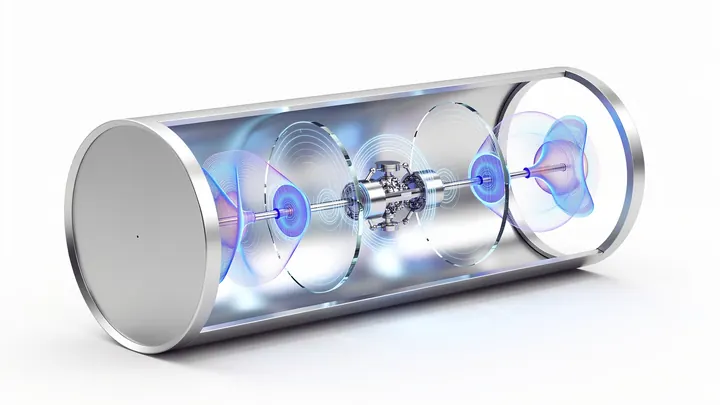
Quantum optomechanics is the study of the interaction between electromagnetic radiation (light) and mechanical motion of macroscopic or mesoscopic objects, where quantum effects become relevant. In this regime, the position and momentum of a mechanical oscillator are subject to quantum fluctuations, and light can be used to cool, control, and measure these motions at the quantum level. This field bridges quantum physics and mechanics, allowing researchers to explore the quantum-classical boundary, test fundamental physics, and develop ultra-sensitive sensors and quantum information interfaces.
History
The theoretical foundations were laid in the 1970s by Vladimir Braginsky, who predicted quantum limits on measurements of mechanical motion. The field gained momentum in the 2000s with advances in micro-fabrication and cryogenics, leading to the first ground-state cooling of a mechanical oscillator in 2010 by several groups.
How it works
The core mechanism is radiation pressure: photons carry momentum, and when they reflect off a movable mirror or a tiny mechanical resonator, they exert a force that changes the object's motion. In a typical optomechanical setup, a laser cavity is formed between a fixed mirror and a movable one (or a micro-mechanical membrane). The light intensity in the cavity depends on the mirror's position, and the mirror's position depends on the light pressure, creating a coupled system. By tuning the laser frequency, researchers can either amplify or damp the mechanical motion — the latter is called 'laser cooling' and can bring the oscillator to its quantumground state. At that point, the mechanical object's behavior is governed by quantum mechanics, and its motion can be entangled with light.
In practice
Quantum optomechanics is used to develop ultra-sensitive force and displacement sensors, including detectors for dark matter candidates, and to create interfaces between optical and mechanical quantum systems for quantum computing and communication.
Fun fact
Optomechanical systems have been cooled to temperatures where the mechanical oscillator's motion is dominated by quantumfluctuations, with an average phonon number less than one — meaning it spends most of its time in the quantum ground state.
A billiard ball hangs in midair. Tiny peas shoot at it from a blowgun. Each hit is barely perceptible, but if the ball is very light and barely trembles from heat, you can make out individual nudges. That's essentially the setup: a glass sphere the size of a bacterium levitates in a vacuum while a narrow beam of xenon atoms flies at it.
Earth's magnetic field is not constant: it trembles from the solar wind, from distant thunderstorms, and from the subway running nearby. To notice these tremors, you need an instrument that doesn't tremble itself. Physicists have built such an instrument from ytterbium atoms cooled to nearly absolute zero.
A light beam usually travels in a straight line, but you can make it spin around its axis, like water swirling into a vortex as it drains. This 'twisted' light carries more information and is needed for ultra-fast communication and quantum computing.
Light in a gravitational-wave detector races through multi-kilometer tunnels, bouncing off mirrors. A perfectly uniform beam resembles a smooth sheet held by its corners. But if one mirror tilts by the width of an atom, the sheet develops wrinkles: 'parasitic' patterns, more complex light spots, awaken in the beam.
Previously, such wrinkles were dismissed as noise.
Light escaping a massive body loses steam. Its frequency dips slightly, and its color shifts toward red. Physicists call this gravitational redshift. In classical theory, it's all clear, but the moment you bring quanta into the picture, trouble starts.
Previously, this shift was modeled as a kind of mode mixer — a device that entangles different states of light.
Two tiny weights, each about the mass of a grain of sand, hang in the dark at a temperature colder than deep space. They don't touch, but an invisible thread connects them — gravity. The experiment physicists are now building aims to catch the moment when that thread tugs one weight due to the motion of the other.
In a dark room, a glass bead the size of a dust grain hangs on a laser beam. Beneath it are two mirrors: one aluminum, one silver. If axions (light, invisible particles that could make up the mysterious dark matter) whiz by, they exchange with the mirror atoms, and the bead shifts ever so slightly.
In the orchestra of atoms, each instrument has its own score. But sometimes two musicians start playing in unison, and the sound amplifies many times over. In the quantum world, this 'harmony' is called a Feshbach resonance. It allows you to control atomic interactions with jeweler-like precision.
A tiny glass bead hangs in a laser beam like a speck of dust in sunlight. Around it is a rarefied gas: atoms of krypton, xenon, and heavy molecules of sulfur hexafluoride. They collide with the bead, and each hit transfers a tiny impulse, like a pea thrown at a taut sheet makes it tremble.
Impulse is a measure of motion: mass times velocity.
On a lab bench sits a laser trap — an invisible hand that holds a glass bead the size of a bacterium in midair. Next to it is a mirrored cavity where light bounces between two reflective walls. Scientists made the bead and the light exchange quantum entanglement: their states are now linked so that measuring one instantly reveals the other.
A football kicked with spin doesn't fly straight: it bends to the side. A tightly focused beam of light does something similar: it starts pushing an atom not just forward but also sideways. Physicists measured this shift on a single calcium ion trapped in a light trap.
The beam was aimed at the atom like a spotlight on a grain of sand.
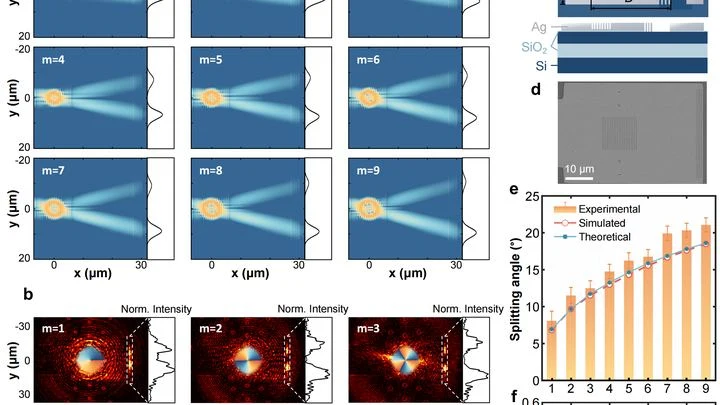
Light doesn't always travel in a straight line. Its wave can be twisted into a spiral, like a stream of water from a rapidly rotating hose. This twist is called orbital angular momentum, and it can hide information: each turn acts as a separate communication channel. The problem was that only bulky setups of lenses and mirrors could recognize these twists.
An ordinary chemical reaction is like a ball rolling down a hill: it has one natural path. But if you place molecules in a tiny mirrored box, an optical microresonator, the light inside starts to interfere with the ball's motion. It can nudge it, hold it back, or even split its trajectory.
In a new study, physicists traced exactly how this happens.
In the Large Hadron Collider's detector, each proton collision leaves thousands of points — tracks of flying particles. A neural network learned to spot patterns in this scatter and predict what happened at the moment of impact.
Cooled nearly to absolute zero with liquid helium, the semiconductor disk reached such a low level of entropy that its thermal trembling became less than one phonon — a quantum of sound.
Open systems exchange energy with their surroundings, like a guitar string fading into the air. Scientists built such a system out of light, twisting the beams into corkscrews and forming an artificial lattice — a maze where losses can be controlled at every step. Light in this maze always moves at the maximum possible speed, but its energy can fade or grow.
In the world of microchips, where streams of photons, quanta of light, carry information, a fundamental problem arises: light passing through matter inevitably heats it. This heating spawns thermal fluctuations — chaotic, unpredictable jostling of atoms that disrupts precise device operation.
A silicon sphere 166 nanometers in diameter floats in a beam of infrared laser light. The pressure is below 10⁻⁸ mbar, and the motional temperature is about 10 millikelvin. That is colder than the cosmic microwave background.
In a dark room, a resonator catches light the way a spiderweb catches dew drops. A laser pulse bursts in, and the mechanical membrane starts to vibrate in sync, leaving a trace in the very fabric of the system. That is how memory is born: not in a silicon cell, but in the dance of photons and phonons.