A Magnetic Lottery in a Crystal express
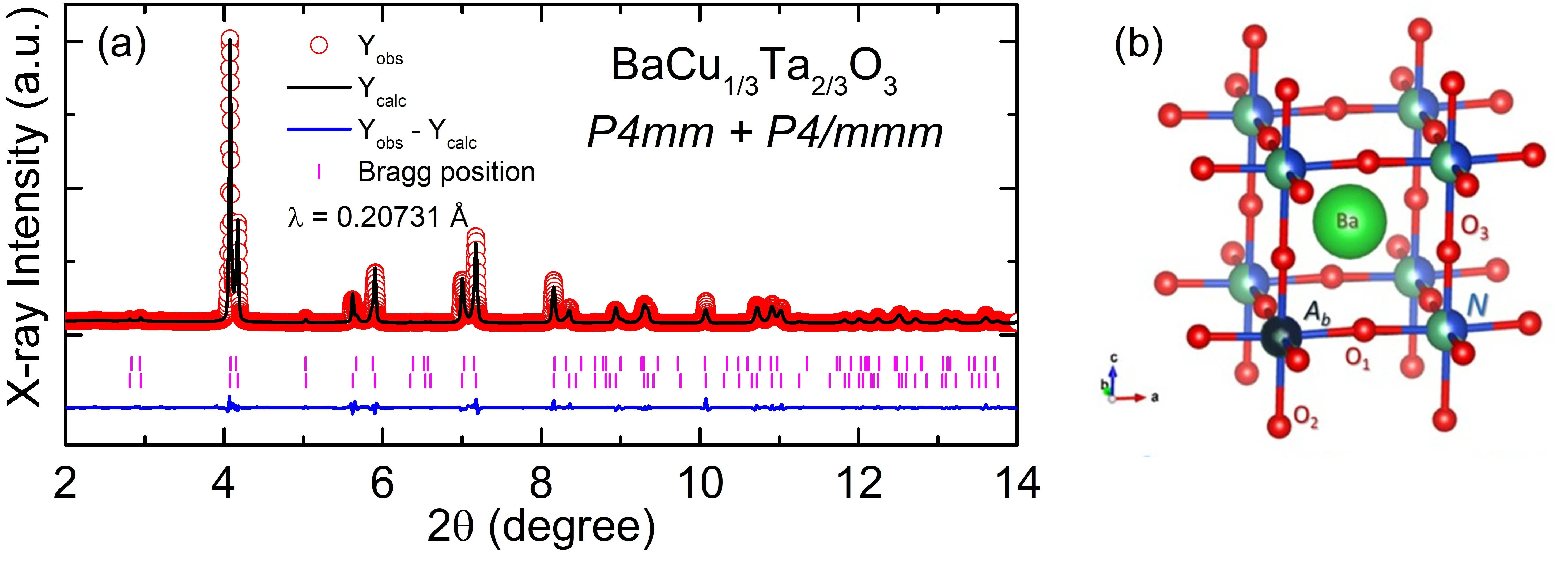
Atoms in a crystal usually sit in their designated spots, like passengers on a plane with assigned seats. But in this material, copper and tantalum have taken their places randomly, as if the tickets got mixed up. Scientists peered into the crystal using X-rays and saw that the disorder is not just on paper but in the actual arrangement of atoms. As a result, the magnetic couplings between copper atoms turned out to be very different. Some pairs are tightly bound, while others barely touch.
Magnetic atoms typically love order: upon cooling, their arrow-like spins align into a neat pattern. Here, even at 0.1 kelvin, colder than outer space, the arrows neither aligned nor froze into disorder. Instead, they formed something like a dance floor where pairs twirl to a common rhythm, yet each pair moves on its own. This state is known as a quantum spin liquid.
This paves the way for a new type of quantum material. If we learn to control such disorder, we could build devices where information is stored not in individual atoms but in their collective dances. Then an ordinary crystal would become not just a piece of matter but a computing machine based on quantum pairs.
Original abstract
as written by the authors arXiv:2601.17455
We investigate the disordered perovskite BaCu$$_{1/3}$$Ta$$_{2/3}$$O$$_3$$, where Cu (spin-1/2) and Ta randomly occupy a pseudo-cubic lattice. Synchrotron X-ray diffraction and X-ray absorption spectroscopy establish the local nature of the disorder, revealing the presence of structurally constrained magnetic exchange paths. No magnetic ordering or spin freezing is observed down to 0.1 K. The low-temperature magnetic and thermodynamic behavior is captured by a broad but non-singular distribution $$P(J)$$ of exchange couplings $$J$$. These results open the possibility of realizing a disordered quantum ground state where the exchange randomness is broad yet intrinsically bounded, departing from the conventional infinite-randomness fixed point driven random-singlet phase.
0.1 kelvin is -273.05 °C. At such a temperature, even air would solidify, yet in this crystal, the spins keep 'dancing'.