A frustrated magnet is a magnetic system where competing interactions between spins—the tiny magnetic moments of atoms—prevent them from settling into a single, orderly pattern. Instead of aligning uniformly, the spins are locked in a state of perpetual compromise, often forming complex, disordered configurations. This frustration arises when the geometry of the lattice (e.g., triangular or kagome) makes it impossible to satisfy all pairwise interaction preferences simultaneously. Frustrated magnets are a rich playground for exotic physics, including spin liquids, where spins remain dynamic even at absolute zero, and unusual phase transitions.
History
The concept was formalized in the 1970s, notably by Philip Anderson, who proposed the resonating valence bond state for frustrated triangular lattices. Earlier, George Wannier studied the Ising model on a triangular lattice in 1950, noting its lack of ordering.
How it works
In a normal magnet, spins align because the energy is minimized when they point in the same direction. In a frustrated system, the lattice geometry creates conflicting constraints: on a triangle, if two spins align, the third cannot satisfy both neighbors. The system must choose a compromise, leading to many nearly degenerate states. Thermal or quantum fluctuations can then drive the system through these states, producing phenomena like spin ice or quantum spin liquids, where order never fully emerges.
In practice
Frustrated magnets are studied for potential applications in quantum computing (as qubit candidates) and in developing new magnetic materials with tunable properties, such as for data storage or spintronics.
Fun fact
In a frustrated magnet, the entropy can remain nonzero even at absolute zero, meaning the system never fully 'freezes' into order—a violation of the third law of thermodynamics in idealized models.
In nature's workshop, there is a strange lathe: it cuts threads on screws but forbids left-handed ones. You can tighten a screw as much as you like, in any clockwise direction, but counterclockwise is not allowed. This lathe is not a fantasy but an exact quantum rule that physicists have just built for magnetic materials.
In a mountain range, there are trails that can be contracted to a point if you walk through a flat valley. But there are also loop routes that cannot be shrunk without crossing a ridge.
The hanmilite crystal, resembling a layered cake of copper and boron, behaves like a ladder: the copper spins are arranged in two parallel rails connected by rungs.
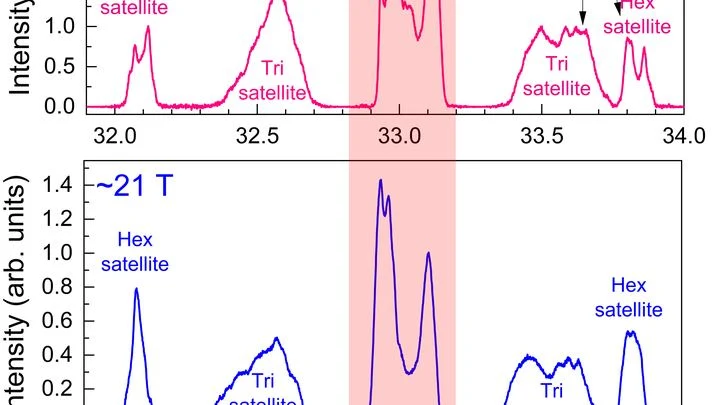
Two dancers on one stage: the triangle and the stripe. In a quantum gas of dysprosium atoms cooled to 62 nanokelvin, these two spatial structures have met for the first time in a single experiment. The gas is held in a trap shaped like a surfboard, and its atoms are among the most magnetic in the periodic table.
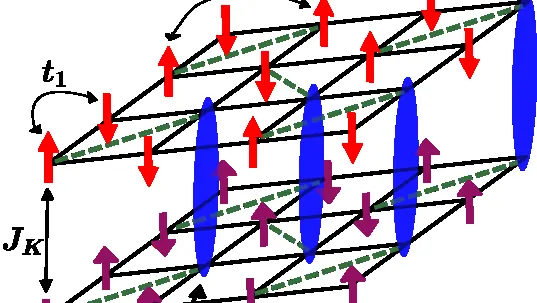
Imagine a ladder whose rungs are tiny magnets. If neighboring magnets point in opposite directions, the ladder is "calm." But if you make them all point the same way, the whole structure becomes magnetized and "stubborn."
Scientists built such a ladder from germanium atoms — a semiconductor used to make transistors.
A superfluid gas is like a crowd of people marching in step: each atom knows where to go and doesn't fall out of the common rhythm. But this crowd has three 'valleys'—three different directions it can take. In a new experiment, physicists made one valley slightly more 'favorable' than the others and watched how the crowd darted between them.
The PbCuTe₂O₆ crystal resembles a three-dimensional web of copper, tellurium, and oxygen. Inside, the magnetic moments, tiny arrows tied to electron spins, are so entangled that they can't settle into an orderly arrangement even near absolute zero.
A magnetic mirror is a tube open at both ends. The magnetic field inside is arranged so that hot plasma doesn't leak out: at the ends, the field lines bunch up like a cork in a bottle. Plasma particles flying toward the exit are repelled by these "corks" and bounce back. But some still escape: that's the classic "loss cone" argument.
A quantum chain is like a string of lights, where the bulbs are the spins of particles. Ideally, all bulbs glow in sync, following a common rhythm: that's symmetry. But if you cut off a piece of the string, the rhythm can get out of step: within that segment, symmetry is broken.
Physicists study a chain of strongly interacting particles (the XYZ model).
A star's radius drops by a thousand kilometers. Not because its mass increased, but because its own magnetic field squeezed the crust like an invisible corset.
A parquet floor where every other plank is turned the opposite way looks symmetric. But if you run your hand over it, in one direction your fingers glide along the grain, and in the other they catch. That's roughly how the new type of magnetism studied in the crystal AgCrP2S6 works.
In the conventional Heisenberg picture, spins at low temperatures are supposed to line up in a strict pattern. But there are crystals — like pyrochlore — where geometry has its own way. Each ion sits at a vertex of a tetrahedron, and the main interaction enforces a rule: two spins point inward, two outward.
A magnetic field holds a tiny particle in mid-air, like an invisible dance partner. A special tuning of the field creates a trap with two "positions." In the ordinary world, a dancer occupies only one, but in the quantum world — both at once. Physicists have learned to achieve this for dust grains weighing trillionths of a gram.
In a crystal that for centuries was called 'fool's gold,' physicists have spotted genuine treasure. The compound MnTe2 with a pyrite structure has become the stage for a quantum ballet: spin waves here twist into left- and right-handed vortices, with the twist direction firmly tied to momentum.
In the world of magnetism, a simple dichotomy long reigned: ferromagnets, where spins point in one direction, and antiferromagnets, where they line up in a checkerboard pattern, canceling each other out. But a recent 'third player' — altermagnets — forced a rewrite of the rules.
In a world striving for chaos, rhythm sometimes arises. The Belousov–Zhabotinsky reaction has amazed for decades: in a test tube, color waves run on their own, as if a living organism breathing matter. Something similar lurks in crystals where iron atoms balance between two magnetic states — high-spin and low-spin.
Light from a distant blazar, an active galactic nucleus whose jet points our way, travels for billions of years. Along the way, it triggers cascades of charged particles that the intergalactic magnetic field deflects sideways. This creates a blurred gamma-ray glow around the blazar: a secondary halo.
An ionic conductor resembles a crowded bus where passengers (ions) try to squeeze toward the exit. Previously, it was thought that fast exit could be achieved either by a gently swaying bus (soft lattice) or by passengers standing in chaotic order (geometric disorder). The new work shows these are not two different tricks but the same one.
An ordinary magnet is like a compass: its needle points north. But a quantum compass can look in both directions at once. If a magnet floating in a vacuum is gently spun, its electron 'tops' synchronize so the whole piece of metal starts living by the rules of the microworld — freezes in a superposition, like a split pointer.
A wormhole is a hypothetical tunnel in curved spacetime connecting two distant regions of the universe and potentially shortening the journey between them.
Imagine an orchestra where every musician plays their own part without listening to the others. Suddenly, without any visible command, neighboring musicians begin to sync perfectly, yet there is still no overall melody.
A tiny magnet levitates in a magnetic trap, like a weightless needle. Its magnetized axis is like a stubborn compass needle that is prevented from turning. An invisible wall rises before it. But in the quantum world, particles can seep through barriers — this trick is called tunneling.
The magnetic field increases, but the magnetization stays put. It's like a scale where you add weight, yet the needle doesn't move until enough has accumulated to jump to the next mark. That's exactly how rare-earth tetraboride crystals behave, and physicists have been puzzled for decades.
If you squeeze an ordinary piece of metal, it heats up — even those who have pumped a bicycle tire know that. But what happens if you squeeze a magnet in which atomic arrows refuse to freeze even at absolute zero?
A magnetic vortex, or skyrmion, is like a tiny whirlpool in the sea of spins — the atoms' intrinsic magnetic moments. Like a whirlpool in a river, it twists the magnetization around itself, and this pattern is remarkably robust: hard to destroy with a random jolt.
A handful of copper coins scattered on a triangular grid freezes into a strange order when a current is passed through them. That's roughly how tiny magnetic arrows, electron spins, behave in a crystal with the rare name Y-capellasite.
The La3Ni2O7 crystal resembles a layered pie, where the filling of nickel and oxygen atoms alternates with lanthanum layers. At ambient pressure, it does not conduct without resistance, but squeeze it or grow it as a thin film, and high-temperature superconductivity emerges.
Imagine a line of people holding hands but facing in opposite directions: some look north, others south. That's how a p-wave magnet is arranged. Electrons in it align their magnetic moments (spins) not randomly but in a strict wave-like pattern.
In an ordinary crystal, atoms stand in neat rows like soldiers on a parade ground. Any deviation from this formation is usually considered harmful: disorder scatters waves and quickly dampens collective motions of particles.
Inside a superconductor, a magnetic field typically twists into tubes, vortices, each carrying one quantum of magnetic flux. That's how the classic Abrikosov lattice works. But in LiFeAs crystals, the picture is different.
Muon spectroscopy showed that the field penetrates not as individual vortices but as stripes. Each stripe contains pairs of 'coreless' vortices.
Physicists are trying to hear a whisper in a noisy room. They build a soundproof booth, but even inside, their own breathing and heartbeat create interference. That's roughly how the search for quantum gravity goes: they want to see gravity bind two particles into a single whole — entangle them.
A superfluid gas behaves like a frictionless liquid. Two clouds of such gas are connected by a narrow bridge, and a stream of particles flows through it. This resembles the Josephson effect in superconductors, but here the particles are neutral atoms instead of electrons.
According to the Standard Model, the vacuum is not emptiness but an ocean of virtual ghost particles. An ultra-strong electromagnetic field, like a storm, yanks electron-positron pairs into reality.
Imagine a triangular grid with tiny magnetic arrows at each node. Electrons, the charge carriers, run across this grid. Usually, the arrows align simply: all pointing the same way (ferromagnet) or alternating in the plane.
In a tiny magnetic dot, smaller than a micron, lives a vortex — magnetization swirls like water in a drain. At the center of this swirl is a core that itself orbits in a small circle, like a spinning top that's been given a nudge.
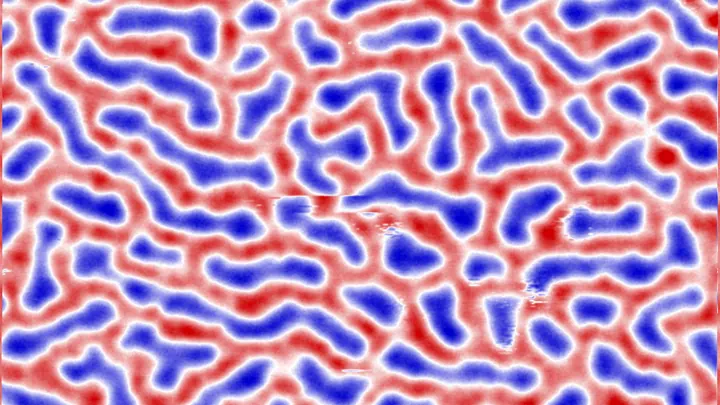
A fridge magnet stays put because the tiny atomic arrows inside it all point in the same direction. But when those arrows start to argue (some pulling left, others right, and some spinning like tops) you get magnetic frustration. That disorder gives rise to whimsical patterns: stripes, spirals, vortices.
Magnetic monopoles are like halves of a magnet that cannot exist alone in ordinary materials. But in spin ice, they appear in pairs connected by an invisible thread — a Dirac string. Previously, such monopoles were only seen in artificial systems at room temperature, but their quantum motion remained a mystery.
The Fe₃Sn₂ crystal looks like a patterned lattice where iron atoms sit at the corners of hexagons. Under normal conditions, their magnetic arrows are aligned neatly, like soldiers in a row. But squeeze the crystal, and the alignment breaks.
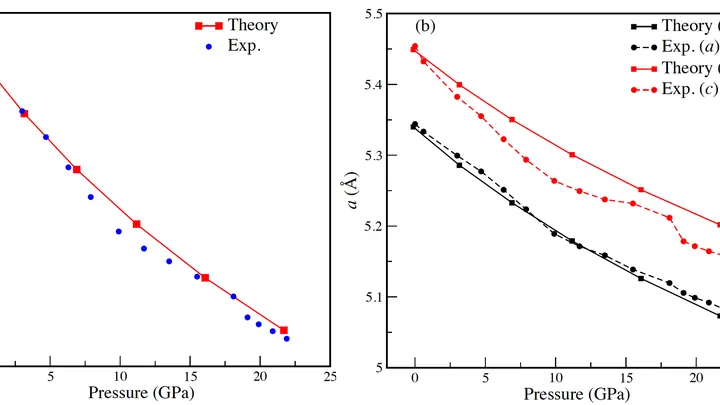
Under a pressure of about 20 gigapascals (imagine twenty elephants standing on your thumbnail), the lattice slightly rearranges.
Magnetic materials can sometimes behave like a group of people who just can't agree: some bonds between atoms pull one way, others the opposite. When such conflicts pile up, the system becomes 'frustrated'—it can't settle into a single state of rest.
A woven bamboo basket is not just a household item: it's an exact blueprint for how atoms are arranged in the crystal YMn₆Sn₆. Six manganese atoms form hexagons that assemble into a pattern reminiscent of the Japanese kagome. In such a lattice, electrons usually behave uniformly, like passengers in a crowded subway car.