Quantumorder from disorder refers to the surprising phenomenon where randomness or chaos in a quantum system can lead to the emergence of ordered, collective states. In classical physics, disorder usually destroys order, but in quantum mechanics, the interplay of interference, entanglement, and symmetry can turn a disordered system into a superfluid, a crystal, or a topological phase. This is a central theme in condensed matter physics, where materials with impurities or random interactions can still exhibit perfect conductivity or frictionless flow.
History
The concept of order from disorder was first explored in the context of spin glasses in the 1970s, but the quantum version gained prominence with the discovery of many-body localization in 2006 by Basko, Aleiner, and Altshuler. The idea that disorder can help create topological order was developed in the 2010s.
How it works
In a disorderedquantum system, particles are localized (Anderson localization) if the disorder is strong. However, interactions between particles can break this localization and lead to a many-body localized phase or, under certain conditions, to a delocalized, orderedstate. For example, in a system of ultracold atoms with random potentials, adding interactions can cause the atoms to form a superfluid, as the quantum fluctuations overcome the disorder. The article 'Когда хаос рождает сверхтекучесть' describes how this happens. Similarly, 'Квантовые узоры из хаоса' shows how disorder can create a rigid flow pattern.
In practice
This principle is used to design quantum memories in diamond (as in 'Беспорядок как союзник: квантовая память в алмазе'), where nitrogen-vacancy centers are randomly distributed but can be harnessed for coherent storage. It also informs the development of robust quantum simulators and superconducting materials.
Fun fact
In 2021, physicists observed that a disordered chain of atoms, when driven by a periodic pulse, spontaneously organized into a time-crystal—a phase that repeats in time, not space.
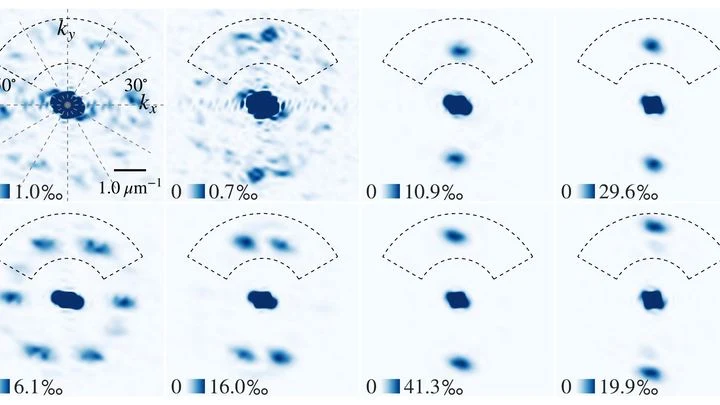
Two dancers on one stage: the triangle and the stripe. In a quantum gas of dysprosium atoms cooled to 62 nanokelvin, these two spatial structures have met for the first time in a single experiment. The gas is held in a trap shaped like a surfboard, and its atoms are among the most magnetic in the periodic table.
A thin silver thread nearly as long as a hair's width, and inside it, pristine quantum laws hold sway. Physicists built a conductor where electrons can only move forward or backward, like on a perfectly straight single-lane road with no shoulders. On such a road, any pothole or pebble would normally destroy the fragile quantum state.
Moiré patterns are familiar to everyone. Two combs with different spacing, placed on top of each other, show dark fringes. Something similar has emerged in time. Physicists took a cloud of Rydberg atoms, particles with unusually large electron orbits, and illuminated it with two lasers.
A mosaic of squares and triangles covers the floor without gaps, yet it never settles into a simple repeating pattern. Such a pattern is a quasicrystal — a solid where atoms are arranged not periodically but according to a pattern of several waves of different lengths. These waves are incommensurate with each other, and together they create long-range order.
The quantum world is often compared to a musical instrument. Each system, whether an atom or a chain of particles, sounds at its own frequencies, which physicists call energy levels. In chaotic systems, like an orchestra without a conductor, these frequencies usually fill the entire available range without gaps.
A black hole merger is not a silent impact. The newborn hole quivers and decays, emitting gravitational waves — ripples in space itself. This signal is called the 'ringdown,' and it resembles the fading chime of a bell: it has a fundamental tone and several overtones.
In quantum field theory, there is a long-standing mystery: infrared divergences. Usually they are seen as an annoying technical nuisance that must be carefully 'papered over' in calculations. But what if this is not a bug, but a feature?
Musicians in an orchestra each play their own part, not hearing the others. In a perfect crystal of tungsten disulfide on graphene, excitons, bound electron-hole pairs, behave the same way: they barely mix due to a hidden symmetry called the valley. The energy levels of such a system resemble notes sorted into separate folders — the chaos is incomplete.
In water cooled to –40°C, a paradoxical pause sets in: perfect hexagonal ice is in no hurry to form. Instead, a disordered structure with interspersed cubic layers emerges — a real cradle for future symmetry, brimming with disorder yet already charged with hidden architecture.
Graphene, a two-dimensional carbon crystal, has long tantalized physicists with the hope of high-temperature superconductivity. Its electrons obey the relativistic equation of Paul Dirac, racing at tremendous speed, barely noticing each other.
Dark matter remains one of the greatest mysteries of modern physics. Back when Vera Rubin observed galaxy rotation, she proved that visible matter is insufficient to keep stars from flying apart.
A string sounds perfectly pure until a draft touches it. That's roughly how a superradiant laser works: a beam of atoms, pre-charged with energy, flies through a room made of two mirrors — an optical resonator (a trap where light bounces back and forth).
Inside a neutron star, matter is squeezed so hard that atomic nuclei stop being separate clumps. Neutrons and protons get closer together, and their innards, quarks, begin to feel their neighbors through the walls of their 'bags'.
A neutron star is a sphere about the size of a small city but with a mass of one and a half Suns.
A crystal is like a row of soldiers on a parade ground: every atom is in its place, and electrons march through it in neat waves. An amorphous material is like a crowd at a train station, where there is no order, just a jostling throng. In such a crowd, an electron usually gets stuck quickly, like a person trying to push through a dense mass of people.
In an ordinary crystal, atoms stand in neat rows like soldiers on a parade ground. Any deviation from this formation is usually considered harmful: disorder scatters waves and quickly dampens collective motions of particles.
In a strong magnetic field, electrons trapped in a thin layer sometimes arrange into a regular pattern, like guests at a crowded party who find a spot where no one jostles them. This order is called a crystal, although it is not ice or salt, but the electrons themselves, frozen in place.
A quantum computer is like an orchestra where each musician plays their own part. If the conductor slips up, the music falls apart. In digital quantum simulations, the conductor's role is played by a sequence of simple operations, and errors accumulate like wrong notes.
In the quantum world, there are rules that seem to be broken. One of them is the conservation law: if in classical physics symmetry guarantees the conservation of charge, then in the quantum description this guarantee can disappear. This phenomenon is called a quantum anomaly.
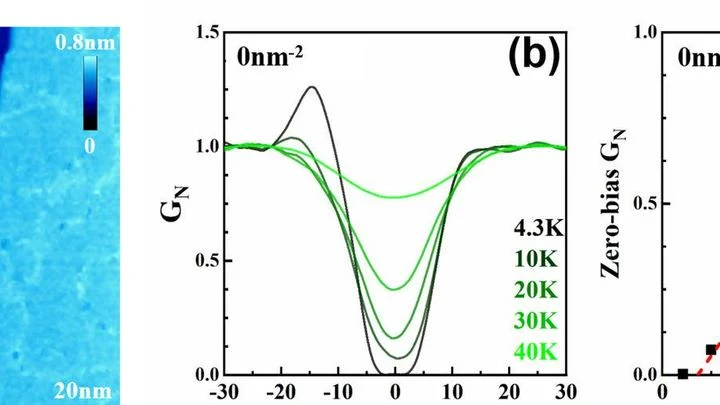
The surface of the uranium compound UTe2 crystal looks like a frozen sea: in some places, electrons move freely; in others, they get stuck near atoms. A scanning tunneling microscope, a device that probes the surface with an atomically sharp tip and senses individual electrons, revealed that this landscape is not random.
A superconductor carries current without loss, like a perfectly smooth road where cars glide with no friction. But what if you scatter rocks and potholes across that road? Scientists decided to find out by adding disorder to a superconducting material just one atom thick.
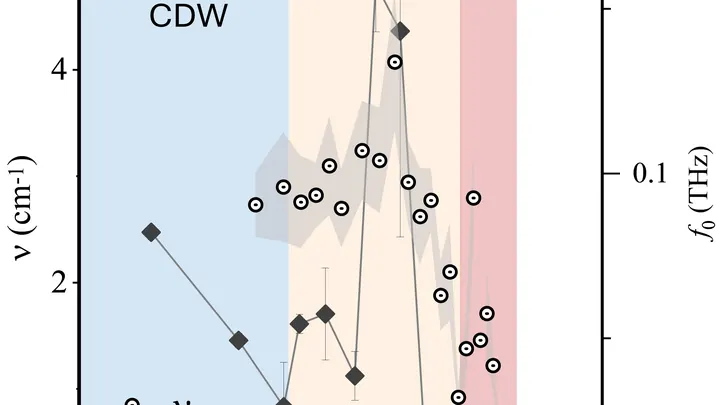
A cooled layered crystal resembles a stack of thin sheets, with electrons wandering between them. At around 17 K, tiny regions appear where electrons line up into a wave, like ripples on water frozen in place. These regions are called charge puddles, and they were previously thought to be static.
A crystal that inside resembles a sponge with a labyrinth of pores turns out to be capable of performing computations. The material, named DUT-8, consists of metal nodes and organic linkers forming an intricate lattice. Under the influence of different gases, this lattice slightly changes shape, like a house of cards that rearranges with a gentle breath.
Ordinary tiles form a repeating pattern. But atoms can do more: under certain conditions, they themselves lay out a complex mosaic where the pattern never repeats, like on antique tile panels.
A superconducting qubit is a tiny electrical circuit that behaves like an artificial atom. In its normal state, current flows through it without resistance, and the energy levels are evenly spaced, like steps on a staircase. But if a single electron gets stuck in the circuit, everything changes.
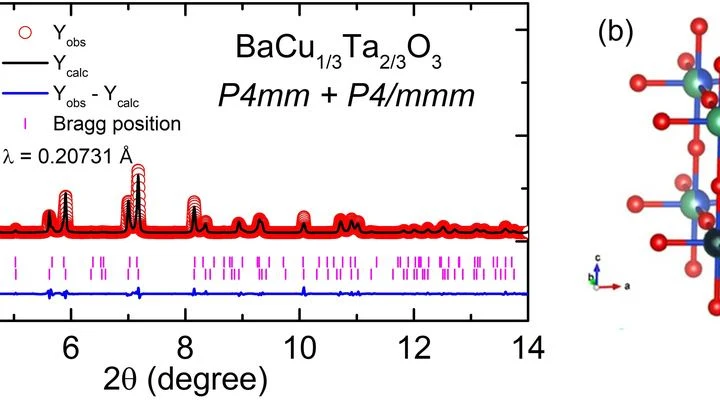
Atoms in a crystal usually sit in their designated spots, like passengers on a plane with assigned seats. But in this material, copper and tantalum have taken their places randomly, as if the tickets got mixed up. Scientists peered into the crystal using X-rays and saw that the disorder is not just on paper but in the actual arrangement of atoms.
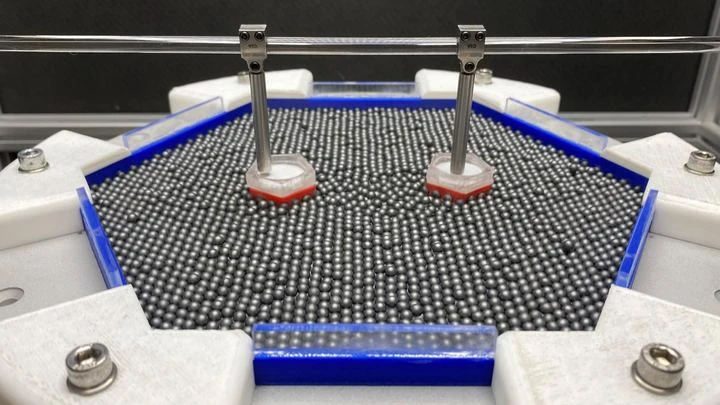
Shake a jar of sand and marbles, and you'll see large objects float or sink depending on their size. But if you shake it cleverly, you can make the marbles gather into pairs and chains, as if glued together. It's this kind of 'invisible glue' that physicists from India and Germany have now caught and measured for the first time.
Time crystals are an exotic phase of matter that exhibits periodic motion not in space but in time, even while in its ground, unexcited state. This idea, reminiscent of a perpetual clock that never needs winding, was first proposed by Frank Wilczek.
Quantum particles in a strongly disordered environment behave like dancers executing steps in sync: each knows its own move and never collides with others. This kind of coordinated, frictionless flow, superfluidity, unexpectedly emerged in an experiment on a superconducting quantum chip.
The Penrose tiling, assembled from two types of tiles, covers a plane without a repeating pattern — a mathematical marvel discovered by Roger Penrose that has found physical embodiment in the quantum world. Researchers modeled a chain of particles interacting according to a rule reminiscent of Fibonacci numbers and the golden ratio.