Hidden magnetic order refers to a type of magnetic arrangement in a crystal that does not produce a net macroscopic magnetization or any easily detectable conventional magnetic signal. It is 'hidden' because the ordered magnetic moments cancel out in a way that makes the state invisible to standard probes like neutron diffraction or magnetometry, yet it fundamentally alters the electronic and thermal properties of the material. This concept is central to understanding certain high-temperature superconductors, where a hidden magnetic state may compete or coexist with superconductivity, and to exotic phases like spin liquids or alternating magnets.
History
The concept gained prominence in the 1990s–2000s, particularly in the context of heavy-fermion compound URu2Si2, where a 'hidden order' transition was observed at 17.5 K, but the exact nature of the order remained debated for decades. The term was coined to describe this mysterious phase, though the underlying idea of multipolar ordering had been discussed earlier.
How it works
In a hidden magnetic order, the local magnetic moments (spins) arrange in a pattern that has zero net moment, often due to a complex unit cell or a non-collinear arrangement. For example, in a 'checkerboard' pattern of up and down spins, the net magnetization is zero, but the order is still detectable via symmetry-breaking. However, in hidden order, the arrangement may be such that even the staggered magnetization is absent, or the order parameter is not a simple spin vector but a higher-order multipole (like a quadrupole). This makes it invisible to magnetic neutron scattering, which only couples to dipoles. Instead, it is revealed through subtle signatures in specific heat, thermal conductivity, or nonlinear optical responses, and by symmetry analysis of the crystal's point group.
In practice
Understanding hidden magnetic order is crucial for designing materials for spintronics and quantum computing, as these states can host topologically protected excitations or be manipulated by external fields without disturbing the magnetic background.
Fun fact
In URu2Si2, the hidden order parameter was so elusive that it took over 30 years of experiments and theory to narrow it down to a likely 'hexadecapole' — a 16-pole moment — which is invisible to almost all standard probes.
In a thin layer of liquid crystal, molecules usually lie like matches in a box — aligned in one direction but randomly oriented: some point up, others down. To make all the matches point the same way, you need a special molecular architecture. Scientists have found a chemical trick that does this almost automatically.
In water cooled to –40°C, a paradoxical pause sets in: perfect hexagonal ice is in no hurry to form. Instead, a disordered structure with interspersed cubic layers emerges — a real cradle for future symmetry, brimming with disorder yet already charged with hidden architecture.
A thin magnetic film is like a row of toy soldiers with tiny magnetic arrows. In the flat world, thermal jostling quickly disrupts this formation — even the slightest heating destroys the order. This is the Mermin–Wagner prohibition: in two dimensions, continuous symmetry cannot survive at finite temperature.
Two entangled photons fly apart in opposite directions but continue to behave as a single whole: measuring one instantly determines the state of the other. That's quantum entanglement. But sometimes it resembles a seasoned spy — leaving no traces detectable by ordinary checks.
The La3Ni2O7 crystal resembles a layered pie, where the filling of nickel and oxygen atoms alternates with lanthanum layers. At ambient pressure, it does not conduct without resistance, but squeeze it or grow it as a thin film, and high-temperature superconductivity emerges.
A layered cake of atomic planes of nickel and oxygen: that's how bilayer nickelates are built. Two such planes are separated by a spacer layer. If an oxygen atom sits in that spacer, it acts as a bridge: it links the layers and triggers a state in which electrons move without resistance.
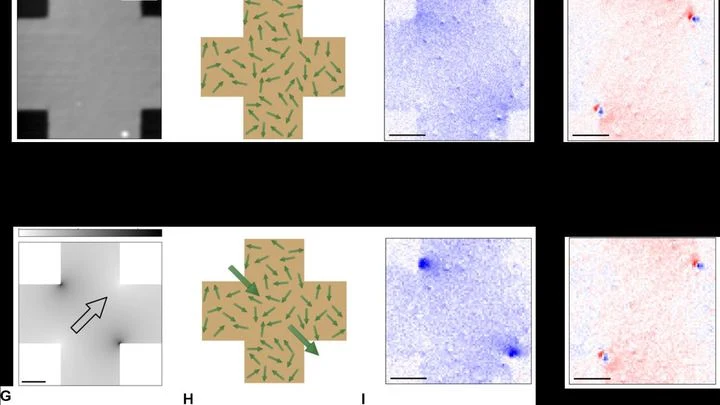
In a tiny magnet, information is encoded not in which way the arrow points, but in how the directions of its atoms alternate. In antiferromagnets, these arrows cancel each other out, so the material appears non-magnetic from the outside. The data is there, but you can't read it the usual way: the state is like a note written in invisible ink.
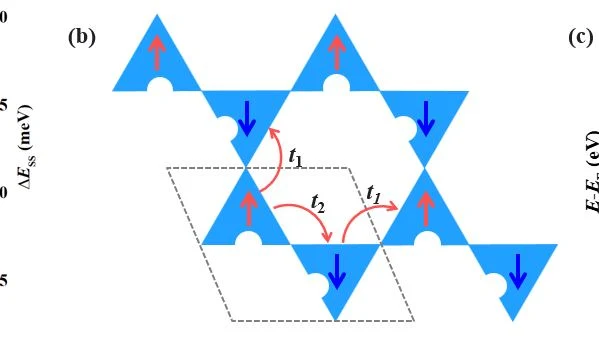
Honeycombs are built from identical cells, but tweak the shape of just one, and the whole structure gains new properties. Researchers did something similar to create a magnet without a single metal atom. They took flat carbon molecules shaped like triangles, triangulenes, and arranged them in a hexagonal lattice, just as bees build honeycombs.
A crystal without inversion symmetry is like a room where one wall is mirrored and the other is frosted: the reflection doesn't match the original. Such materials often behave unusually because electrons feel the lattice distortion.
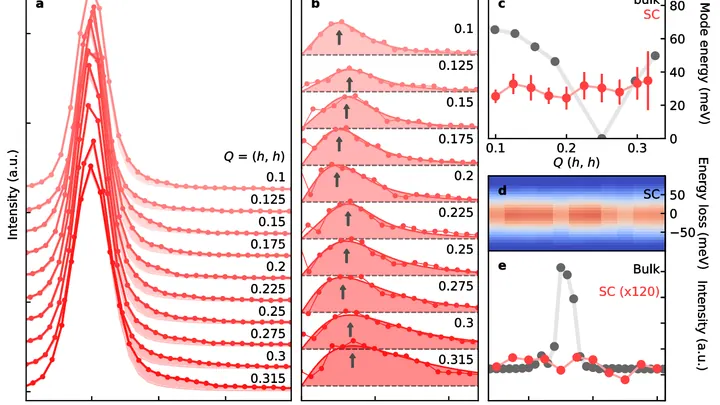
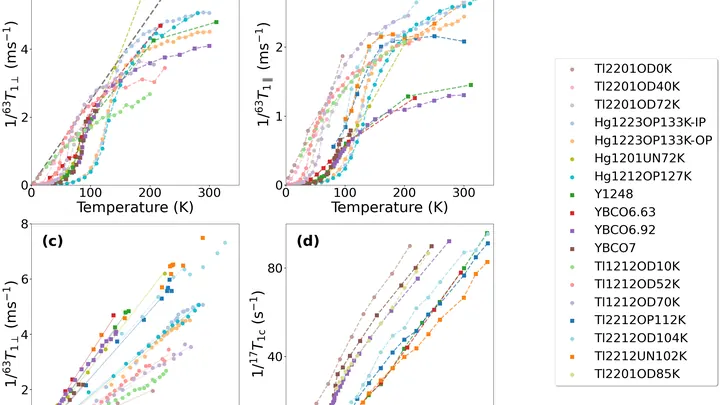
Inside copper-based superconductors, materials that carry current without loss at unexpectedly high temperatures, there is a hidden phase. It behaves like an ordinary metal, but it's invisible in standard measurements.
The crystal CeB6 is like a box with a secret: inside it, electrons can occupy four nearly identical positions, like four chairs around a table. While no one is watching, the electron seems to sit on all four at once. Physicists call this hidden state quadrupolar, and it affects magnetic properties, but it is hard to see directly.
Two people read the same book, but one turns the page first and then looks at the text, while the other does the opposite. It would seem the result is the same. But in the quantum world, the order of operations changes everything.
This work examines models that output sequences of symbols, like a ticket machine.
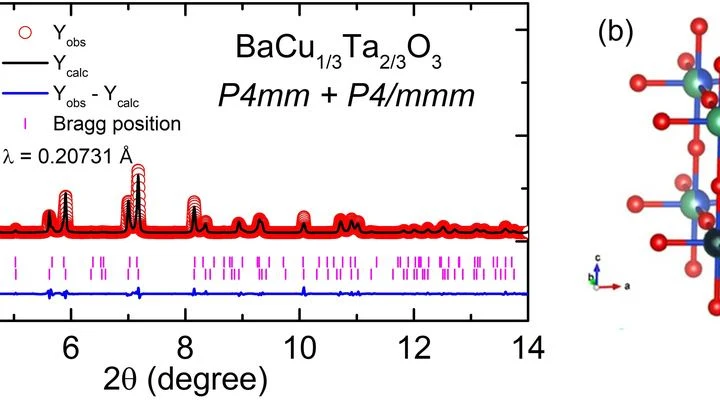
Atoms in a crystal usually sit in their designated spots, like passengers on a plane with assigned seats. But in this material, copper and tantalum have taken their places randomly, as if the tickets got mixed up. Scientists peered into the crystal using X-rays and saw that the disorder is not just on paper but in the actual arrangement of atoms.
When cooled to -272°C, the Fe₄Nb₂O₉ crystal turns into a magnetic pattern where atomic arrows don't line up in a single row but fan out. It's like a crowd frozen in place, but each person looks in their own direction rather than at the back of the neighbor's head.
A ruthenium oxide film is like a soap bubble film stretched over a frame, but made of atoms. For a long time, it was believed that in this film, ruthenium atoms align in a magnetic order, like compass needles pointing in opposite directions. This order was dubbed altermagnetism, and great hopes were placed on it for future electronics.