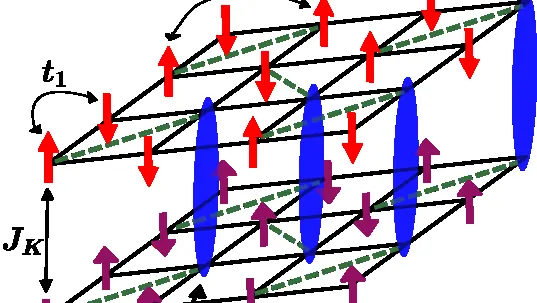
Magnetic frustration is a phenomenon that occurs in materials where the geometry of the crystal lattice prevents magnetic moments (spins) from settling into a single, orderly arrangement. In a simple ferromagnet, all spins align in parallel; in an antiferromagnet, they alternate up-down-up-down. But on a triangular lattice, for example, if two spins align antiparallel, the third cannot satisfy both — it is 'frustrated'. This leads to a huge number of nearly equivalent ground states, and the system never fully 'decides' what configuration to adopt, even at absolute zero.
History
The concept was introduced by Philip Anderson in 1956 when he studied the Ising model on a triangular lattice and noted the impossibility of satisfying all bonds. The term 'frustration' was coined later, in 1977, by Gérard Toulouse.
How it works
The competition arises from the geometry of the lattice combined with the nature of the exchange interaction between neighboring spins. When the lattice is not bipartite (like a triangle or a tetrahedron), it is impossible to satisfy all pairwise antiferromagnetic bonds simultaneously. The result is a degenerate ground state manifold: many different spin configurations have essentially the same energy. This degeneracy suppresses magnetic ordering and can give rise to exotic states like spin liquids, where spins remain dynamic and correlated but never freeze into a pattern.
In practice
Frustrated magnets are studied as candidate materials for quantum spin liquids, which could be useful for topological quantum computation. They also appear in the design of artificial spin ice systems used to study magnetic monopoles and information storage.
Fun fact
In a frustrated magnet, the spins can remain in constant, slow motion even at temperatures near absolute zero, behaving almost like a liquid of magnetic moments rather than a frozen solid.
In nature's workshop, there is a strange lathe: it cuts threads on screws but forbids left-handed ones. You can tighten a screw as much as you like, in any clockwise direction, but counterclockwise is not allowed. This lathe is not a fantasy but an exact quantum rule that physicists have just built for magnetic materials.
Moiré patterns are familiar to everyone. Two combs with different spacing, placed on top of each other, show dark fringes. Something similar has emerged in time. Physicists took a cloud of Rydberg atoms, particles with unusually large electron orbits, and illuminated it with two lasers.
In the world of two-dimensional materials, states sometimes emerge that are as extraordinary as they are fragile. One of them — the fractional anomalous Hall crystal (FAHC)—is like a quantum centaur: half ordered lattice, half topological liquid.
In the conventional Heisenberg picture, spins at low temperatures are supposed to line up in a strict pattern. But there are crystals — like pyrochlore — where geometry has its own way. Each ion sits at a vertex of a tetrahedron, and the main interaction enforces a rule: two spins point inward, two outward.
In a crystal that for centuries was called 'fool's gold,' physicists have spotted genuine treasure. The compound MnTe2 with a pyrite structure has become the stage for a quantum ballet: spin waves here twist into left- and right-handed vortices, with the twist direction firmly tied to momentum.
An ionic conductor resembles a crowded bus where passengers (ions) try to squeeze toward the exit. Previously, it was thought that fast exit could be achieved either by a gently swaying bus (soft lattice) or by passengers standing in chaotic order (geometric disorder). The new work shows these are not two different tricks but the same one.
Physicists have achieved three-dimensional Anderson localization of electromagnetic waves — a phenomenon where waves become permanently entangled in a random labyrinth of metal particles and cease to propagate.
An ordinary magnet is like a compass: its needle points north. But a quantum compass can look in both directions at once. If a magnet floating in a vacuum is gently spun, its electron 'tops' synchronize so the whole piece of metal starts living by the rules of the microworld — freezes in a superposition, like a split pointer.
The magnetic field increases, but the magnetization stays put. It's like a scale where you add weight, yet the needle doesn't move until enough has accumulated to jump to the next mark. That's exactly how rare-earth tetraboride crystals behave, and physicists have been puzzled for decades.
If you squeeze an ordinary piece of metal, it heats up — even those who have pumped a bicycle tire know that. But what happens if you squeeze a magnet in which atomic arrows refuse to freeze even at absolute zero?
A handful of copper coins scattered on a triangular grid freezes into a strange order when a current is passed through them. That's roughly how tiny magnetic arrows, electron spins, behave in a crystal with the rare name Y-capellasite.
In an ordinary crystal, atoms stand in neat rows like soldiers on a parade ground. Any deviation from this formation is usually considered harmful: disorder scatters waves and quickly dampens collective motions of particles.
Inside a superconductor, a magnetic field typically twists into tubes, vortices, each carrying one quantum of magnetic flux. That's how the classic Abrikosov lattice works. But in LiFeAs crystals, the picture is different.
Muon spectroscopy showed that the field penetrates not as individual vortices but as stripes. Each stripe contains pairs of 'coreless' vortices.
Imagine a triangular grid with tiny magnetic arrows at each node. Electrons, the charge carriers, run across this grid. Usually, the arrows align simply: all pointing the same way (ferromagnet) or alternating in the plane.
The void can produce particles if a strong enough field is applied. Physicists call this the Dirac–Klein paradox. Previously, explaining it required the most complex calculations of quantum field theory. But we can make do with a visual image: a tightly stretched rubber band with a knot. The knot is a particle.
A crystal without inversion symmetry is like a room where one wall is mirrored and the other is frosted: the reflection doesn't match the original. Such materials often behave unusually because electrons feel the lattice distortion.
A fridge magnet stays put because the tiny atomic arrows inside it all point in the same direction. But when those arrows start to argue (some pulling left, others right, and some spinning like tops) you get magnetic frustration. That disorder gives rise to whimsical patterns: stripes, spirals, vortices.
Magnetic monopoles are like halves of a magnet that cannot exist alone in ordinary materials. But in spin ice, they appear in pairs connected by an invisible thread — a Dirac string. Previously, such monopoles were only seen in artificial systems at room temperature, but their quantum motion remained a mystery.
The Fe₃Sn₂ crystal looks like a patterned lattice where iron atoms sit at the corners of hexagons. Under normal conditions, their magnetic arrows are aligned neatly, like soldiers in a row. But squeeze the crystal, and the alignment breaks.
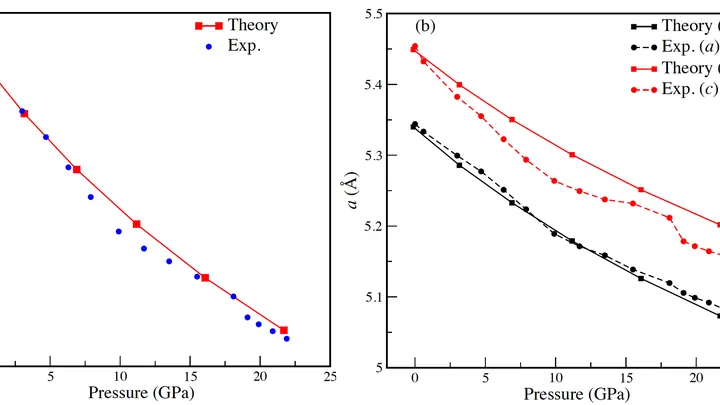
Under a pressure of about 20 gigapascals (imagine twenty elephants standing on your thumbnail), the lattice slightly rearranges.
Magnetic materials can sometimes behave like a group of people who just can't agree: some bonds between atoms pull one way, others the opposite. When such conflicts pile up, the system becomes 'frustrated'—it can't settle into a single state of rest.
A flat magnet is like a thin sheet with waves of magnetization running across it. Under normal conditions, these waves quickly die out, but when a strong magnetic field is switched on, an unexpected signal appears in the material — sharp and narrow, like a shadow cast by the main wave.
Magnetic atoms in a solid are like compass needles: usually, when cooled, they align in one direction: that's how magnetism arises. But in TbInO3, the terbium needles sit on a triangular lattice where it's impossible to please all neighbors at once. One needle wants to point north, another south, and in the end none can settle into a stable position.
Inside a magnet, there are regions where all the atomic magnets point in the same direction. Between such regions lies a narrow transition zone where the magnetization direction gradually rotates. This zone is called a domain wall. Previously, it was considered massless: give it a push, and it stops immediately.
A crystal the size of half a matchbox was grown in a furnace, where a molten zone slowly crept along a rod, leaving perfectly ordered layers behind. Inside this crystal, copper ions sit at the nodes of a triangular lattice, but the triangles are slightly skewed, as if someone pressed on one corner. Each copper ion behaves like a tiny magnetic needle that can point up or down.
Schrödinger's cat, according to quantum rules, can be both alive and dead at once. But a table can't pull that off. When a massive object tries to be in two places, its mass curves spacetime so drastically that instead of two points, a single deep depression forms, and the object rolls into it.
Ordinary tiles form a repeating pattern. But atoms can do more: under certain conditions, they themselves lay out a complex mosaic where the pattern never repeats, like on antique tile panels.
If you stick an ordinary piece of metal into a strong magnetic field, it warms up slightly. But some materials do the opposite: they cool down. This is called the magnetocaloric effect, and it's already being used to build future refrigerators without Freon.
The magnets in this crystal behave like guests at a party where everyone wants the same chair. No one can settle down for good, and from this chaos, a special state emerges. In it, spin momentum (what makes an electron a tiny magnet) manages to travel 480 micrometers.
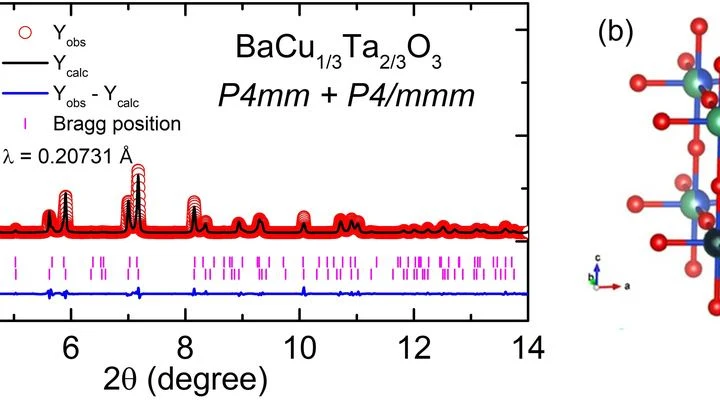
Atoms in a crystal usually sit in their designated spots, like passengers on a plane with assigned seats. But in this material, copper and tantalum have taken their places randomly, as if the tickets got mixed up. Scientists peered into the crystal using X-rays and saw that the disorder is not just on paper but in the actual arrangement of atoms.
The EuAuBi crystal is like a layered cake of europium, gold, and bismuth atoms. When cooled to near absolute zero, three different magnetic patterns appear in sequence, like a kaleidoscope pattern shifting with a slight turn. First, the magnetic atoms align strictly in antiphase, then they tilt slightly, and at even lower temperatures, a third order emerges.
Electrons in a conductor usually behave like a gas: they dart around chaotically, collide, and don't hold formation. But if you spread them far apart and cool them down, their mutual repulsion can force them into place, like attendees in an overcrowded hall who settle into every other seat.
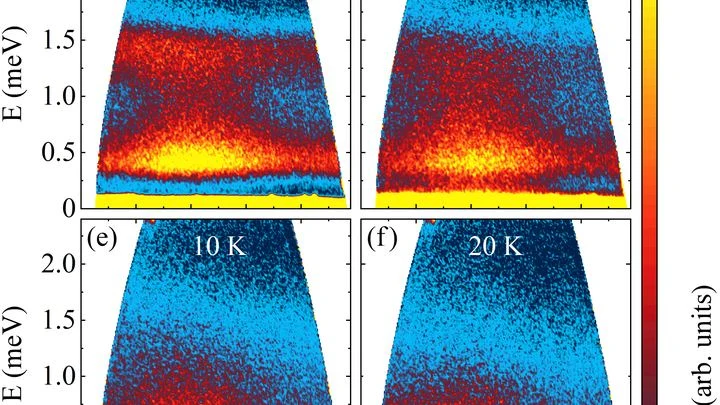
The tiny magnetic arrows inside a crystal of terbium-iridium oxide behave strangely: instead of lying along their preferred axis, they stand across it. This state fully forms when cooled to 1.5 Kelvin — colder than outer space.
Researchers probed the crystal with neutrons and observed how these flipped arrows oscillate and exchange energy.
Imagine a stack of pancakes where each pancake is magnetized, but the magnetization directions in adjacent pancakes are opposite. That's exactly how this new magnetic material is arranged: in each atomic layer, all magnetic moments — the atom's 'arrows'—point in one direction, while the next layer is magnetized in the opposite direction.
Niobium diselenide is a layered material that conducts current without resistance at low temperatures. If you weave nickel atoms between its layers, like extra threads in a fabric, superconductivity vanishes.