A Diamond Speck Becomes a Sound Laser express
A diamond dust particle made of carbon floats in a vacuum on a laser beam. Inside there is a defect: a nitrogen atom next to a vacancy. Under the influence of light and microwaves, it starts to jitter, rocking the entire particle. This is how a sound laser starts: weak random nudges turn into a powerful steady hum. The mechanism echoes the idea of Charles Townes, who built the maser for microwaves, but here sound vibrations are amplified. All it takes is a tiny excess of excited states — just a couple of percent.
The calculations fully match the laws of quantum optics. Such a system can detect gravitational waves or the force of impact from a single molecule. And, perhaps for the first time, it will let us see quantum effects — such as the simultaneous existence of two opposite vibrations — in an object visible to the naked eye.
Original abstract
as written by the authors arXiv:2601.17552
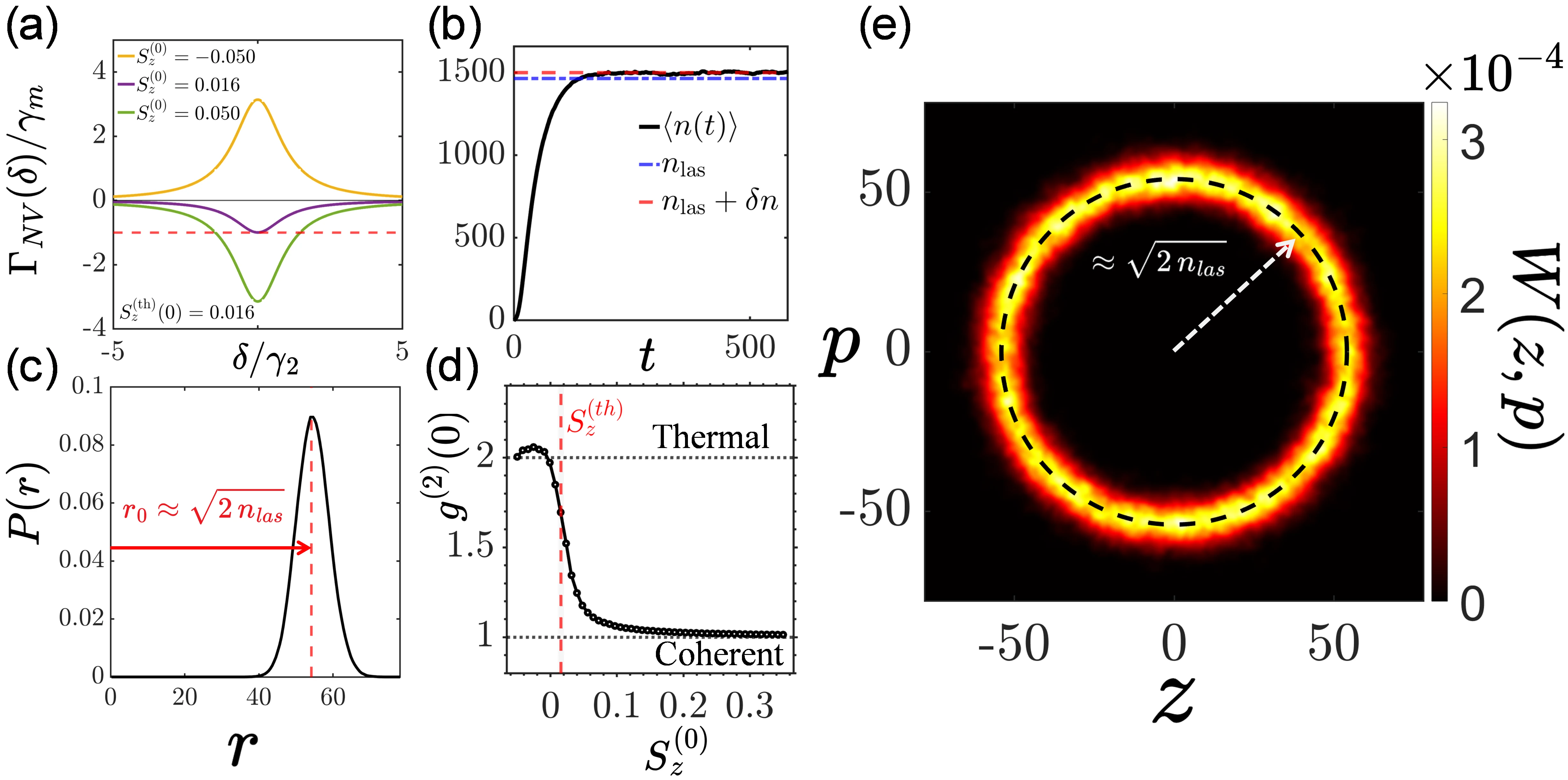
Levitated nanodiamonds hosting a single nitrogen-vacancy (NV) center provide an ultra-low-frequency mechanical mode with widely tunable dissipation and spin backaction under microwave dressing and optical pumping. We demonstrate that the driven NV spin can be tuned to act as an inverted gain medium for the center-of-mass motion, thereby stabilizing an autonomous phonon maser. In the separation-of-timescales regime where spin dynamics is fast, adiabatic elimination yields a reduced mechanical master equation with closed-form, detuning-dependent transition rates and a sharp threshold given by the sign change of the phonon-number damping. For representative levitated-NV parameters, we find that a percent-level dressed-basis inversion is sufficient to reach the threshold, and the small-signal gain can exceed the intrinsic mechanical loss by orders of magnitude. Full master-equation simulations confirm above-threshold self-oscillation and a phase-diffusing, coherent steady state, whose saturation follows the Maxwell-Bloch prediction.
The maser is the older brother of the laser: it was first built in 1954 for microwaves, and now the same principle brings sound vibrations to life in a crystal.
In science fiction, self-exciting crystals often serve as the heart of detectors and engines.